







Question: Problem 16-1 20 points Babe Ruth Co is a small company that transports business packages between Denver and Miami. It operates a fleet of
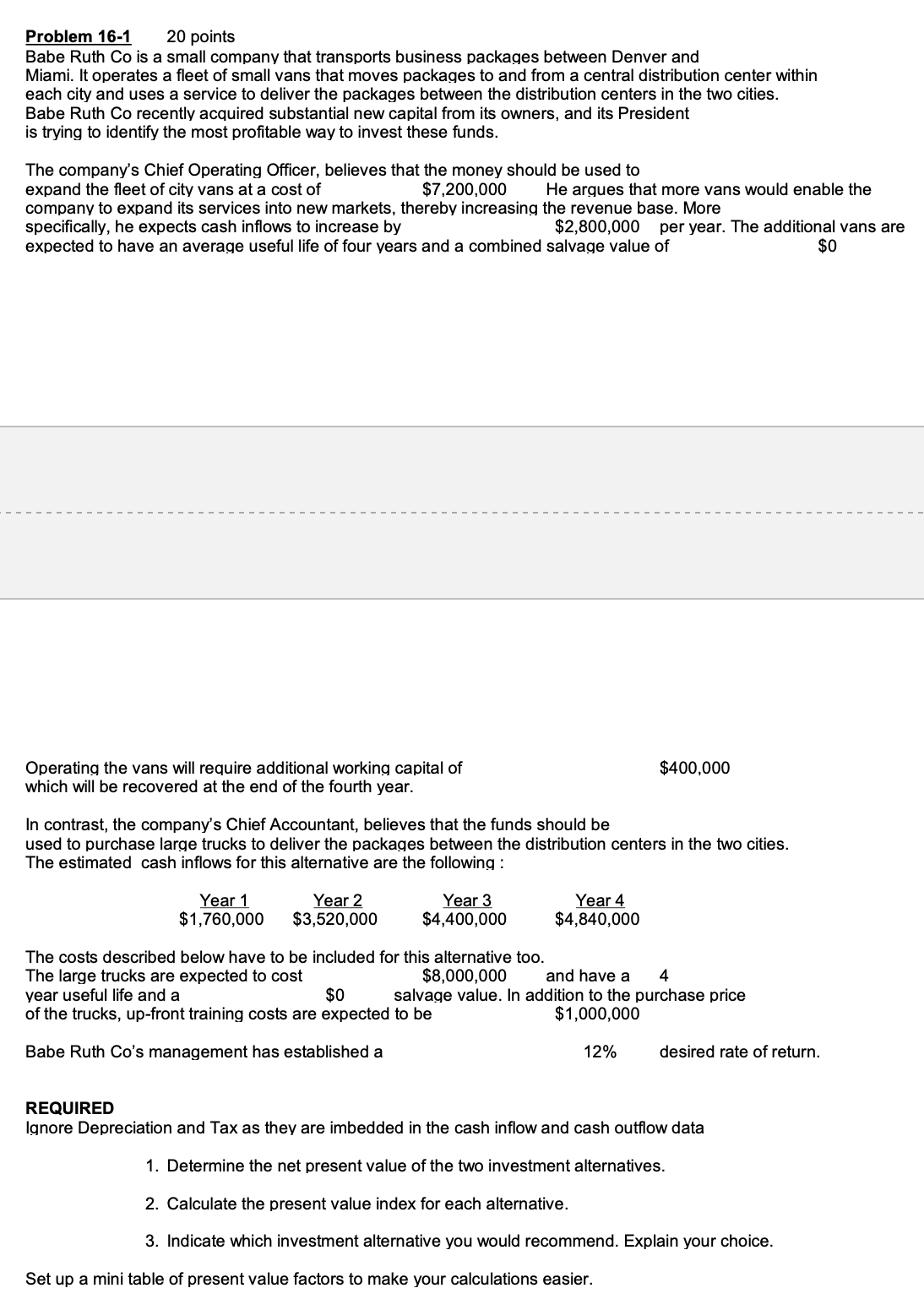
Problem 16-1 20 points Babe Ruth Co is a small company that transports business packages between Denver and Miami. It operates a fleet of small vans that moves packages to and from a central distribution center within each city and uses a service to deliver the packages between the distribution centers in the two cities. Babe Ruth Co recently acquired substantial new capital from its owners, and its President is trying to identify the most profitable way to invest these funds. The company's Chief Operating Officer, believes that the money should be used to expand the fleet of city vans at a cost of $7,200,000 He argues that more vans would enable the company to expand its services into new markets, thereby increasing the revenue base. More specifically, he expects cash inflows to increase by $2,800,000 per year. The additional vans are $0 expected to have an average useful life of four years and a combined salvage value of Operating the vans will require additional working capital of which will be recovered at the end of the fourth year. $400,000 In contrast, the company's Chief Accountant, believes that the funds should be used to purchase large trucks to deliver the packages between the distribution centers in the two cities. The estimated cash inflows for this alternative are the following: Year 1 $1,760,000 Year 2 $3,520,000 Year 3 $4,400,000 Year 4 $4,840,000 The costs described below have to be included for this alternative too. The large trucks are expected to cost $8,000,000 and have a 4 salvage value. In addition to the purchase price year useful life and a $0 of the trucks, up-front training costs are expected to be Babe Ruth Co's management has established a $1,000,000 12% desired rate of return. REQUIRED Ignore Depreciation and Tax as they are imbedded in the cash inflow and cash outflow data 1. Determine the net present value of the two investment alternatives. 2. Calculate the present value index for each alternative. 3. Indicate which investment alternative you would recommend. Explain your choice. Set up a mini table of present value factors to make your calculations easier.
Step by Step Solution
There are 3 Steps involved in it

Get step-by-step solutions from verified subject matter experts
 Study Help