





Question: Problem 16-15 (Static) A foreman has determined processing times at a work center for a set of jobs and now wants to sequence them. Given
Problem 16-15 (Static) A foreman has determined

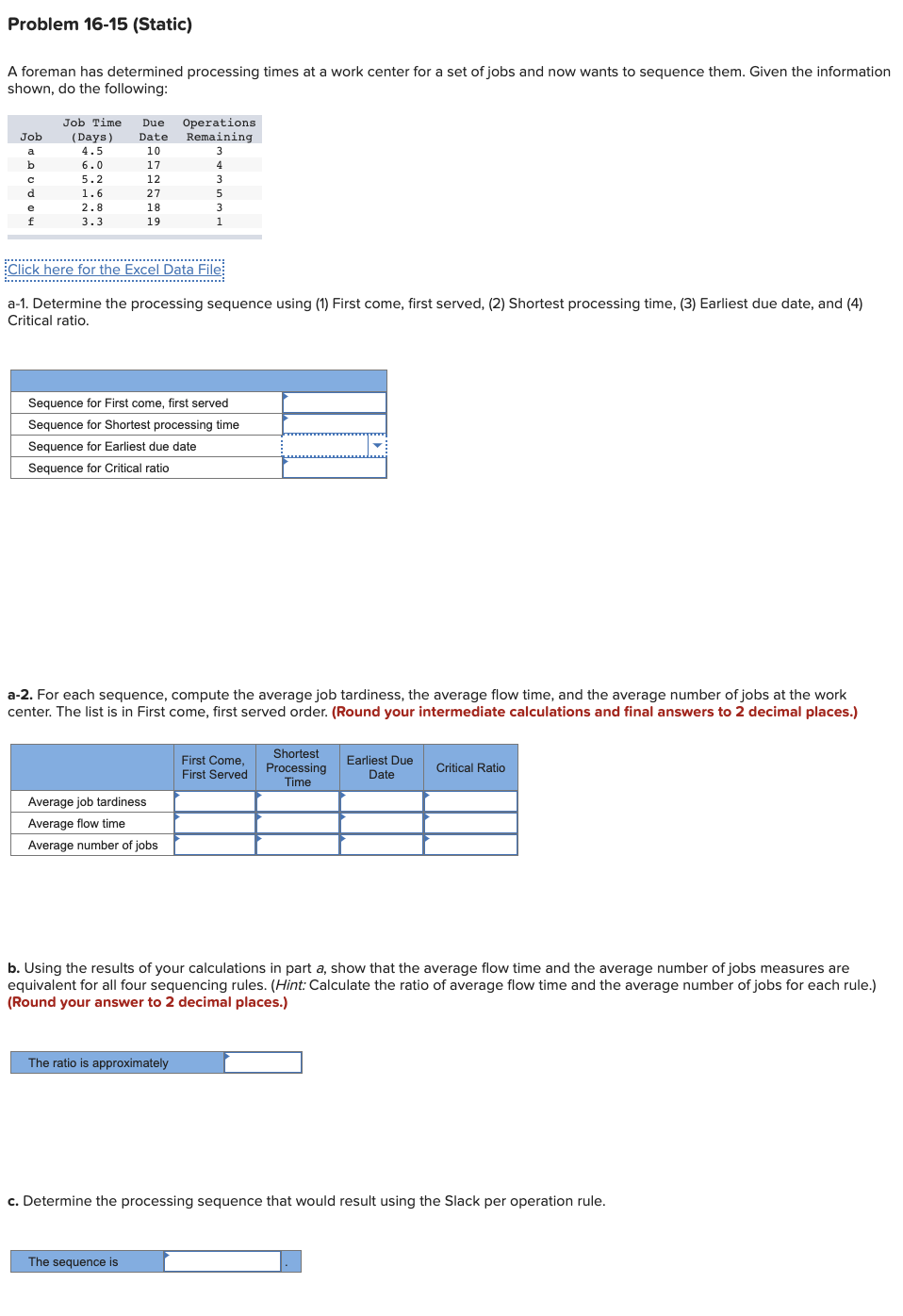
Problem 16-15 (Static) A foreman has determined processing times at a work center for a set of jobs and now wants to sequence them. Given the information shown, do the following: Job a b d e f Job Time Due Operations Date Remaining 10 3 17 4 12 27 18 19 (Days) 4.5 6.0 5.2 1.6 2.8 3.3 Click here for the Excel Data File . a-1. Determine the processing sequence using (1) First come, first served, (2) Shortest processing time, (3) Earliest due date, and (4) Critical ratio. 3 5 3 1 Sequence for First come, first served Sequence for Shortest processing time Sequence for Earliest due date Sequence for Critical ratio a-2. For each sequence, compute the average job tardiness, the average flow time, and the average number of jobs at the work center. The list is in First come, first served order. (Round your intermediate calculations and final answers to 2 decimal places.) Average job tardiness Average flow time Average number of jobs The ratio is approximately First Come, First Served The sequence is Shortest Processing Time Earliest Due Date b. Using the results of your calculations in part a, show that the average flow time and the average number of jobs measures are equivalent for all four sequencing rules. (Hint: Calculate the ratio of average flow time and the average number of jobs for each rule.) (Round your answer to 2 decimal places.) Critical Ratio c. Determine the processing sequence that would result using the Slack per operation rule

Step by Step Solution

There are 3 Steps involved in it

1 Expert Approved Answer
Step: 1 Unlock blur-text-image

Question Has Been Solved by an Expert!

Get step-by-step solutions from verified subject matter experts

Step: 2 Unlock
Step: 3 Unlock

Students Have Also Explored These Related General Management Questions!