







Question: Problem 1[8 points}: Suppose screening test A has been used to detect disease D. Based on historical performance, it's known that 21% of patients who
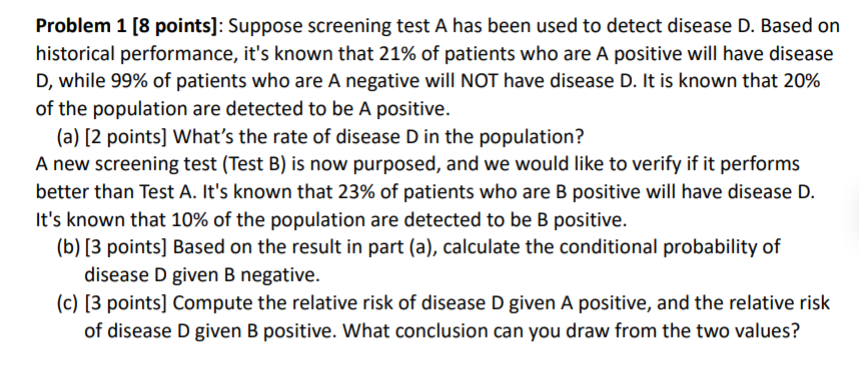
Problem 1[8 points}: Suppose screening test A has been used to detect disease D. Based on historical performance, it's known that 21% of patients who are A positive will have disease D, while 99% of patients who are A negative will NOT have disease D. It is known that 20% of the population are detected to be A positive- (a) [2 points] What's the rate of disease D in the population? A new screening test (Test B) is now purposed, and we would like to verify if it performs better than Test A. It's known that 23% of patients who are B positive will have disease D. It's known that 10% of the population are detected to be B positive. (b) [3 points] Based on the resuit in part (a), calculate the conditional probability of disease D given B negative. (c) [3 points] Compute the relative risk of disease D given A positive, and the relative risk of disease D given B positive. What conclusion can you draw from the two values
Step by Step Solution
There are 3 Steps involved in it

Get step-by-step solutions from verified subject matter experts
 Study Help