







Question: Problem 1.8 Using compound interest formula ,what principal does Andrew need to invest at 15% compounding annually so that he ends up with $10,000 at
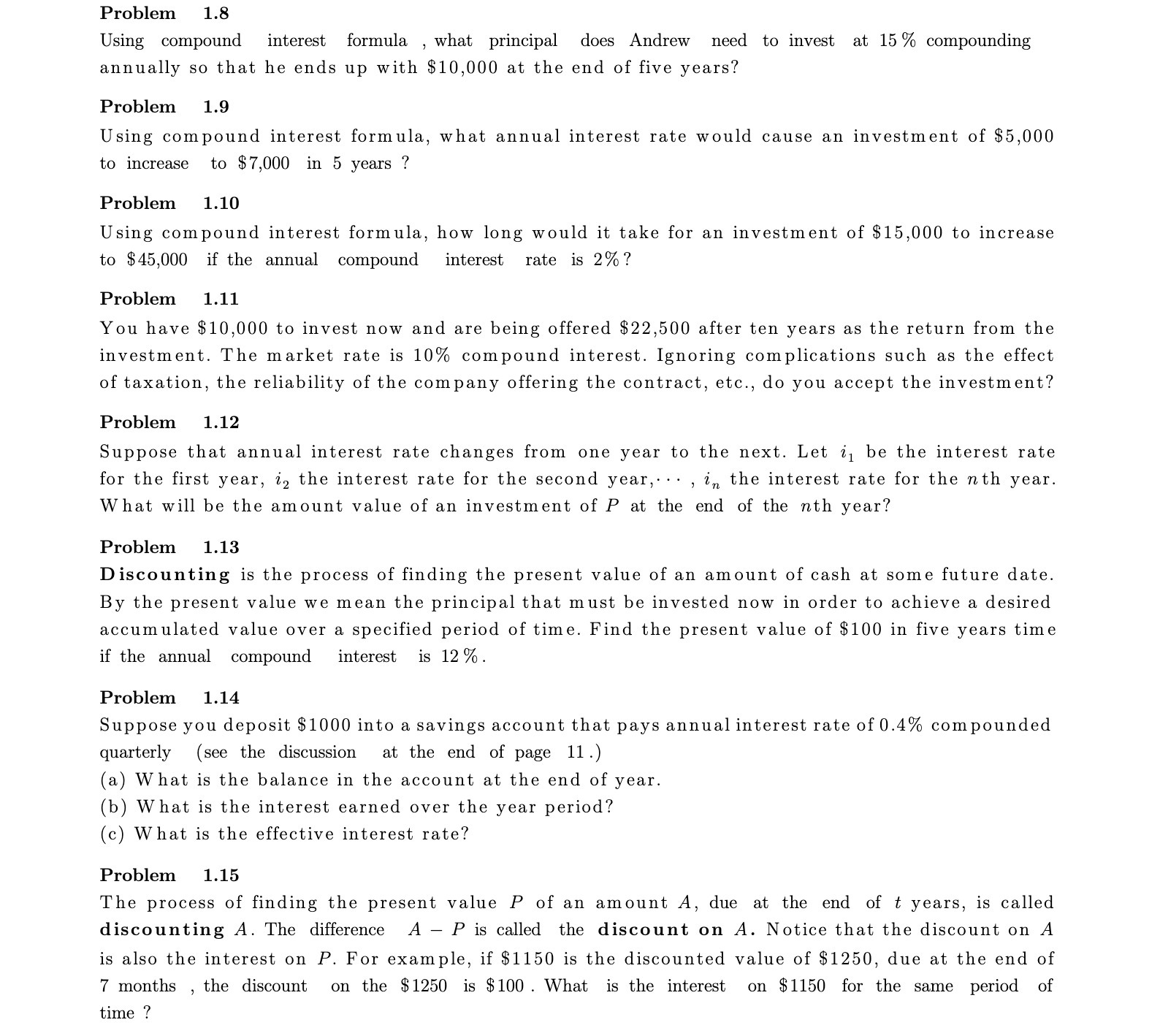
Problem 1.8 Using compound interest formula ,what principal does Andrew need to invest at 15% compounding annually so that he ends up with $10,000 at the end of five years? Problem 1 .9 Using compound interest formula, what annual interest rate would cause an investment of $5,000 to increase to $7,000 in 5 years ? Problem 1 . 10 Using compound interest formula, how long would it take for an investment of $15,000 to increase to $45,000 if the annual compound interest rate is 2%? Problem 1.11 You have $10,000 to invest now and are being offered $22,500 after ten years as the return from the investment. The market rate is 10% compound interest. Ignoring complications such as the effect of taxation, the reliability of the company offering the contract, etc., do you accept the investment? Problem 1.12 Suppose that annual interest rate changes from one year to the next. Let 2'1 be the interest rate for the first year, 2'2 the interest rate for the second year,- -- , in the interest rate for the nth year. What will be the amount value of an investment of P at the end of the nth year? Problem 1.13 Discounting is the process of finding the present value of an amount of cash at some future date. By the present value we mean the principal that must be invested now in order to achieve a desired accumulated value over a specified period of time. Find the present value of $100 in five years time if the annual compound interest is 12%. Problem 1.14 Suppose you deposit $1000 into a savings account that pays annual interest rate of 0.4% compounded quarterly (see the discussion at the end of page 11.) (a) What is the balance in the account at the end of year. (b) What is the interest earned over the year period? (c) What is the effective interest rate? Problem 1.15 The process of finding the present value P of an amount A, due at the end of 1: years, is called discounting A. The difference A 1 P is called the discount on A. Notice that the discount on A is also the interest on P. For example, if $1150 is the discounted value of $1250, due at the end of 7 months ,the discount on the $1250 is $100. What is the interest on $1150 for the same period of time
Step by Step Solution
There are 3 Steps involved in it

Get step-by-step solutions from verified subject matter experts
 Study Help