





Question: Problem 1(A 5.3.2 The calculation of local stability 2. Limit of the width-to-thickness ratio of plates ( 2 ) Determination principle of the allowable

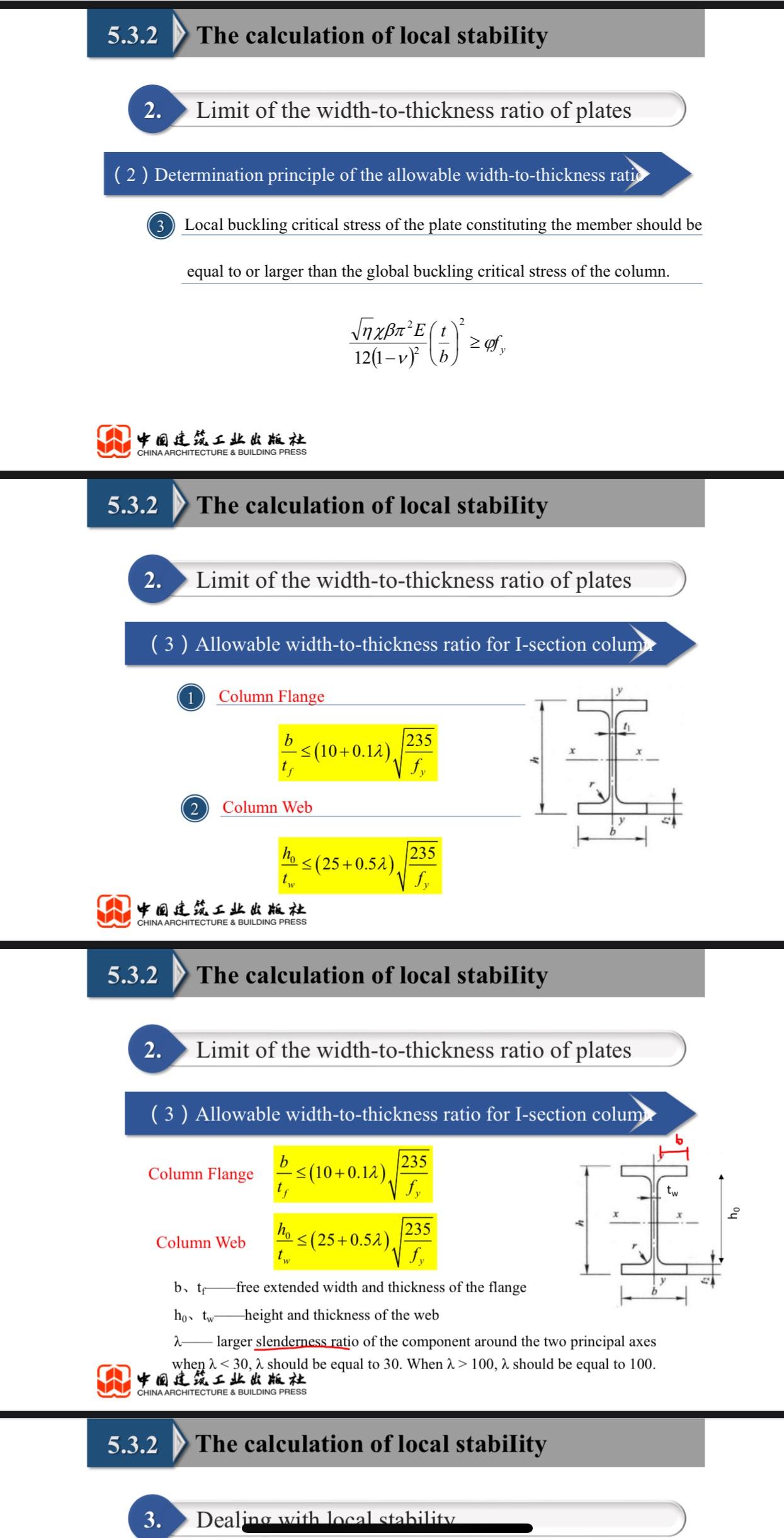
Problem 1(A\ \ 5.3.2\ The calculation of local stability\ 2. Limit of the width-to-thickness ratio of plates\ ( 2 ) Determination principle of the allowable width-to-thickness ratil\ (3) Local buckling critical stress of the plate constituting the member should be equal to or larger than the global buckling critical stress of the column.\

(\\\\sqrt(\\\\eta )\\\\chi \\\\beta \\\\pi ^(2)E)/(12(1-v)^(2))((t)/(b))^(2)>=\\\\phi f_(y)

\ \ 5.3.2\ The calculation of local stability\ 2. Limit of the width-to-thickness ratio of plates\ ( 3 ) Allowable width-to-thickness ratio for I-section colum\ (1) Column Flange\

(b)/(t_(f))

\ (2) Column Web\

(h_(0))/(t_(w))

\ 4\ 5.3.2\ The calculation of local stability\ 2. Limit of the width-to-thickness ratio of plates\ ( 3 ) Allowable width-to-thickness ratio for I-section colum\ Column Flange\

(b)/(t_(f))

\ Column Web\

(h_(0))/(t_(w))

\

bt_(f)

free extended width and thickness of the flange\

h_(0)t_(w)

- height and thickness of the web\

\\\\lambda

- larger slenderness ratio of the component around the two principal axes when

\\\\lambda

should be equal to 30 . When

\\\\lambda >100,\\\\lambda

should be equal to 100 .\ \ CHINAARCHITECTURE & BUILDING PRESS\ 5.3.2\ The calculation of local stability\ 3. Dealino with local stahilityxially loaded member). Fig.1 shows cross section of a weld

H

shape axially loaded member (column), S3 type. It is a weld section; flanges are sheared edge. The steel is grade 235B. Given design static load of

N=1500kN

. Please check\ (1) Overall stability (including both

x

and

y

axis)\ (2) Local stability (including flanges and web)\ TELL ME THE ANSWER AND STEPS NOT JUST STEPS\ \
Problem 1(A\ \ 5.3.2\ The calculation of local
The calculation of local stability 2. Determination principle of the allowable width-to-thickness ratis (3) Local buckling critical stress of the plate constituting the member should be equal to or larger than the global buckling critical stress of the column. 12(1v)22E(bt)2fy CHINA ARCHITECTURE \& BUILDING PRESS The calculation of local stability 2. Limit of the width-to-thickness ratio of plates ( 3 ) Allowable width-to-thickness ratio for I-section colum (1) Column Flange tfb(10+0.1)fy235 (2) Column Web twh0(25+0.5)fy235 The calculation of local stability 2. Limit of the width-to-thickness ratio of plates ( 3 ) Allowable width-to-thickness ratio for I-section colum) Column Flange tfb(10+0.1)fy235 Column Web twh0(25+0.5)fy235 btf - free extended width and thickness of the flange h0tw height and thickness of the web - larger slenderness ratio of the component around the two principal axes when 100, should be equal to 100 . The calculation of local stability The calculation of local stability 2. Determination principle of the allowable width-to-thickness ratis (3) Local buckling critical stress of the plate constituting the member should be equal to or larger than the global buckling critical stress of the column. 12(1v)22E(bt)2fy CHINA ARCHITECTURE \& BUILDING PRESS The calculation of local stability 2. Limit of the width-to-thickness ratio of plates ( 3 ) Allowable width-to-thickness ratio for I-section colum (1) Column Flange tfb(10+0.1)fy235 (2) Column Web twh0(25+0.5)fy235 The calculation of local stability 2. Limit of the width-to-thickness ratio of plates ( 3 ) Allowable width-to-thickness ratio for I-section colum) Column Flange tfb(10+0.1)fy235 Column Web twh0(25+0.5)fy235 btf - free extended width and thickness of the flange h0tw height and thickness of the web - larger slenderness ratio of the component around the two principal axes when 100, should be equal to 100 . The calculation of local stability

Step by Step Solution

There are 3 Steps involved in it

1 Expert Approved Answer
Step: 1 Unlock blur-text-image
Question Has Been Solved by an Expert!

Get step-by-step solutions from verified subject matter experts

Step: 2 Unlock
Step: 3 Unlock

Students Have Also Explored These Related Civil Engineering Questions!