







Question: Problem 2 (10 points). The following program example can be used to sum the array values of size N elements in parallel on a system
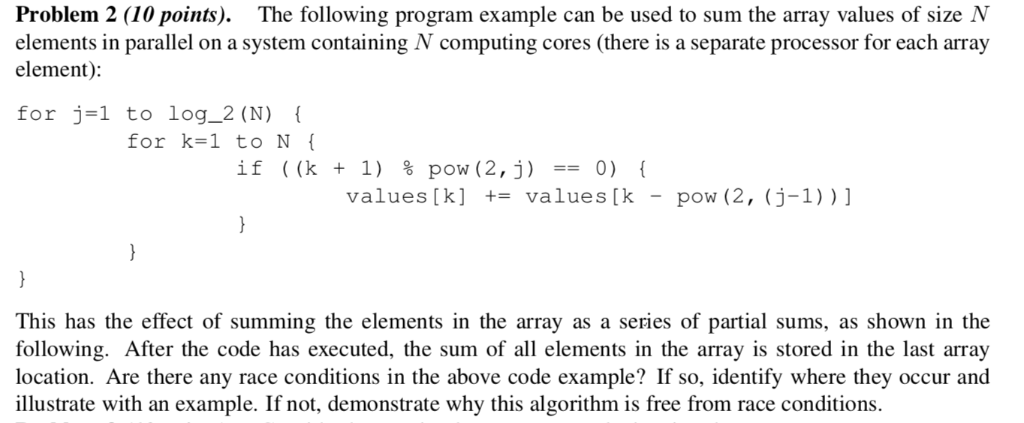
Problem 2 (10 points). The following program example can be used to sum the array values of size N elements in parallel on a system containing N computing cores (there is a separate processor for each array element) for j-l to log_2 (N) for k-1 to N if ( (k + 1) % pow (2,j)-0) { values [k] values [kpow (2, (j-1))1 This has the effect of summing the elements in the array as a series of partial sums, as shown in the following. After the code has executed, the sum of all elements in the array is stored in the last array location. Are there any race conditions in the above code example? If so, identify where they occur and illustrate with an example. If not, demonstrate why this algorithm is free from race conditions Problem 2 (10 points). The following program example can be used to sum the array values of size N elements in parallel on a system containing N computing cores (there is a separate processor for each array element) for j-l to log_2 (N) for k-1 to N if ( (k + 1) % pow (2,j)-0) { values [k] values [kpow (2, (j-1))1 This has the effect of summing the elements in the array as a series of partial sums, as shown in the following. After the code has executed, the sum of all elements in the array is stored in the last array location. Are there any race conditions in the above code example? If so, identify where they occur and illustrate with an example. If not, demonstrate why this algorithm is free from race conditions
Step by Step Solution
There are 3 Steps involved in it

Get step-by-step solutions from verified subject matter experts
 Study Help