







Question: Problem 2 (15 points): Suppose that you are making forecast by exponential smoothing: x(t) = x(t 1) + (1 )x(t 1), where x(t) is the
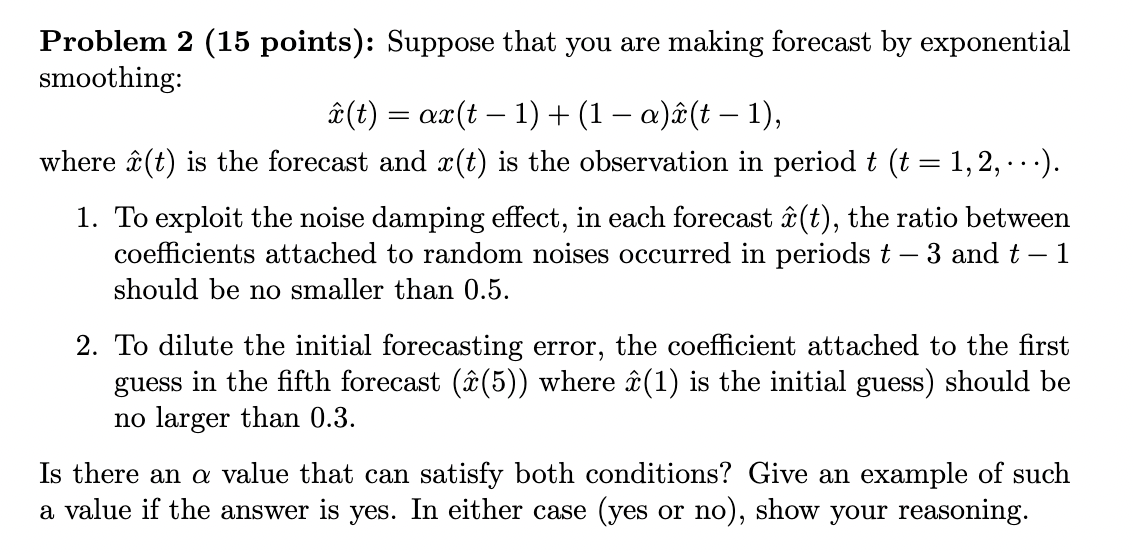 Problem 2 (15 points): Suppose that you are making forecast by exponential smoothing: x(t) = x(t 1) + (1 )x(t 1), where x(t) is the forecast and x(t) is the observation in period t (t = 1,2,). 1. To exploit the noise damping effect, in each forecast x(t), the ratio between coefficients attached to random noises occurred in periods t 3 and t 1 should be no smaller than 0.5. 2. To dilute the initial forecasting error, the coefficient attached to the first guess in the fifth forecast (x(5)) where x(1) is the initial guess) should be no larger than 0.3. Is there an value that can satisfy both conditions? Give an example of such a value if the answer is yes. In either case (yes or no), show your reasoning.
Problem 2 (15 points): Suppose that you are making forecast by exponential smoothing: x^(t)=x(t1)+(1)x^(t1), where x^(t) is the forecast and x(t) is the observation in period t(t=1,2,). 1. To exploit the noise damping effect, in each forecast x^(t), the ratio between coefficients attached to random noises occurred in periods t3 and t1 should be no smaller than 0.5. 2. To dilute the initial forecasting error, the coefficient attached to the first guess in the fifth forecast (x^(5)) where x^(1) is the initial guess) should be no larger than 0.3. Is there an value that can satisfy both conditions? Give an example of such a value if the answer is yes. In either case (yes or no), show your reasoning
Step by Step Solution
There are 3 Steps involved in it

Get step-by-step solutions from verified subject matter experts
 Study Help