







Question: Problem 2 (16 pts) Consider a ball dropped from a height, h, in the absence of any fluid, i.e., in a vacuum. This is a
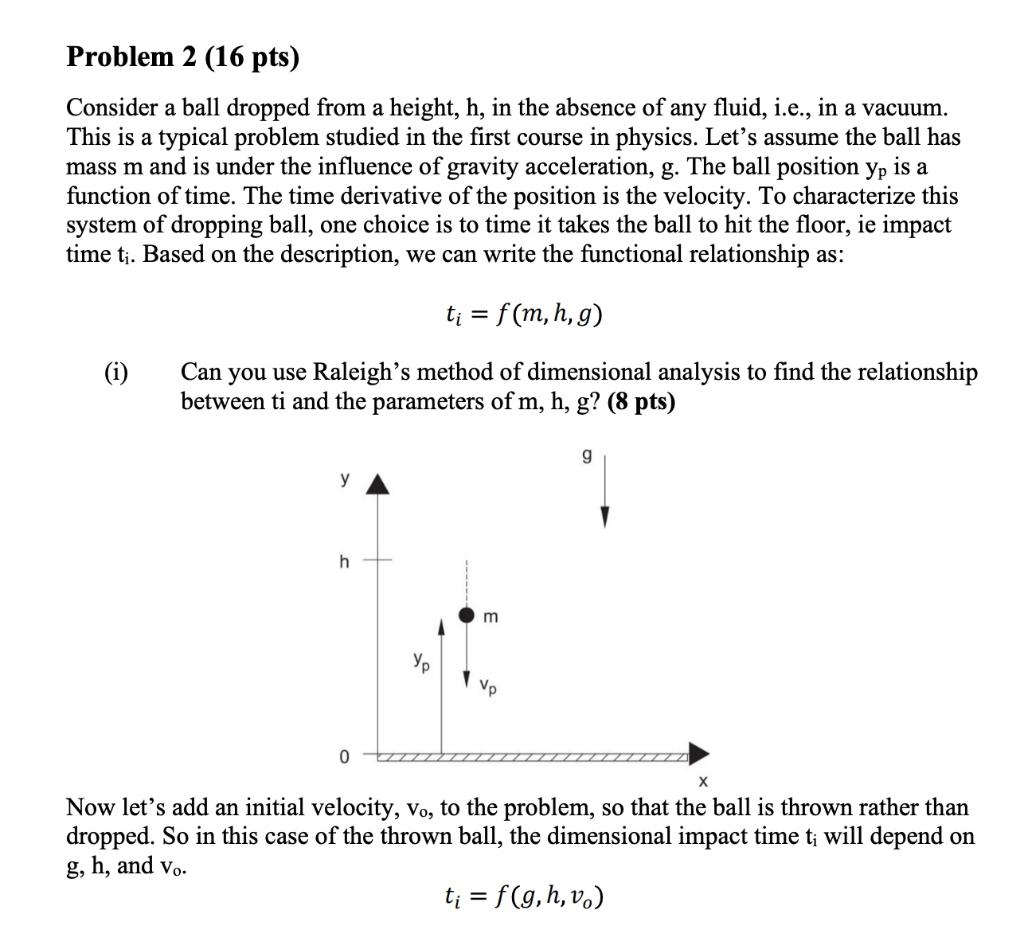

Problem 2 (16 pts) Consider a ball dropped from a height, h, in the absence of any fluid, i.e., in a vacuum. This is a typical problem studied in the first course in physics. Let's assume the ball has mass m and is under the influence of gravity acceleration, g. The ball position yp is a function of time. The time derivative of the position is the velocity. To characterize this system of dropping ball, one choice is to time it takes the ball to hit the floor, ie impact time t. Based on the description, we can write the functional relationship as: t = f(m, h, g) (i) Can you use Raleigh's method of dimensional analysis to find the relationship between ti and the parameters of m, h, g? (8 pts) g h m vo 0 ZZZZZZZZA Now let's add an initial velocity, Vo, to the problem, so that the ball is thrown rather than dropped. So in this case of the thrown ball, the dimensional impact time t will depend on g, h, and vo. t = f(g,h, v.) (ii) Can you use Buckingham Pi theorem to find the relationship of ti in terms of Vo variables g, h, vo. Hint: Froude number = Fr (8 pts) = Vgh
Step by Step Solution
There are 3 Steps involved in it

Get step-by-step solutions from verified subject matter experts
 Study Help