



Question: Problem 2 (17 pts.) Expected Time: 1-2 hours. Similar to: Tutorial 8 P3, Thtorial .9 P3, Problem Set 7 P2, Paths, Cycles 8 Trees lecture.
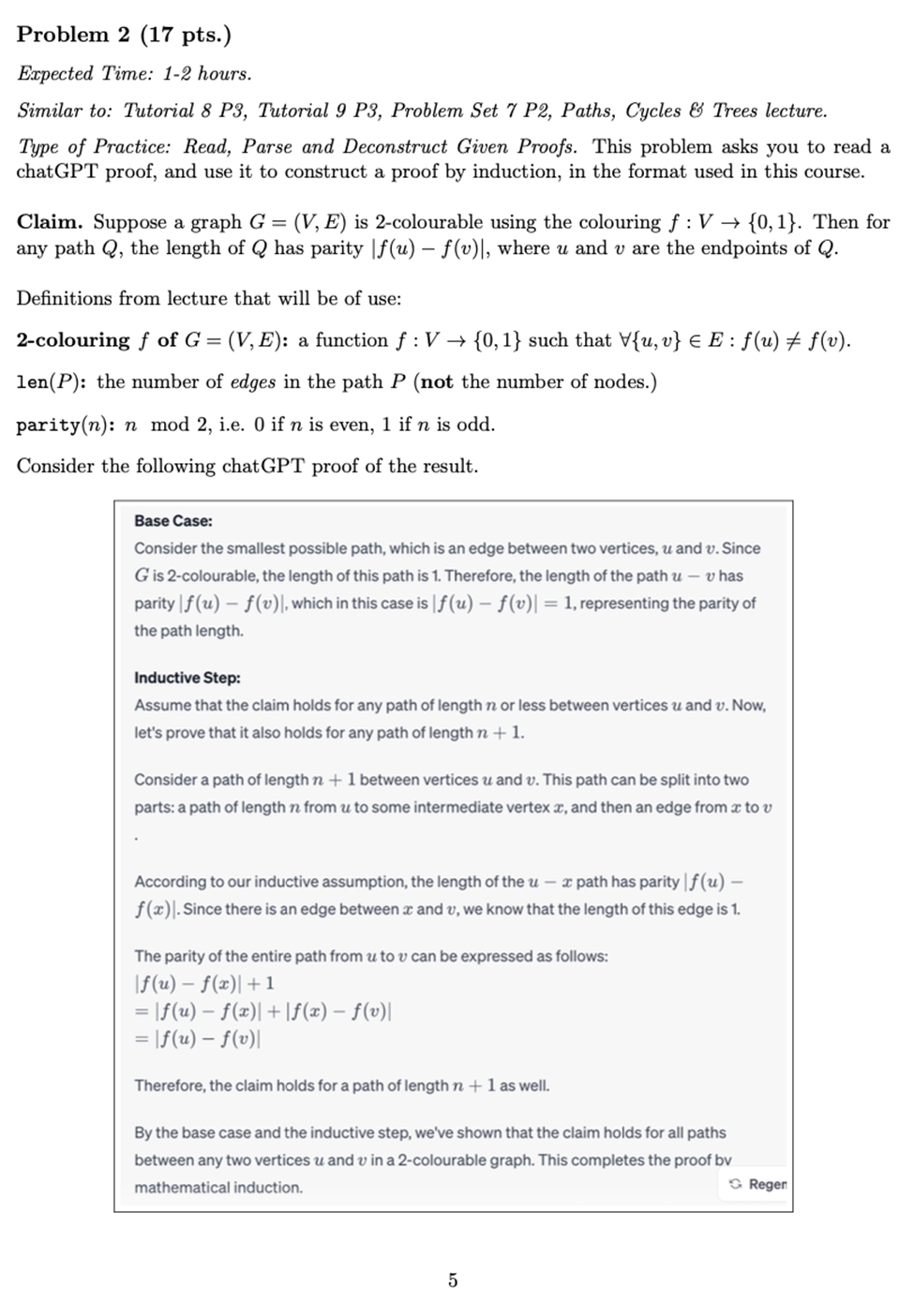
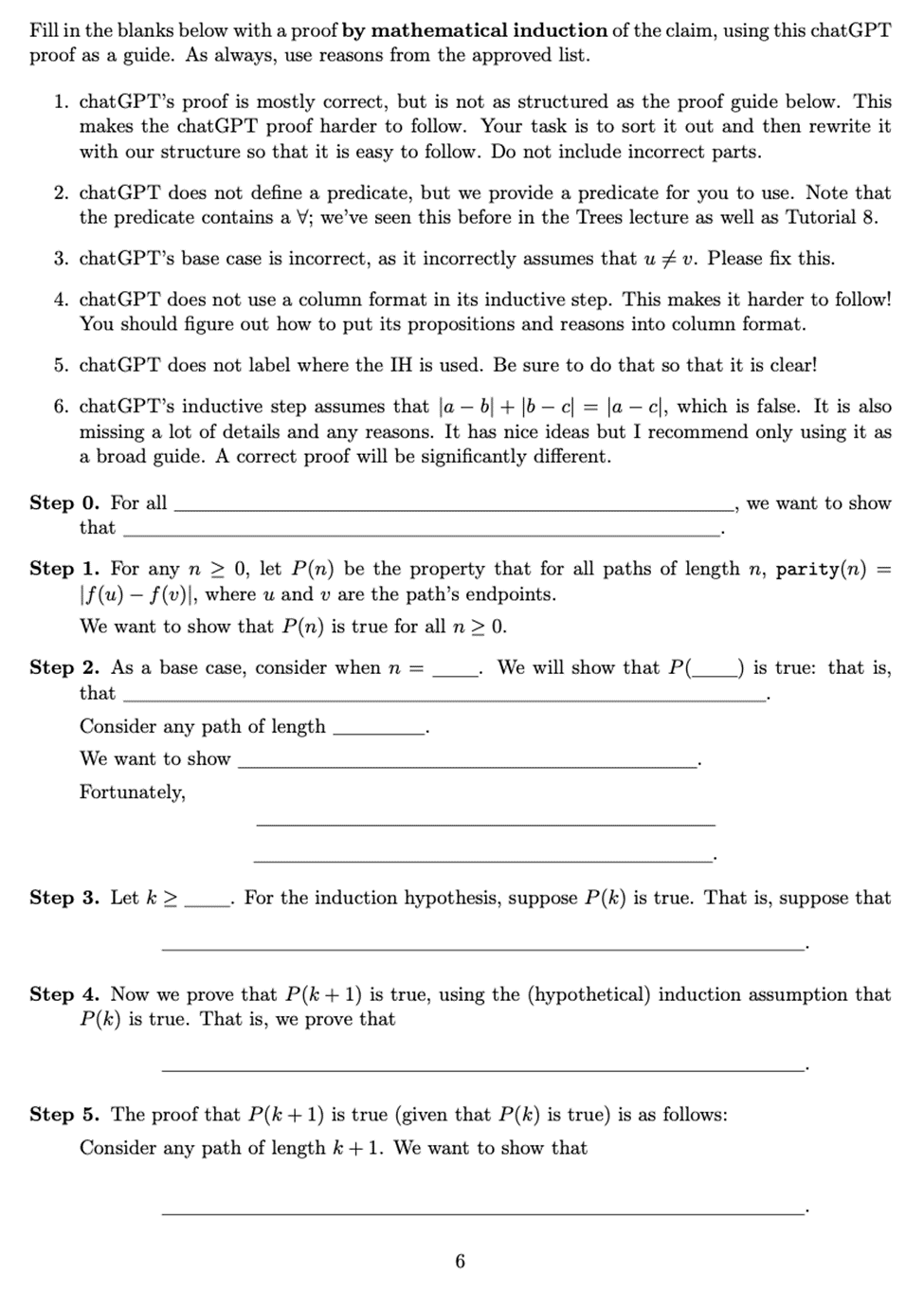
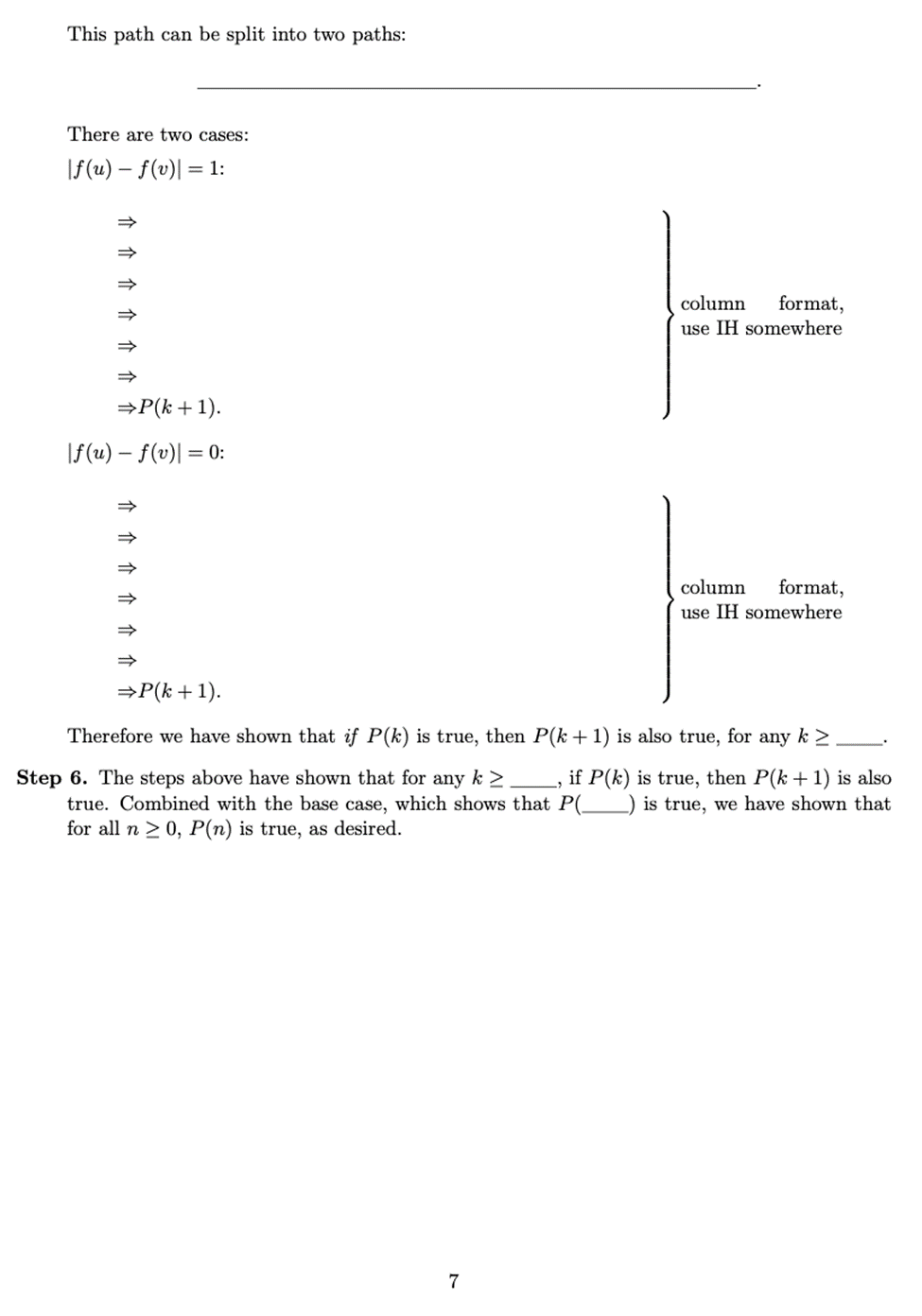
Problem 2 (17 pts.) Expected Time: 1-2 hours. Similar to: Tutorial 8 P3, Thtorial .9 P3, Problem Set 7 P2, Paths, Cycles 8 Trees lecture. Type of Practice: Reed, Parse and Deconstruct Given Proofs. This problem asks you to read a chatGPT proof, and use it to construct a proof by induction, in the format used in this course. Claim. Suppose a graph G = (V, E) is 2-oolourable using the colouring f : V ) {0, 1}. Then for any path Q, the length of Q has parity |f(u) f(o)|, where u and v are the endpoints of Q. Denitions from lecture that will be of use: 2-colouring f of G = (V, E): a function f: V l- {0,1} such that V{u,v} E E : u) 7E u). len(P): the number of edges in the path P (not the number of nodes.) parity(n): n mod 2, Le. 0 if n is even, 1 if n is odd. Consider the following chatGPT proof of the result. Base Case: Consider the smallest possible path. which is an edge between two vertices. u and v. Since G is 2-colourable. the length of this path is 1. Therefore. the length of the path it v has parity Ju) u) l, which in this case is |f(u) f(v)| = 1. representing the parity ot the path length. inductive Step: Assume that the claim holds for any path ot length n or less between vertices u and 1:. Now, let's prove that it also holds for any path of length n + 1. Consider a path of length n + 1 between vertices u and v. This path can be split into two parts: a path of length n from u to some intermediate vertex 3. and then an edge from a: to 1; According to our inductive assumption. the length of the tr ~ I path has parity | u) _ x) |. Since there is an edge between :r and v. we know that the length of this edge is 1. The parity of the entire path from u to v can be expressed as follows: |f(u) - f(==)| +1 = lflu) flxll + Iflx) - flv)| = mu} - flvll Therefore. the claim holds for a path of length n + l as well. By the base case and the inductive step. we've shown that the claim holds tor all paths between any two vertices u and v in a 2-colourable graph. This completes the proof bv mathematical induction. '3 Repel\" Fill in the blanks below with a proof by mathematical induction of the claim, using this chatGPT proof as a guide. As always, use reasons from the approved list. 1. chatGPT's proof is mostly correct, but is not as structured as the proof guide below. This makes the chatGPT proof harder to follow. Your task is to sort it out and then rewrite it with our structure so that it is easy to follow. Do not include incorrect parts. 2. chatGPT does not define a predicate, but we provide a predicate for you to use. Note that the predicate contains a V; we've seen this before in the Trees lecture as well as Tutorial 8. 3. chatGPT's base case is incorrect, as it incorrectly assumes that u * v. Please fix this. 4. chatGPT does not use a column format in its inductive step. This makes it harder to follow! You should figure out how to put its propositions and reasons into column format. 5. chatGPT does not label where the IH is used. Be sure to do that so that it is clear! 6. chatGPT's inductive step assumes that la - b| + |b - c) = la - c), which is false. It is also missing a lot of details and any reasons. It has nice ideas but I recommend only using it as a broad guide. A correct proof will be significantly different. Step 0. For all we want to show that Step 1. For any n 2 0, let P(n) be the property that for all paths of length n, parity(n) = If(u) - f(v)|, where u and v are the path's endpoints. We want to show that P(n) is true for all n 2 0. Step 2. As a base case, consider when n = We will show that P( ) is true: that is, that Consider any path of length We want to show Fortunately, Step 3. Let k 2. For the induction hypothesis, suppose P(k) is true. That is, suppose that Step 4. Now we prove that P(k + 1) is true, using the (hypothetical) induction assumption that P(k) is true. That is, we prove that Step 5. The proof that P(k + 1) is true (given that P(k) is true) is as follows: Consider any path of length k + 1. We want to show thatThis path can be split into two paths: There are two cases: mu) - f(t')l=1= => => 2) => column format, use IH somewhere => =>P(k + 1) We) f('U)l = 01 :> =;. => => column format, use 1H somewhere :> 2:. =>P(k + 1). Therefore we have shown that if P(k) is true, then PU: + 1) is also true. for any is 2 . Step 6. The steps above have shown that for any It 2 , if PUC) is true, then PUG + 1) is also true. Combined with the base case, which shows that P( ) is true, we have shown that for all n 2 0, P(n) is true, as desired
Step by Step Solution
There are 3 Steps involved in it

Get step-by-step solutions from verified subject matter experts