







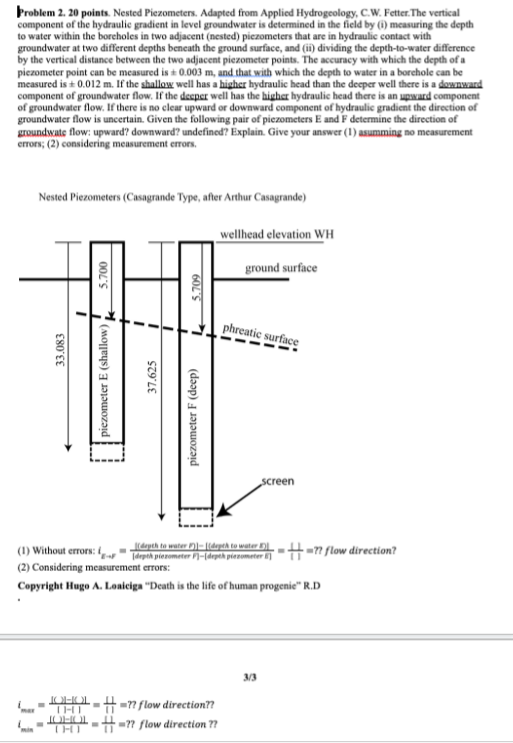
Question: Problem 2 . 2 0 points. Nested Piezometers. Adapted from Applied Hydrogeology, C . W . Fetter. The vertical component of the hydraulic gradient in
Problem points. Nested Piezometers. Adapted from Applied Hydrogeology, CW Fetter. The vertical component of the hydraulic gradient in level groundwater is determined in the field by i measuring the depth to water within the boreholes in two adjacent nested piezometers that are in hydraulic contact with groundwater at two different depths beneath the ground surface, and ii dividing the depthtowater difference by the vertical distance between the two adjacent piezometer points. The accuracy with which the depth of a piezometer point can be measured is : and that with which the depth to water in a borehole can be measured is If the shallow well has a higher hydraulic head than the deeper well there is a downward component of groundwater flow. If the deeper well has the bigher hydraulic head there is an upward component of groundwater flow. If there is no clear upward or dowaward component of hydraulic gradient the direction of groundwater flow is uncertain. Given the following pair of piezometers and determine the direction of groundwate flow: upward? downward? undefined? Explain. Give your answer asumming no measurement errors; considering measurement errors.
Nested Piezometers Casagrande Type, after Arthur Casagrande
Considering measurement errors:
Step by Step Solution
There are 3 Steps involved in it
1 Expert Approved Answer
Step: 1 Unlock

Question Has Been Solved by an Expert!
Get step-by-step solutions from verified subject matter experts
Step: 2 Unlock
Step: 3 Unlock
 Study Help