





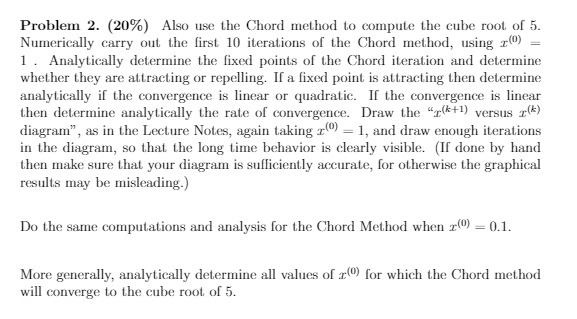
Question: Problem 2. (20%) Also use the Chord method to compute the cube root of 5. Numerically carry out the first 10 iterations of the Chord
Problem 2. (20%) Also use the Chord method to
Problem 2. (20%) Also use the Chord method to compute the cube root of 5. Numerically carry out the first 10 iterations of the Chord method, using z() = 1 . Analytically determine the fixed points of the Chord iteration and determine whether they are attracting or repelling. If a fixed point is attracting then determine analytically if the convergence is linear or quadratic. If the convergence is linear then determine analytically the rate of convergence. Draw the "r(*+1) versus r(k) diagram", as in the Lecture Notes, again taking r) = 1, and draw enough iterations in the diagram, so that the long time behavior is clearly visible. (If done by hand then make sure that your diagram is sufficiently accurate, for otherwise the graphical results may be misleading.) Do the same computations and analysis for the Chord Method when z() = 0.1. More generally, analytically determine all values of r) for which the Chord method will converge to the cube root of 5

Step by Step Solution

There are 3 Steps involved in it

1 Expert Approved Answer
Step: 1 Unlock blur-text-image

Question Has Been Solved by an Expert!

Get step-by-step solutions from verified subject matter experts

Step: 2 Unlock
Step: 3 Unlock

Students Have Also Explored These Related Mathematics Questions!