







Question: Problem 2. [20 points) Design deterministic finite automata for the following languages. You can give the DFA by their transition diagrams. You do not need
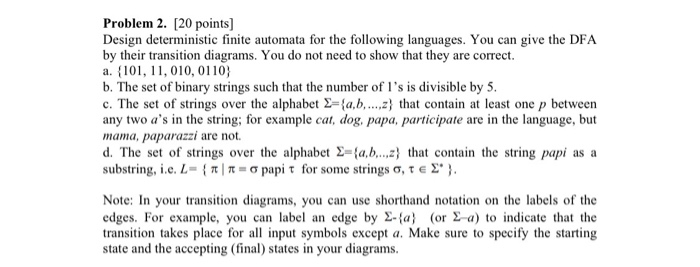
Problem 2. [20 points) Design deterministic finite automata for the following languages. You can give the DFA by their transition diagrams. You do not need to show that they are correct. a. {101, 11, 010, 0110) b. The set of binary strings such that the number of l's is divisible by 5. c. The set of strings over the alphabet E={a,b,....z) that contain at least one p between any two a's in the string; for example cat, dog, papa, participate are in the language, but mama, paparazzi are not d. The set of strings over the alphabet ={a,b....z) that contain the string papi as a substring, i.e. L= { t = papi t for some strings , TE E' }, Note: In your transition diagrams, you can use shorthand notation on the labels of the edges. For example, you can label an edge by E-{a} (or E a) to indicate that the transition takes place for all input symbols except a. Make sure to specify the starting state and the accepting (final) states in your diagrams. Problem 2. [20 points) Design deterministic finite automata for the following languages. You can give the DFA by their transition diagrams. You do not need to show that they are correct. a. {101, 11, 010, 0110) b. The set of binary strings such that the number of l's is divisible by 5. c. The set of strings over the alphabet E={a,b,....z) that contain at least one p between any two a's in the string; for example cat, dog, papa, participate are in the language, but mama, paparazzi are not d. The set of strings over the alphabet ={a,b....z) that contain the string papi as a substring, i.e. L= { t = papi t for some strings , TE E' }, Note: In your transition diagrams, you can use shorthand notation on the labels of the edges. For example, you can label an edge by E-{a} (or E a) to indicate that the transition takes place for all input symbols except a. Make sure to specify the starting state and the accepting (final) states in your diagrams
Step by Step Solution
There are 3 Steps involved in it

Get step-by-step solutions from verified subject matter experts
 Study Help