







Question: Problem 2: 2.1) Write down the mathematical definition of each of the following. (Be precise in your definitions. Each definition should be a mathematical statement.)
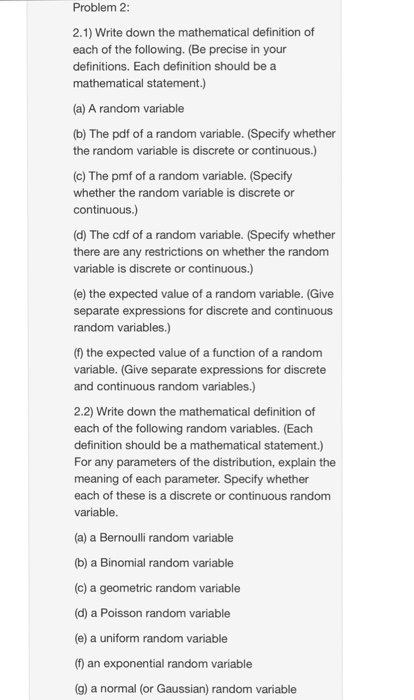
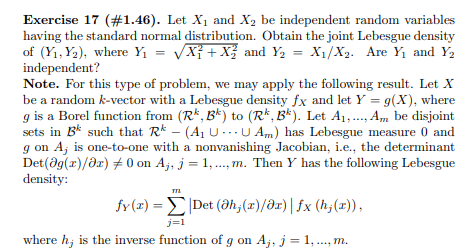
Problem 2: 2.1) Write down the mathematical definition of each of the following. (Be precise in your definitions. Each definition should be a mathematical statement.) (a) A random variable (b) The pdf of a random variable. (Specify whether the random variable is discrete or continuous.) (c) The pmf of a random variable. (Specify whether the random variable is discrete or continuous.) (d) The cdf of a random variable. (Specify whether there are any restrictions on whether the random variable is discrete or continuous.) (e) the expected value of a random variable. (Give separate expressions for discrete and continuous random variables.) (f) the expected value of a function of a random variable. (Give separate expressions for discrete and continuous random variables.) 2.2) Write down the mathematical definition of each of the following random variables. (Each definition should be a mathematical statement.) For any parameters of the distribution, explain the meaning of each parameter. Specify whether each of these is a discrete or continuous random variable. (a) a Bernoulli random variable (b) a Binomial random variable (c) a geometric random variable (d) a Poisson random variable (e) a uniform random variable (f) an exponential random variable (g) a normal (or Gaussian) random variableExercise 17 (#1.46). Let X, and X2 be independent random variables having the standard normal distribution. Obtain the joint Lebesgue density of (Y1, Y2), where Yi = VX7 + X? and Y2 = X1/X2. Are Y, and Yz independent? Note. For this type of problem, we may apply the following result. Let X be a random k-vector with a Lebesgue density fx and let Y = g(X), where g is a Borel function from (R*, B*) to (R*, B* ). Let A1, ...; Am be disjoint sets in B' such that RK - (A] U . . . U Am) has Lebesgue measure 0 and g on A; is one-to-one with a nonvanishing Jacobian, i.e., the determinant Det(Og(x)/0x) # 0 on Aj j =1. .... m. Then Y has the following Lebesgue density: fv(x) = ) Det (Oh; (x)/0r) fx (h;(x)), j=1 where h; is the inverse function of g on Aj, j = 1, .... m
Step by Step Solution
There are 3 Steps involved in it

Get step-by-step solutions from verified subject matter experts
 Study Help