







Question: Problem 2. (24 points) Consider the following two-player games. In each game, Player 1 (the row player) has two strategies {,}, and Player 2 (the
Problem 2. (24 points) Consider the following two-player games. In each game, Player 1 (the row player) has two strategies {,}, and Player 2 (the column player) has two strategies {, }. In each cell, the first number is the pay-off of Player 1, and the second is that of Player 2. For each game (1)(4), does either player have a dominant strategy? If yes, which player does, and what is its dominant strategy? For each game (1)(4), find all the Nash equilibria of it. Note: consider pure strategies only (i.e., no mixed strategy), in which case it is possible that a game has no Nash equilibrium. (1) (6 points). L R U (2, 5) (2, 1) D (3, 1) (4, 4) (2) (6 points). L R U (0, -1) (3, -3) D (-2, 0) (5, -1) (3) (6 points). L R U (1, 1) (3, 3) D (2, 1) (-2, 0) (4) (6 points). L R U (2, 4) (4, 2) D (3, -1) (-1, 4)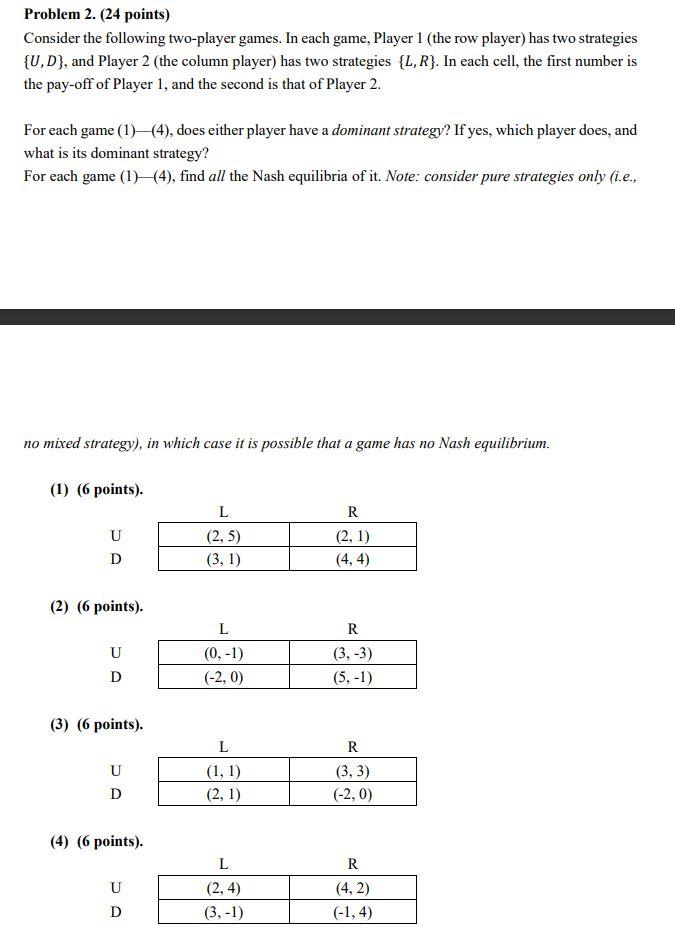
Problem 2. (24 points) Consider the following two-player games. In each game, Player 1 (the row player) has two strategies {U,D}, and Player 2 (the column player) has two strategies {L,R}. In each cell, the first number is the pay-off of Player 1 , and the second is that of Player 2. For each game (1) - (4), does either player have a dominant strategy? If yes, which player does, and what is its dominant strategy? For each game (1) -(4), find all the Nash equilibria of it. Note: consider pure strategies only (i.e., no mixed strategy), in which case it is possible that a game has no Nash equilibrium. (1) (6 points). U D (2) (6 points). U D (3) (6 points). U D (4) (6 points)
Step by Step Solution
There are 3 Steps involved in it

Get step-by-step solutions from verified subject matter experts
 Study Help