







Question: Problem 2 (25 Points) Please read carefully: There are 2 firms, Firm B (Bad) and Firm G(Good that each have $10 in cash but need
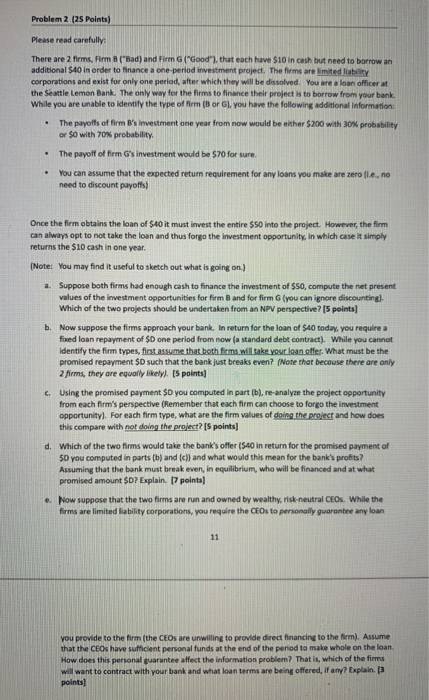
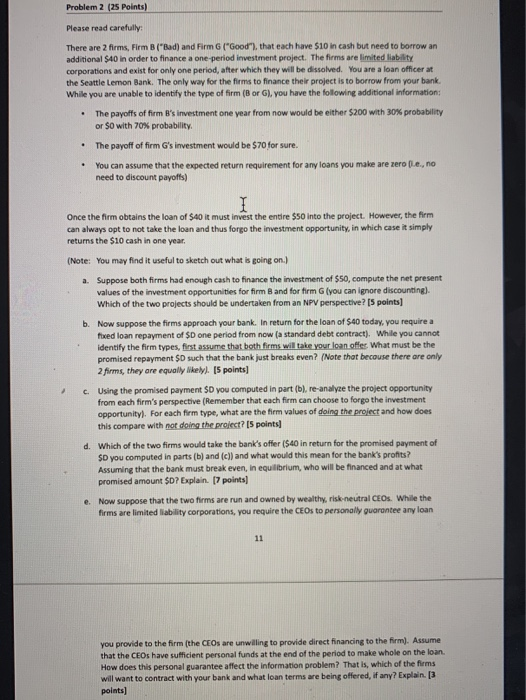
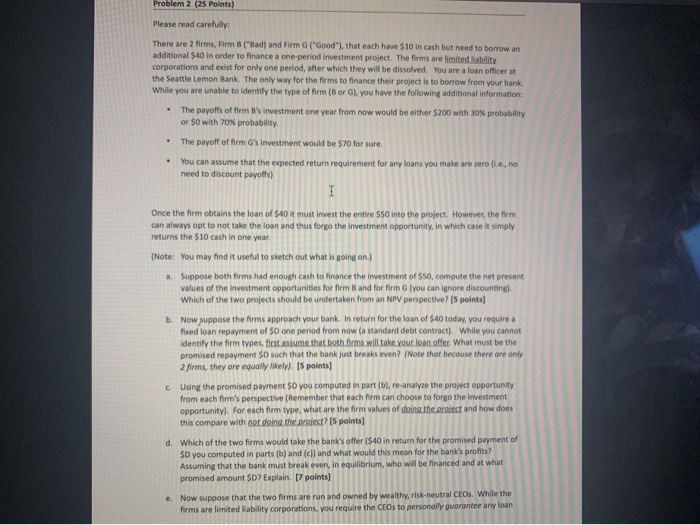
Problem 2 (25 Points) Please read carefully: There are 2 firms, Firm B ("Bad) and Firm G("Good that each have $10 in cash but need to borrow an additional $40 in order to finance a one period investment project. The firms are limited liability corporations and exist for only one period, after which they will be dissolved. You are a loan officer the Seattle Lemon Bank. The only way for the firms to finance their project is to borrow from your bank While you are unable to identify the type of firm (B or G), you have the following additional information: The payoffs of firm B's investment one year from now would be either $200 with 30% probability or $o with 70% probability, The payoff of firm G's investment would be $70 for sure You can assume that the expected return requirement for any loans you make are zero fe, no need to discount payoffs) Once the firm obtains the loan of $40 it must invest the entire 550 into the project. However, the firm can always opt to not take the loan and thus forgo the investment opportunity, in which case it simply returns the SID cash in one year, (Note: You may find it useful to sketch out what is going on.) a. Suppose both firms had enough cash to finance the investment of $50, compute the net present values of the investment opportunities for firmand for firm (you can ignore discounting) Which of the two projects should be undertaken from an NPV perspective? S points b. Now suppose the firms approach your bank. In return for the loan of $40 today, you require a foxed loan repayment of $D one period from now (a standard debt contract). While you cannot Identify the firm types, first assume that both firms will take your loan offer. What must be the promised repayment SD such that the bank just breaks even? (Note that because there are only 2 firms, they are equally bely). S points) Using the promised payment SD you computed in part (b), re-analyze the project opportunity from each firm's perspective (Remember that each firm can choose to forgo the investment opportunity). For each firm type, what are the firm values of doing the project and how does this compare with not doing the project? [5 points] Which of the two firms would take the bank's offer ($40 in return for the promised payment of So you computed in parts (b) and (c)) and what would this mean for the bank's profits? Assuming that the bank must break even in equilibrium, who will be financed and at what promised amount $D? Explain. 17 points) e. Now suppose that the two firms are run and owned by wealthy, risk neutral CEOs. While the firms are limited liability corporations, you require the CEOs to personally guarantee any loan you provide to the firm the CEOs are unwilling to provide direct financing to the firm). Assume that the CEOs have sufficient personal funds at the end of the period to make whole on the loan How does this personal guarantee affect the information problem? That is, which of the firms will want to contract with your bank and what loan terms are being offered, If any? Explain. points) Problem 2 (25 Points) Please read carefully: There are 2 firms, Firma "Bad) and Firm G("Goodthat each have $10 in cash but need to borrow an additional $40 in order to finance a one period investment project. The firms are limited ability corporations and exist for only one period, after which they will be dissolved. You are a loan officer at the Seattle Lemon Bank. The only way for the firms to finance their project is to borrow from your bank. While you are unable to identify the type of firm (Bor G), you have the following additional information: The payoffs of firm B's investment one year from now would be either $200 with 10% probability or $0 with 70% probability, The payoff of firm 's Investment would be $70 for sure. You can assume that the expected return requirement for any loans you make are vero fe, no need to discount payoffs) Once the firm obtains the loan of $40 it must invest the entire 50 into the project. However, the firm can always opt to not take the loan and thus forgo the investment opportunity, in which case it simply returns the $10 cash in one year (Note: You may find it useful to sketch out what is going on.) a. Suppose both firms had enough cash to finance the investment of $50, compute the net present values of the investment opportunities for firm Band for firm you can ignore discounting) Which of the two projects should be undertaken from an NPV perspective? (5 points) b. Now suppose the firms approach your bank. In return for the loan of $40 today you require a fixed loan repayment of SD one period from now (a standard debt contract). While you cannot identify the firm types, first assume that both firms will take your loan offer What must be the promised repayments such that the bank just breaks even? (Note that because there are only 2 firms, they are equally likely). I points) c. Using the promised payment SD you computed in part (bl, re-analyze the project opportunity from each firm's perspective (Remember that each firm can choose to forgo the investment opportunity), for each firm type, what are the firm values of doing the project and how does this compare with not doing the project? (5 points) d. Which of the two firms would take the bank's offer 1840 in return for the promised payment of SD you computed in parts (b) and (c) and what would this mean for the bank's profits? Assuming that the bank must break ever, in equilibrium, who will be financed and at what promised amount $07 Explain. 17 points) e. Now suppose that the two firms are run and owned by wealthy, risk-neutral CEOs. While the firms are limited liability corporations, you require the CEOs to personally guarantee any loan Problem 2 (25 Points) Please read carefully: There are 2 firms, Firm B ("Bad) and Firm G("Good that each have $10 in cash but need to borrow an additional $40 in order to finance a one period investment project. The firms are limited liability corporations and exist for only one period, after which they will be dissolved. You are a loan officer the Seattle Lemon Bank. The only way for the firms to finance their project is to borrow from your bank While you are unable to identify the type of firm (B or G), you have the following additional information: The payoffs of firm B's investment one year from now would be either $200 with 30% probability or $o with 70% probability, The payoff of firm G's investment would be $70 for sure You can assume that the expected return requirement for any loans you make are zero fe, no need to discount payoffs) Once the firm obtains the loan of $40 it must invest the entire 550 into the project. However, the firm can always opt to not take the loan and thus forgo the investment opportunity, in which case it simply returns the SID cash in one year, (Note: You may find it useful to sketch out what is going on.) a. Suppose both firms had enough cash to finance the investment of $50, compute the net present values of the investment opportunities for firmand for firm (you can ignore discounting) Which of the two projects should be undertaken from an NPV perspective? S points b. Now suppose the firms approach your bank. In return for the loan of $40 today, you require a foxed loan repayment of $D one period from now (a standard debt contract). While you cannot Identify the firm types, first assume that both firms will take your loan offer. What must be the promised repayment SD such that the bank just breaks even? (Note that because there are only 2 firms, they are equally bely). S points) Using the promised payment SD you computed in part (b), re-analyze the project opportunity from each firm's perspective (Remember that each firm can choose to forgo the investment opportunity). For each firm type, what are the firm values of doing the project and how does this compare with not doing the project? [5 points] Which of the two firms would take the bank's offer ($40 in return for the promised payment of So you computed in parts (b) and (c)) and what would this mean for the bank's profits? Assuming that the bank must break even in equilibrium, who will be financed and at what promised amount $D? Explain. 17 points) e. Now suppose that the two firms are run and owned by wealthy, risk neutral CEOs. While the firms are limited liability corporations, you require the CEOs to personally guarantee any loan you provide to the firm the CEOs are unwilling to provide direct financing to the firm). Assume that the CEOs have sufficient personal funds at the end of the period to make whole on the loan How does this personal guarantee affect the information problem? That is, which of the firms will want to contract with your bank and what loan terms are being offered, If any? Explain. points) Problem 2 (25 Points) Please read carefully: There are 2 firms, Firma "Bad) and Firm G("Goodthat each have $10 in cash but need to borrow an additional $40 in order to finance a one period investment project. The firms are limited ability corporations and exist for only one period, after which they will be dissolved. You are a loan officer at the Seattle Lemon Bank. The only way for the firms to finance their project is to borrow from your bank. While you are unable to identify the type of firm (Bor G), you have the following additional information: The payoffs of firm B's investment one year from now would be either $200 with 10% probability or $0 with 70% probability, The payoff of firm 's Investment would be $70 for sure. You can assume that the expected return requirement for any loans you make are vero fe, no need to discount payoffs) Once the firm obtains the loan of $40 it must invest the entire 50 into the project. However, the firm can always opt to not take the loan and thus forgo the investment opportunity, in which case it simply returns the $10 cash in one year (Note: You may find it useful to sketch out what is going on.) a. Suppose both firms had enough cash to finance the investment of $50, compute the net present values of the investment opportunities for firm Band for firm you can ignore discounting) Which of the two projects should be undertaken from an NPV perspective? (5 points) b. Now suppose the firms approach your bank. In return for the loan of $40 today you require a fixed loan repayment of SD one period from now (a standard debt contract). While you cannot identify the firm types, first assume that both firms will take your loan offer What must be the promised repayments such that the bank just breaks even? (Note that because there are only 2 firms, they are equally likely). I points) c. Using the promised payment SD you computed in part (bl, re-analyze the project opportunity from each firm's perspective (Remember that each firm can choose to forgo the investment opportunity), for each firm type, what are the firm values of doing the project and how does this compare with not doing the project? (5 points) d. Which of the two firms would take the bank's offer 1840 in return for the promised payment of SD you computed in parts (b) and (c) and what would this mean for the bank's profits? Assuming that the bank must break ever, in equilibrium, who will be financed and at what promised amount $07 Explain. 17 points) e. Now suppose that the two firms are run and owned by wealthy, risk-neutral CEOs. While the firms are limited liability corporations, you require the CEOs to personally guarantee any loan
Step by Step Solution
There are 3 Steps involved in it

Get step-by-step solutions from verified subject matter experts
 Study Help