







Question: Problem 2 (3 points total) Cheese is a dairy product that is a staple of diets in many countries. High demand for cheese puts pressure
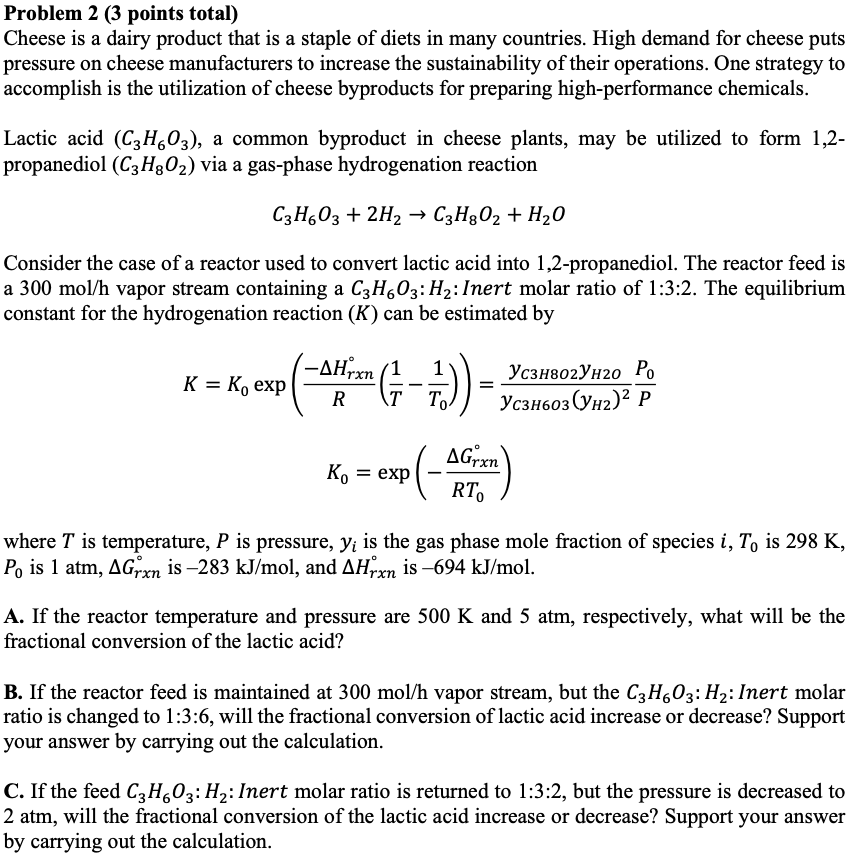
Problem 2 (3 points total) Cheese is a dairy product that is a staple of diets in many countries. High demand for cheese puts pressure on cheese manufacturers to increase the sustainability of their operations. One strategy to accomplish is the utilization of cheese byproducts for preparing high-performance chemicals. Lactic acid (C3H6O3), a common byproduct in cheese plants, may be utilized to form 1,2propanediol (C3H8O2) via a gas-phase hydrogenation reaction C3H6O3+2H2C3H8O2+H2O Consider the case of a reactor used to convert lactic acid into 1,2-propanediol. The reactor feed is a 300mol/h vapor stream containing a C3H6O3:H2: Inert molar ratio of 1:3:2. The equilibrium constant for the hydrogenation reaction (K) can be estimated by K=K0exp(RHrxn(T1T01))=yC3H603(yH2)2yC3H8O2yH2OPP0K0=exp(RT0Grxn) where T is temperature, P is pressure, yi is the gas phase mole fraction of species i,T0 is 298K, P0 is 1atm,Grxn is 283kJ/mol, and Hrxn is 694kJ/mol. A. If the reactor temperature and pressure are 500K and 5atm, respectively, what will be the fractional conversion of the lactic acid? B. If the reactor feed is maintained at 300mol/h vapor stream, but the C3H6O3:H2: Inert molar ratio is changed to 1:3:6, will the fractional conversion of lactic acid increase or decrease? Support your answer by carrying out the calculation. C. If the feed C3H6O3:H2 : Inert molar ratio is returned to 1:3:2, but the pressure is decreased to 2atm, will the fractional conversion of the lactic acid increase or decrease? Support your answer by carrying out the calculation
Step by Step Solution
There are 3 Steps involved in it

Get step-by-step solutions from verified subject matter experts
 Study Help