







Question: Problem 2 . 3 You are selling fish and can purchase fresh products at $ 1 8 per crate each morning from the Fish Market.
Problem
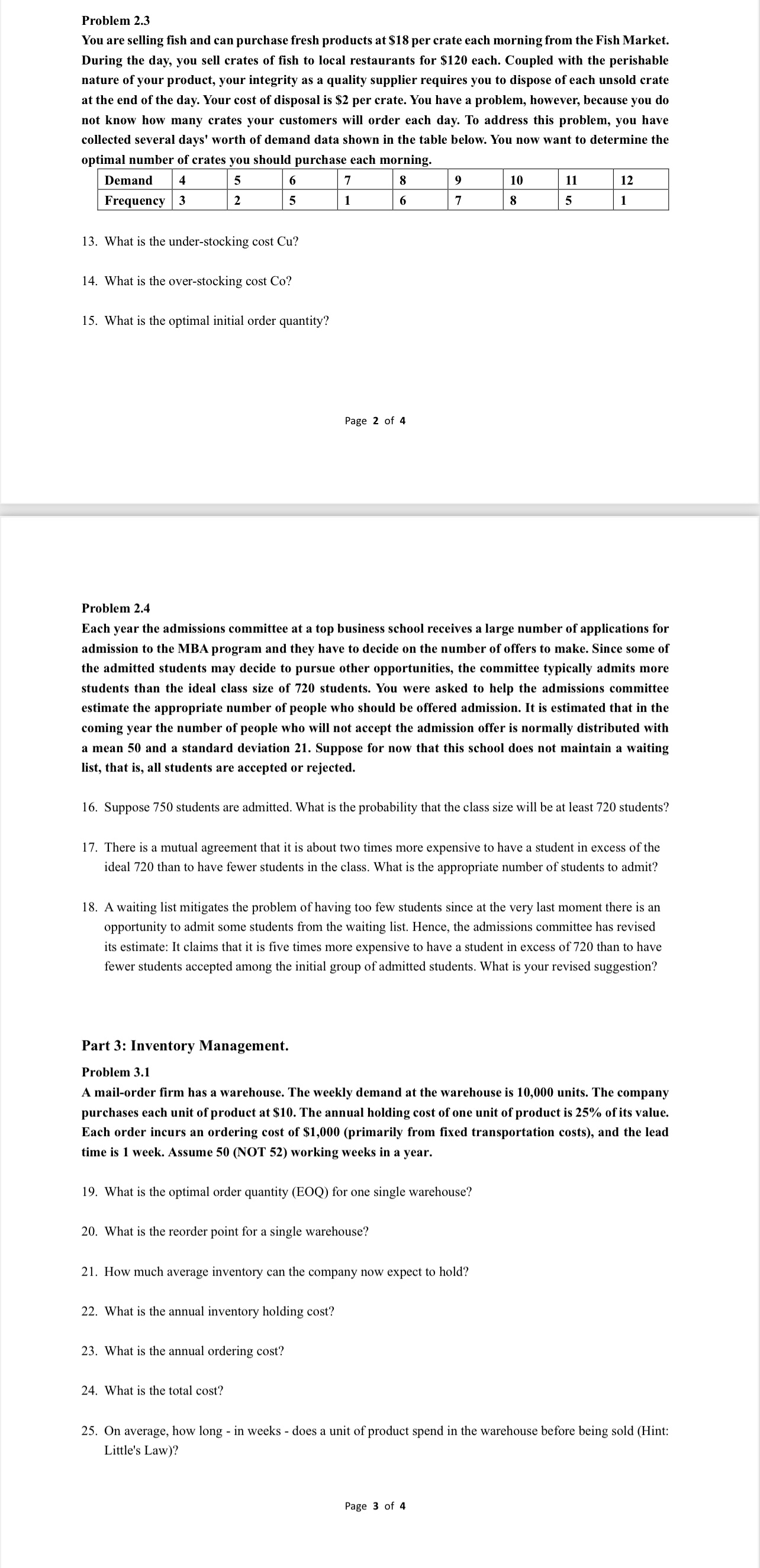
You are selling fish and can purchase fresh products at $ per crate each morning from the Fish Market. During the day, you sell crates of fish to local restaurants for $ each. Coupled with the perishable nature of your product, your integrity as a quality supplier requires you to dispose of each unsold crate at the end of the day. Your cost of disposal is $ per crate. You have a problem, however, because you do not know how many crates your customers will order each day. To address this problem, you have collected several days' worth of demand data shown in the table below. You now want to determine the optimal number of crates you should purchase each morning.
tableDemandFrequency
What is the understocking cost
What is the overstocking cost Co
What is the optimal initial order quantity?
Page of
Problem
Each year the admissions committee at a top business school receives a large number of applications for admission to the MBA program and they have to decide on the number of offers to make. Since some of the admitted students may decide to pursue other opportunities, the committee typically admits more students than the ideal class size of students. You were asked to help the admissions committee estimate the appropriate number of people who should be offered admission. It is estimated that in the coming year the number of people who will not accept the admission offer is normally distributed with a mean and a standard deviation Suppose for now that this school does not maintain a waiting list, that is all students are accepted or rejected.
Suppose students are admitted. What is the probability that the class size will be at least students?
There is a mutual agreement that it is about two times more expensive to have a student in excess of the ideal than to have fewer students in the class. What is the appropriate number of students to admit?
A waiting list mitigates the problem of having too few students since at the very last moment there is an opportunity to admit some students from the waiting list. Hence, the admissions committee has revised its estimate: It claims that it is five times more expensive to have a student in excess of than to have fewer students accepted among the initial group of admitted students. What is your revised suggestion?
Part : Inventory Management.
Problem
A mailorder firm has a warehouse. The weekly demand at the warehouse is units. The company purchases each unit of product at $ The annual holding cost of one unit of product is of its value. Each order incurs an ordering cost of $primarily from fixed transportation costs and the lead time is week. Assume NOT working weeks in a year.
What is the optimal order quantity EOQ for one single warehouse?
What is the reorder point for a single warehouse?
How much average inventory can the company now expect to hold?
What is the annual inventory holding cost?
What is the annual ordering cost?
What is the total cost?
On average, how long in weeks does a unit of product spend in the warehouse before being sold Hint: Little's Law
Page of
Step by Step Solution
There are 3 Steps involved in it
1 Expert Approved Answer
Step: 1 Unlock

Question Has Been Solved by an Expert!
Get step-by-step solutions from verified subject matter experts
Step: 2 Unlock
Step: 3 Unlock
 Study Help