







Question: Problem 2 (30 points) A microscopic spring-mass system has a mass m = 2 x 10 kq and the energy gap between the 2nd and
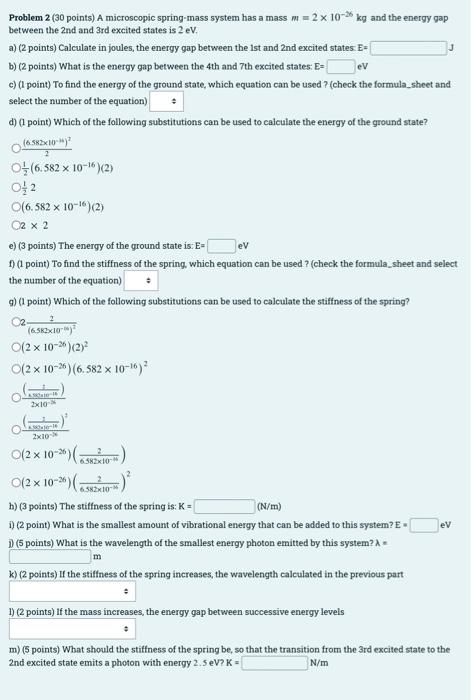
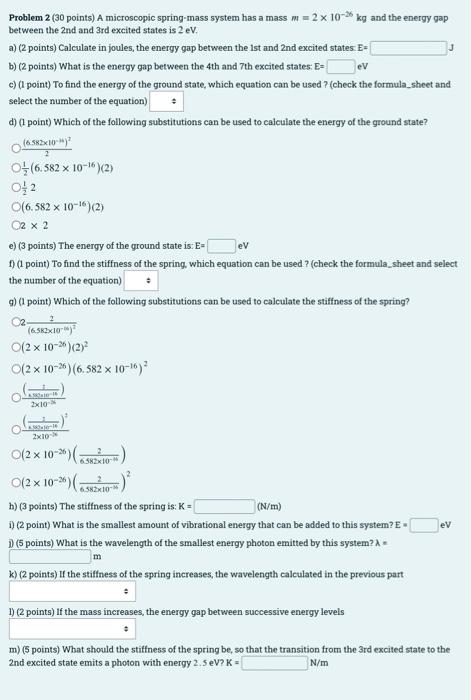
Problem 2 (30 points) A microscopic spring-mass system has a mass m = 2 x 10" kq and the energy gap between the 2nd and 3rd excited states is 2 ev. a) (2 points) Calculate in joules, the energy gap between the ist and 2nd excited states E- b) (2 points) What is the energy gap between the 4th and 7th excited states: E= ev c) (1 point) To find the energy of the ground state, which equation can be used 7 (check the formula_sheet and select the number of the equation) d) (1 point) Which of the following substitutions can be used to calculate the energy of the ground state? OH(6. 582 x 10-15 )(2) 01 2 O(6. 582 x 10-15)(2) Q2 x 2 e) (3 points) The energy of the ground state is: E= ev f) (1 point) To find the stiffness of the spring, which equation can be used ? (check the formula_sheet and select the number of the equation) g) (1 point) Which of the following substitutions can be used to calculate the stiffness of the spring? 02 (6582X10 O(2 x 10-20)(2)2 O(2 x 10-26 ) (6. 582 x 10-16)2 O(2 x 10 26 ) O(2 x 10⁻² )( 6 58PM 10 5 h) (3 points) The stiffness of the spring is: K = (N/m) i) (2 point) What is the smallest amount of vibrational energy that can be added to this system? E = ev 1) (5 points) What is the wavelength of the smallest energy photon emitted by this system? A . m k) (2 points) If the stiffness of the spring increases, the wavelength calculated in the previous part 1) (2 points) If the mass increases, the energy gap between successive energy levels m) (5 points) What should the stiffness of the spring be, so that the transition from the 3rd excited state to the 2nd excited state emits a photon with energy 2.$ ev? K = N/m
Step by Step Solution
There are 3 Steps involved in it

Get step-by-step solutions from verified subject matter experts
 Study Help