



Question: Problem 2: [30 pts] Consider the power series f (x) = 3 . (-1)k . 2k k +1 -(x - 1)3k For the duration of
![Problem 2: [30 pts] Consider the power series f (x) =](https://s3.amazonaws.com/si.experts.images/answers/2024/06/667fbe6405507_843667fbe63e7ec3.jpg)
![Taylor polynomial centered at x = 1. A. [20 pts] Do the](https://s3.amazonaws.com/si.experts.images/answers/2024/06/667fbe64d5897_844667fbe64b88dd.jpg)
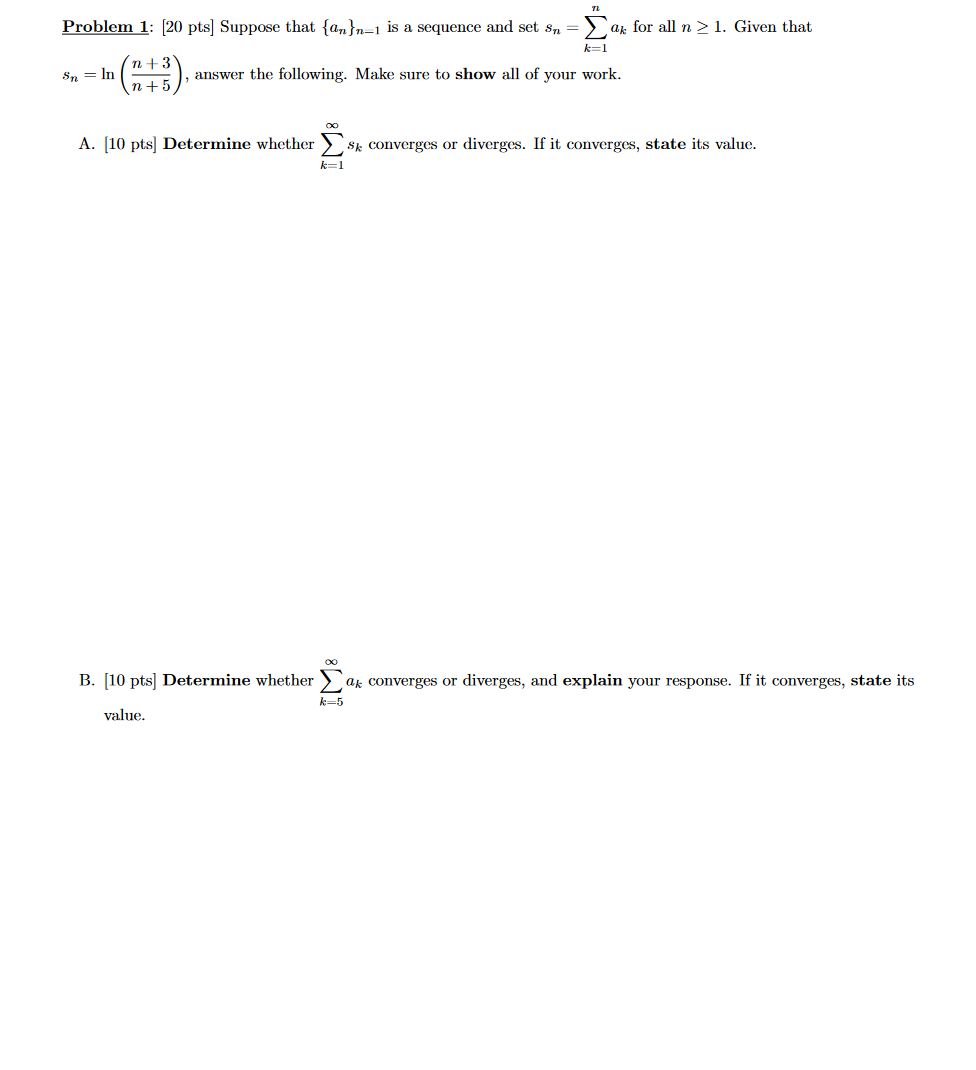
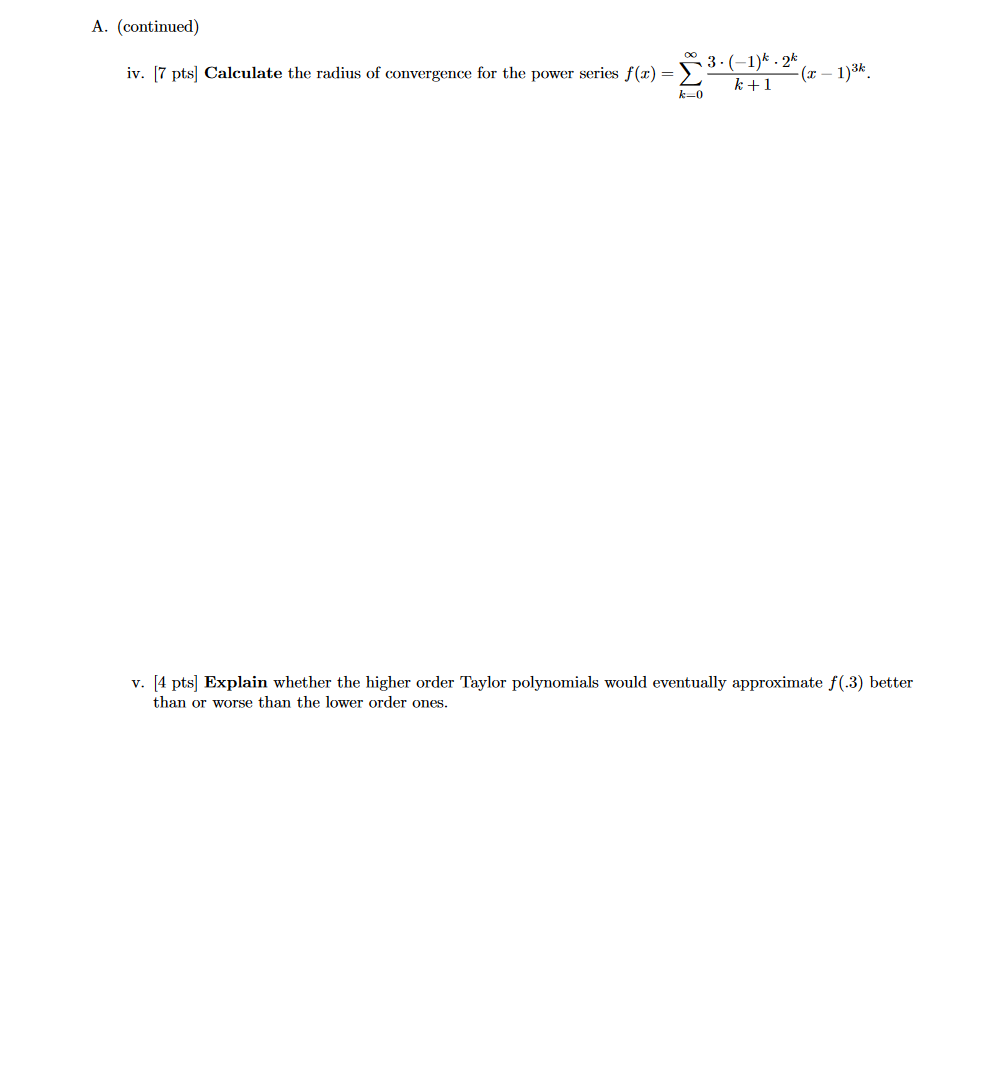
Problem 2: [30 pts] Consider the power series f (x) = 3 . (-1)k . 2k k +1 -(x - 1)3k For the duration of this problem, Pn(x) will represent the n - th order Taylor polynomial centered at x = 1. A. [20 pts] Do the following. i. [3 pts] Exhibit p3(x), P6(T), P9(2), and p12(r) in the space below. ii. [3 pts] Graph all of the Taylor polynomials above on the same set of axes for -1 3 . (-1)k . 2k 2- k + 1 -(x - 1)3kProblem 1: [20 pts] Suppose that {an }n-1 is a sequence and set s, = > ak for all n 2 1. Given that K= 1 Sn = In (n+3 n +5, , answer the following. Make sure to show all of your work. A. [10 pts] Determine whether _ $k converges or diverges. If it converges, state its value. B. [10 pts] Determine whether > ax converges or diverges, and explain your response. If it converges, state its K _ 5 value.A. (continued) iv. [7 pts] Calculate the radius of convergence for the power series f (I) = 3. (-1)* . 2k -(:r - 1)3k k - 0 k+1 v. [4 pts] Explain whether the higher order Taylor polynomials would eventually approximate f(.3) better than or worse than the lower order ones.(Problem 2, continued) B. [10 pts] Morgan, Avery, and Taylor are asked to compute f(1) and provide the following argument. We know that all = f(11) (0) 11! : 50 11! - ani = f(D)(0). Also, an is the coefficient of (z - 1)". Since (x - 1)3k = (x - 1)" when 3k = 11, we see that k = 11/3. Unfortunately, they cannot agree on how to interpret the result. 3 . (-1)* . 2k | 3 . (-1)11/3 . 211/3 9 . 211/3 . Morgan claims that since k = 11/3, an = k+ 1 k=11/3 14/3 14 Hence, Morgan believes that f()(1) = 11! . an = 11!. 9 . 211/3 14 . Avery notes that k = 11/3 is not an integer, so f()(1) does not exist. . Taylor notes that k = 11/3 is not an integer, so f(1) (1) = 0. Explain which, if any of the students is correct. Make sure to justify your answer via an explanation and/or a calculation. Do not simply quote a result that may have been discussed in lecture or recitation
Step by Step Solution
There are 3 Steps involved in it

Get step-by-step solutions from verified subject matter experts