







Question: Problem 2 ( 4 0 Points ) : 1 0 0 0 spherical ball bearings of ( 1 0 - mathrm { cm
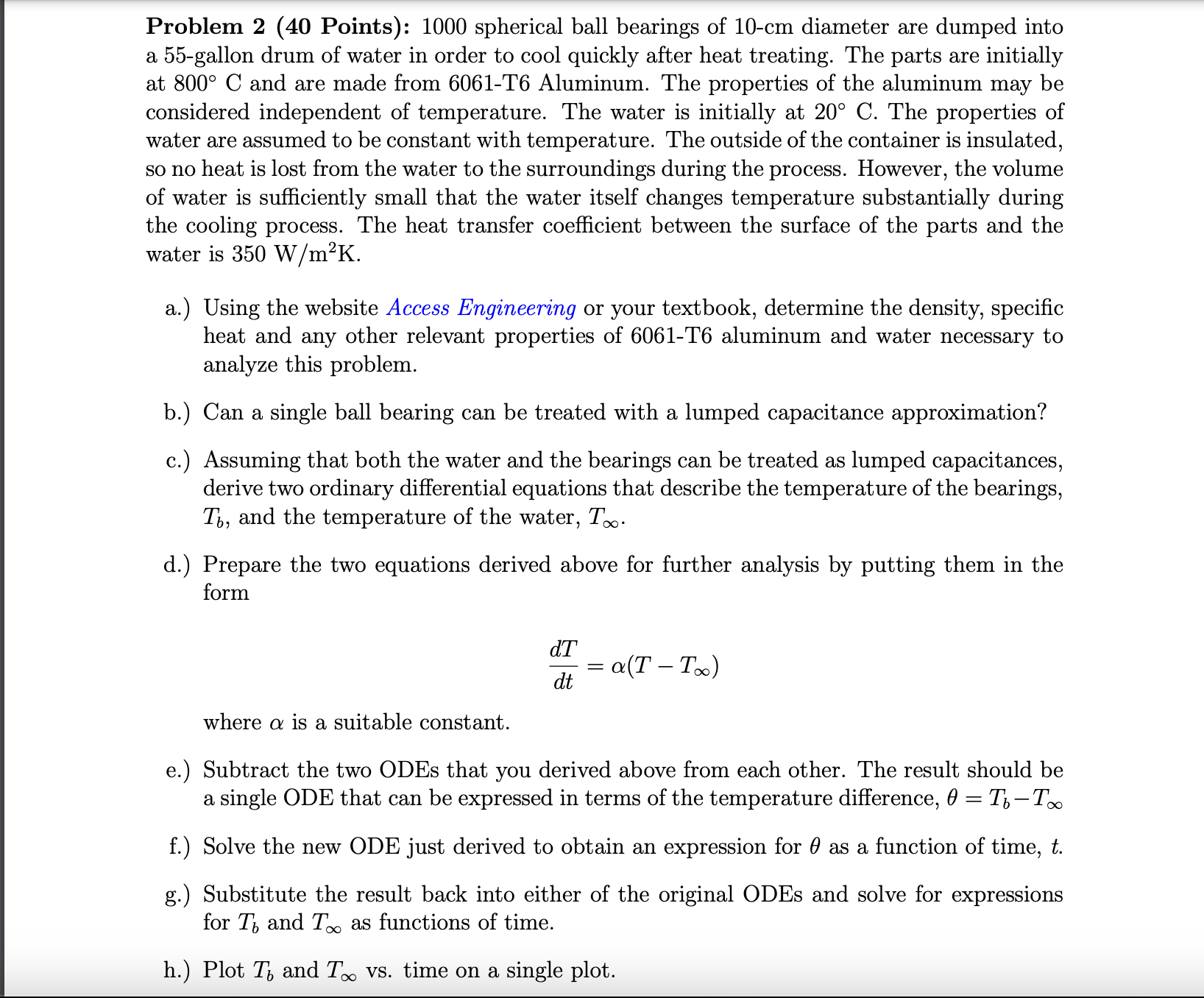
Problem Points: spherical ball bearings of mathrmcm diameter are dumped into a gallon drum of water in order to cool quickly after heat treating. The parts are initially at circmathrmC and are made from T Aluminum. The properties of the aluminum may be considered independent of temperature. The water is initially at circmathrmC The properties of water are assumed to be constant with temperature. The outside of the container is insulated, so no heat is lost from the water to the surroundings during the process. However, the volume of water is sufficiently small that the water itself changes temperature substantially during the cooling process. The heat transfer coefficient between the surface of the parts and the water is mathrm~Wmathrmmmathrm~K
a Using the website Access Engineering or your textbook, determine the density, specific heat and any other relevant properties of T aluminum and water necessary to analyze this problem.
b Can a single ball bearing can be treated with a lumped capacitance approximation?
c Assuming that both the water and the bearings can be treated as lumped capacitances, derive two ordinary differential equations that describe the temperature of the bearings, Tb and the temperature of the water, Tinfty
d Prepare the two equations derived above for further analysis by putting them in the form
fracd Td talphaleftTTinftyright
where alpha is a suitable constant.
e Subtract the two ODEs that you derived above from each other. The result should be a single ODE that can be expressed in terms of the temperature difference, thetaTbTinfty
f Solve the new ODE just derived to obtain an expression for theta as a function of time, t
g Substitute the result back into either of the original ODEs and solve for expressions for Tb and Tinfty as functions of time.
h Plot Tb and Tinfty vs time on a single plot. i Based on your plot, how much time will elapse before a state of equilibrium is reached?
j Prepare a single plot that shows Tb and Tinfty vs time when the number of parts submerged in the same volume of water is increased to and
k What happens to the cooling process as you dump more bearings into the same volume of water? Eg Discuss the physics of what is happening.
Step by Step Solution
There are 3 Steps involved in it
1 Expert Approved Answer
Step: 1 Unlock

Question Has Been Solved by an Expert!
Get step-by-step solutions from verified subject matter experts
Step: 2 Unlock
Step: 3 Unlock
 Study Help