







Question: Problem 2 (4 marks] Consider a two-period model of a closed economy with production, similar to that dis- cussed in class, but with a few
![Problem 2 (4 marks] Consider a two-period model of a closed](https://s3.amazonaws.com/si.experts.images/answers/2024/09/66d7efd96ff16_67266d7efd8f1c58.jpg)
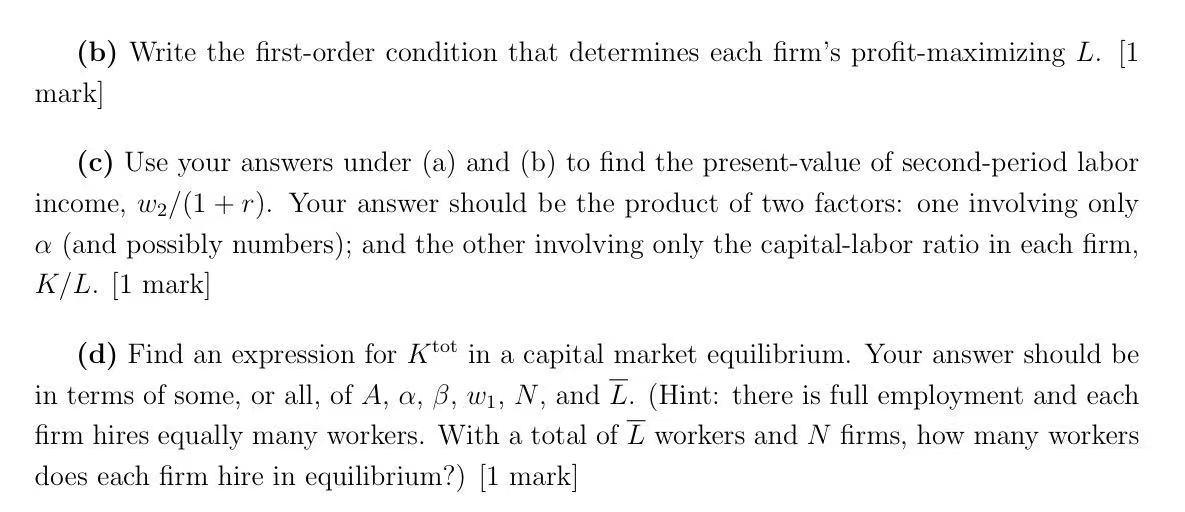
Problem 2 (4 marks] Consider a two-period model of a closed economy with production, similar to that dis- cussed in class, but with a few variations. Instead of one representative agent we let the number or "mass) of agents be L. Similarly, instead of assuming one reprentative firm, we let there be N identical firms. Each of the L agents is also a worker in both periods, earning labor income w, in the first period, and wg in the second. (Note that we vary also this notation slightly compared to class.) Consumption is in the first period, and C, in the second. The budget constraints for each agent can be written C1 = wi-S, and C2 = W2+S(1+r), where S is saving and r the interest rate. Each agent maximizes the utility function U = (1 - 3) In(C) + B ln(C2), where 8 (0,1). This gives optimal saving of each agent as S = Bwi -(1-3) W2 1+ which you do not need to show in this problem. Second-period production by each of the N firms is given by AK"L-a, where K and L denote inputs of capital and labor, respectively, and A > 0 and a (0,1) are exogenous parameters. With the interest rate being r, and the second-period cost of labor being w2, each firm's profit becomes T= AKL-o - (1 + r)K - W2L. The total amount of capital invested by all N firms becomes Klot = NK, and the total amount of saving by all the L agents becomes Stot = LS. In a capital market equilibrium, it holds that Ktot = Stot. (a) Write the first-order condition that determines each firm's profit-maximizing K. (1 mark (b) Write the first-order condition that determines each firm's profit-maximizing L. [1 mark] (c) Use your answers under (a) and (b) to find the present-value of second-period labor income, w2/(1+r). Your answer should be the product of two factors: one involving only a (and possibly numbers); and the other involving only the capital-labor ratio in each firm, K/L. [1 mark] 7 (d) Find an expression for Ktot in a capital market equilibrium. Your answer should be in terms of some, or all, of A, A, B, wi, N, and I. (Hint: there is full employment and each firm hires equally many workers. With a total of I workers and N firms, how many workers does each firm hire in equilibrium?) [1 mark] Problem 2 (4 marks] Consider a two-period model of a closed economy with production, similar to that dis- cussed in class, but with a few variations. Instead of one representative agent we let the number or "mass) of agents be L. Similarly, instead of assuming one reprentative firm, we let there be N identical firms. Each of the L agents is also a worker in both periods, earning labor income w, in the first period, and wg in the second. (Note that we vary also this notation slightly compared to class.) Consumption is in the first period, and C, in the second. The budget constraints for each agent can be written C1 = wi-S, and C2 = W2+S(1+r), where S is saving and r the interest rate. Each agent maximizes the utility function U = (1 - 3) In(C) + B ln(C2), where 8 (0,1). This gives optimal saving of each agent as S = Bwi -(1-3) W2 1+ which you do not need to show in this problem. Second-period production by each of the N firms is given by AK"L-a, where K and L denote inputs of capital and labor, respectively, and A > 0 and a (0,1) are exogenous parameters. With the interest rate being r, and the second-period cost of labor being w2, each firm's profit becomes T= AKL-o - (1 + r)K - W2L. The total amount of capital invested by all N firms becomes Klot = NK, and the total amount of saving by all the L agents becomes Stot = LS. In a capital market equilibrium, it holds that Ktot = Stot. (a) Write the first-order condition that determines each firm's profit-maximizing K. (1 mark (b) Write the first-order condition that determines each firm's profit-maximizing L. [1 mark] (c) Use your answers under (a) and (b) to find the present-value of second-period labor income, w2/(1+r). Your answer should be the product of two factors: one involving only a (and possibly numbers); and the other involving only the capital-labor ratio in each firm, K/L. [1 mark] 7 (d) Find an expression for Ktot in a capital market equilibrium. Your answer should be in terms of some, or all, of A, A, B, wi, N, and I. (Hint: there is full employment and each firm hires equally many workers. With a total of I workers and N firms, how many workers does each firm hire in equilibrium?) [1 mark]
Step by Step Solution
There are 3 Steps involved in it

Get step-by-step solutions from verified subject matter experts
 Study Help