







Question: Problem 2 (40 points) Explain your work. Three blocks with masses mi, m2, and my, are sitting on a horizontally rotating table (note: the setup
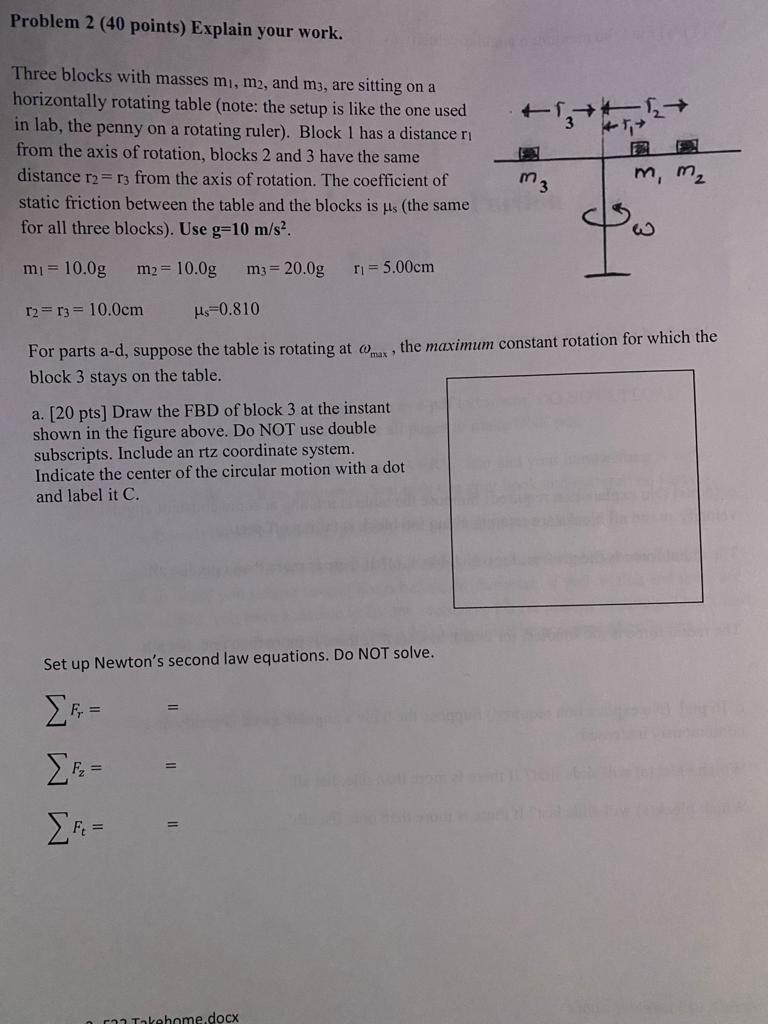
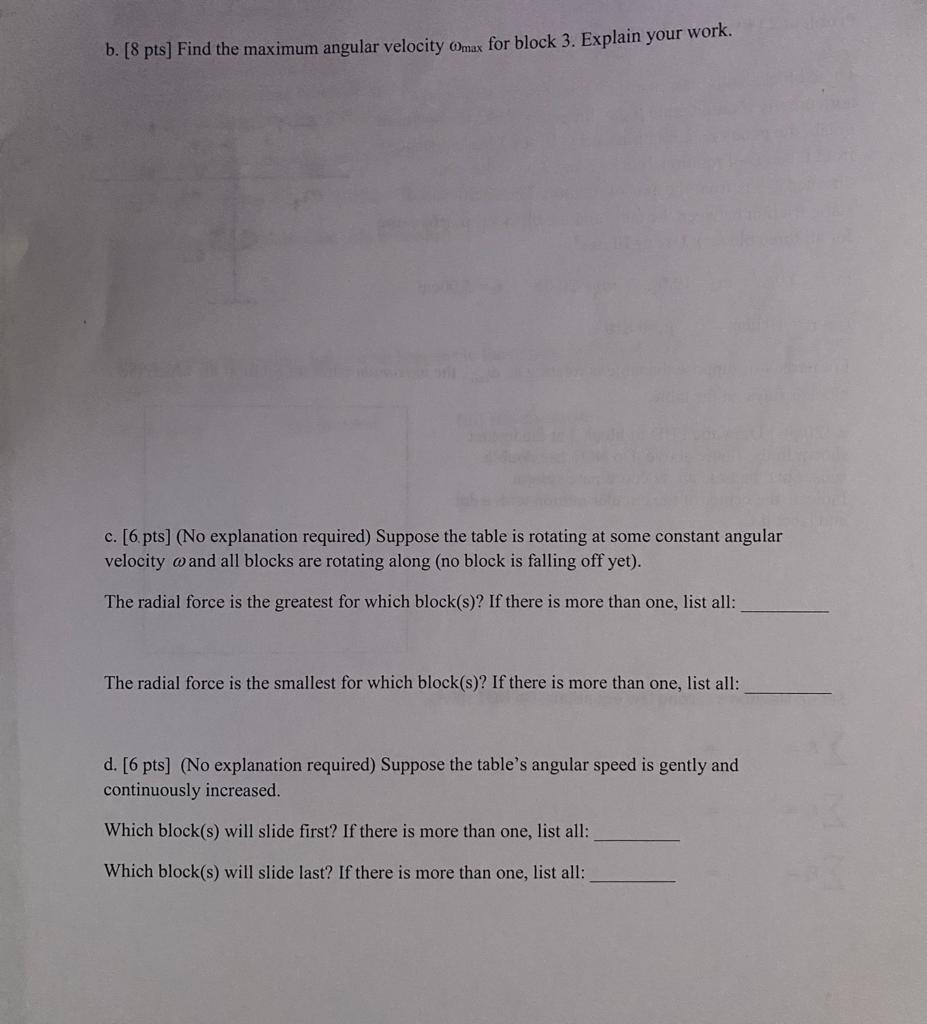
Problem 2 (40 points) Explain your work. Three blocks with masses mi, m2, and my, are sitting on a horizontally rotating table (note: the setup is like the one used in lab, the penny on a rotating ruler). Block I has a distance ri from the axis of rotation, blocks 2 and 3 have the same distance r2 = 13 from the axis of rotation. The coefficient of m 3 m, mz static friction between the table and the blocks is His (the same for all three blocks). Use g=10 m/s mi = 10.0g my= 10.0g m3= 20.0g ri= 5.00cm 12 = 13 = 10.0cm Hs=0.810 For parts a-d, suppose the table is rotating at @ , the maximum constant rotation for which the block 3 stays on the table. a. [20 pts] Draw the FBD of block 3 at the instant shown in the figure above. Do NOT use double subscripts. Include an rtz coordinate system. Indicate the center of the circular motion with a dot and label it C. Set up Newton's second law equations. Do NOT solve. F2 = IF. = docxb. [8 pts] Find the maximum angular velocity @max for block 3. Explain your work. c. [6. pts] (No explanation required) Suppose the table is rotating at some constant angular velocity @ and all blocks are rotating along (no block is falling off yet). The radial force is the greatest for which block(s)? If there is more than one, list all: The radial force is the smallest for which block(s)? If there is more than one, list all: d. [6 pts] (No explanation required) Suppose the table's angular speed is gently and continuously increased. Which block(s) will slide first? If there is more than one, list all: Which block(s) will slide last? If there is more than one, list all
Step by Step Solution
There are 3 Steps involved in it

Get step-by-step solutions from verified subject matter experts
 Study Help