Question: Problem #2 (48 points; 8 points each) A dietician in the Ohio State University Hospital developed a formulation of supplemental healthy breakfast that may greatly
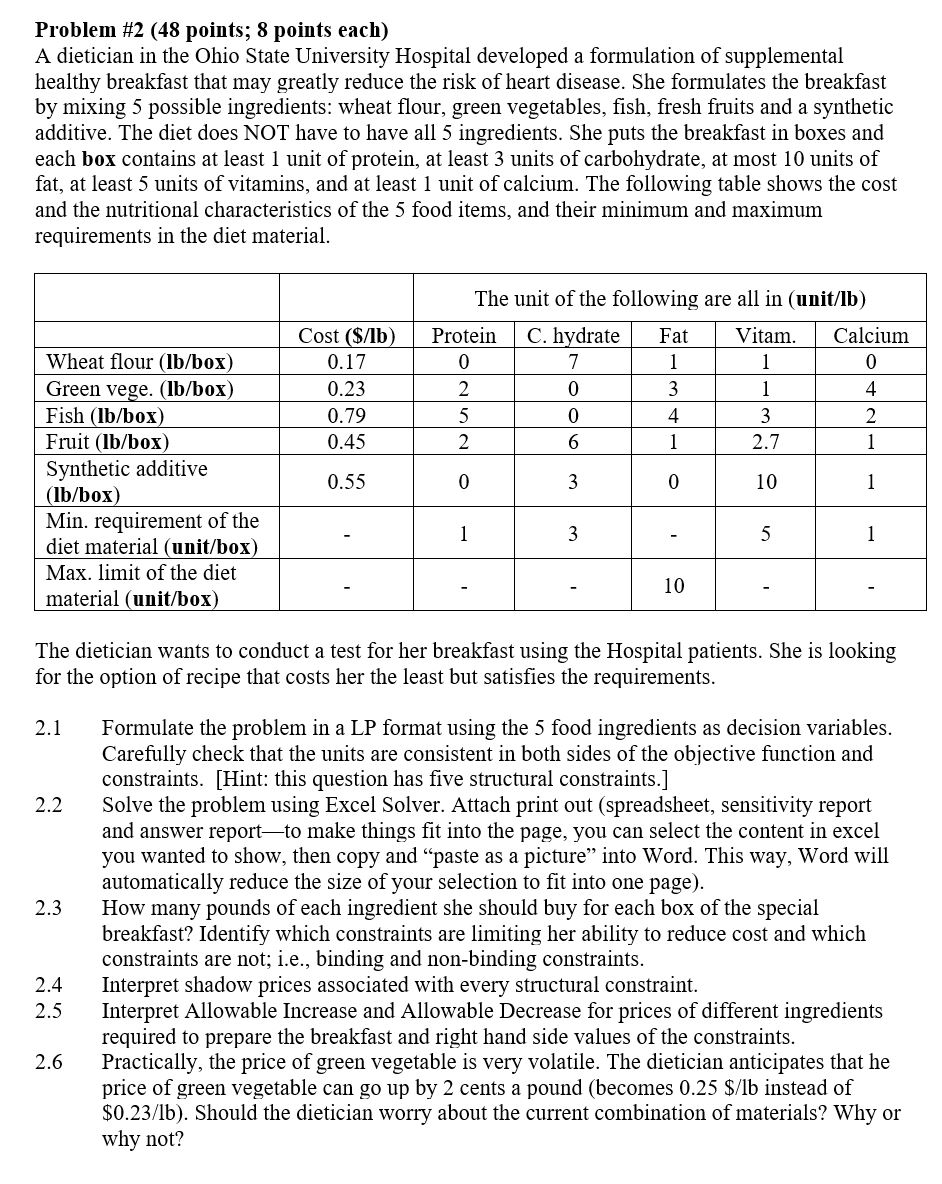
Problem #2 (48 points; 8 points each) A dietician in the Ohio State University Hospital developed a formulation of supplemental healthy breakfast that may greatly reduce the risk of heart disease. She formulates the breakfast by mixing 5 possible ingredients: wheat flour, green vegetables, fish, fresh fruits and a synthetic additive. The diet does NOT have to have all 5 ingredients. She puts the breakfast in boxes and each box contains at least 1 unit of protein, at least 3 units of carbohydrate, at most 10 units of fat, at least 5 units of vitamins, and at least 1 unit of calcium. The following table shows the cost and the nutritional characteristics of the 5 food items, and their minimum and maximum requirements in the diet material. The unit of the following are all in (unit/lb) Protein C. hydrate Fat Vitam. Calcium Cost ($/lb) 0.17 0.23 0.79 0.45 - 4 5 1 0 4 2 2 L 2.7 Wheat flour (lb/box) Green vege. (lb/box) Fish (lb/box Fruit (lb/box) Synthetic additive (lb/box) Min. requirement of the diet material (unit/box) Max. limit of the diet material (unit/box) 0.55 10 The dietician wants to conduct a test for her breakfast using the Hospital patients. She is looking for the option of recipe that costs her the least but satisfies the requirements. 2.1 2.2 2.3 Formulate the problem in a LP format using the 5 food ingredients as decision variables. Carefully check that the units are consistent in both sides of the objective function and constraints. [Hint: this question has five structural constraints.] Solve the problem using Excel Solver. Attach print out (spreadsheet, sensitivity report and answer reportto make things fit into the page, you can select the content in excel you wanted to show, then copy and paste as a picture" into Word. This way, Word will automatically reduce the size of your selection to fit into one page). How many pounds of each ingredient she should buy for each box of the special breakfast? Identify which constraints are limiting her ability to reduce cost and which constraints are not; i.e., binding and non-binding constraints. Interpret shadow prices associated with every structural constraint. Interpret Allowable Increase and Allowable Decrease for prices of different ingredients required to prepare the breakfast and right hand side values of the constraints. Practically, the price of green vegetable is very volatile. The dietician anticipates that he price of green vegetable can go up by 2 cents a pound (becomes 0.25 $/lb instead of $0.23/lb). Should the dietician worry about the current combination of materials? Why or why not? 2.4 2.5 2.6 Problem #2 (48 points; 8 points each) A dietician in the Ohio State University Hospital developed a formulation of supplemental healthy breakfast that may greatly reduce the risk of heart disease. She formulates the breakfast by mixing 5 possible ingredients: wheat flour, green vegetables, fish, fresh fruits and a synthetic additive. The diet does NOT have to have all 5 ingredients. She puts the breakfast in boxes and each box contains at least 1 unit of protein, at least 3 units of carbohydrate, at most 10 units of fat, at least 5 units of vitamins, and at least 1 unit of calcium. The following table shows the cost and the nutritional characteristics of the 5 food items, and their minimum and maximum requirements in the diet material. The unit of the following are all in (unit/lb) Protein C. hydrate Fat Vitam. Calcium Cost ($/lb) 0.17 0.23 0.79 0.45 - 4 5 1 0 4 2 2 L 2.7 Wheat flour (lb/box) Green vege. (lb/box) Fish (lb/box Fruit (lb/box) Synthetic additive (lb/box) Min. requirement of the diet material (unit/box) Max. limit of the diet material (unit/box) 0.55 10 The dietician wants to conduct a test for her breakfast using the Hospital patients. She is looking for the option of recipe that costs her the least but satisfies the requirements. 2.1 2.2 2.3 Formulate the problem in a LP format using the 5 food ingredients as decision variables. Carefully check that the units are consistent in both sides of the objective function and constraints. [Hint: this question has five structural constraints.] Solve the problem using Excel Solver. Attach print out (spreadsheet, sensitivity report and answer reportto make things fit into the page, you can select the content in excel you wanted to show, then copy and paste as a picture" into Word. This way, Word will automatically reduce the size of your selection to fit into one page). How many pounds of each ingredient she should buy for each box of the special breakfast? Identify which constraints are limiting her ability to reduce cost and which constraints are not; i.e., binding and non-binding constraints. Interpret shadow prices associated with every structural constraint. Interpret Allowable Increase and Allowable Decrease for prices of different ingredients required to prepare the breakfast and right hand side values of the constraints. Practically, the price of green vegetable is very volatile. The dietician anticipates that he price of green vegetable can go up by 2 cents a pound (becomes 0.25 $/lb instead of $0.23/lb). Should the dietician worry about the current combination of materials? Why or why not? 2.4 2.5 2.6









 Study Help