



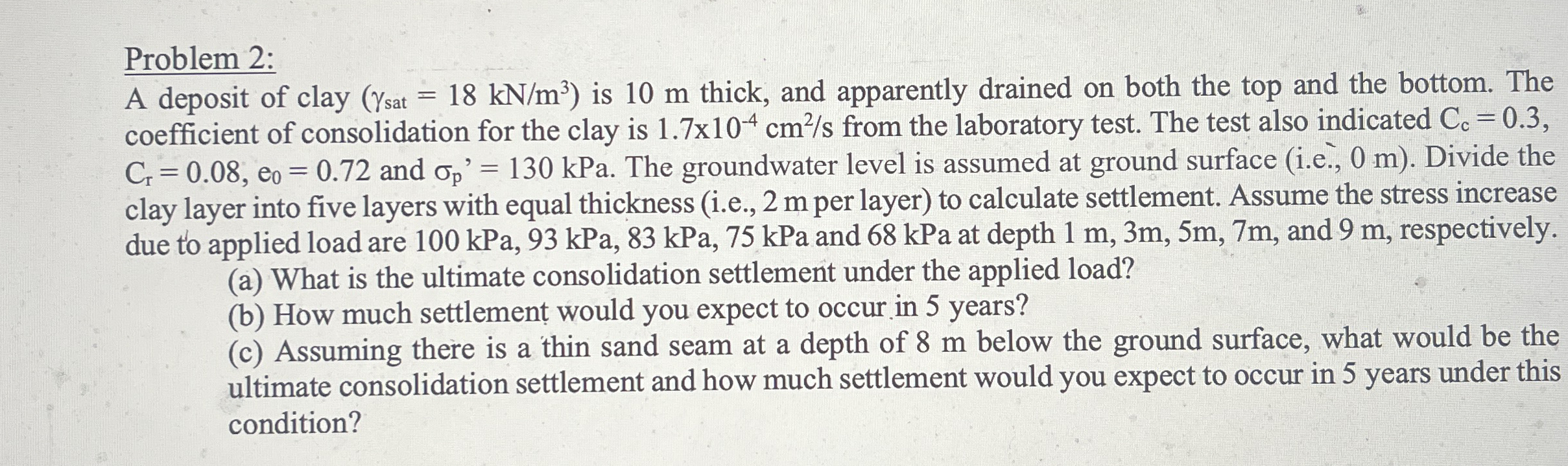
Question: Problem 2 : A deposit of clay ) = ( 1 8 k N m 3 is 1 0 m thick, and apparently drained on
Problem :
A deposit of clay is m thick, and apparently drained on both the top and the bottom. The coefficient of consolidation for the clay is from the laboratory test. The test also indicated and kPa. The groundwater level is assumed at ground surface ie m Divide the clay layer into five layers with equal thickness ie m per layer to calculate settlement. Assume the stress increase due to applied load are kPa,kPa,kPa,kPa and kPa at depth and m respectively.
a What is the ultimate consolidation settlement under the applied load?
b How much settlement would you expect to occur in years?
c Assuming there is a thin sand seam at a depth of m below the ground surface, what would be the ultimate consolidation settlement and how much settlement would you expect to occur in years under this condition?
Step by Step Solution
There are 3 Steps involved in it
1 Expert Approved Answer
Step: 1 Unlock

Question Has Been Solved by an Expert!
Get step-by-step solutions from verified subject matter experts
Step: 2 Unlock
Step: 3 Unlock