







Question: Problem 2: a toy model for an ideal gas. Consider a system that has L sites and N indistinguishable particles. Any amount of particles can
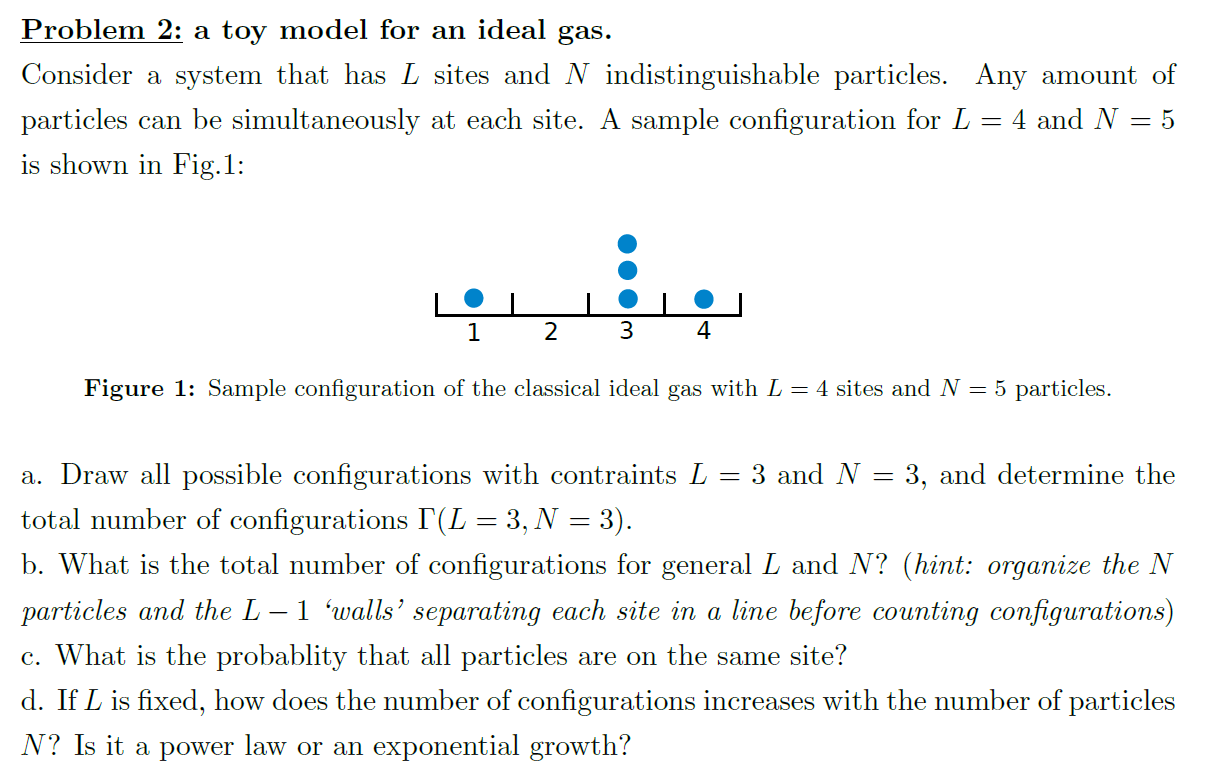
Problem 2: a toy model for an ideal gas. Consider a system that has L sites and N indistinguishable particles. Any amount of particles can be simultaneously at each site. A sample configuration for L = 4 and N = 5 is shown in Fig. 1: 1 2 3 4 Figure 1: Sample configuration of the classical ideal gas with L = 4 sites and N = 5 particles. a. Draw all possible configurations with contraints L = 3 and N = 3, and determine the total number of configurations T(L = 3, N = 3). b. What is the total number of configurations for general L and N? (hint: organize the N particles and the L -1 'walls' separating each site in a line before counting configurations) c. What is the probablety that all particles are on the same site? d. If L is fixed, how does the number of configurations increases with the number of particles N? Is it a power law or an exponential growth
Step by Step Solution
There are 3 Steps involved in it

Get step-by-step solutions from verified subject matter experts
 Study Help