







Question: Problem 2 : altitudes ( ( mathbf { 2 0 } mathbf { ~ p t s } ) ) .
Problem : altitudes mathbfmathbf~ p t s Look up the radius of the earth and answer the following questions.
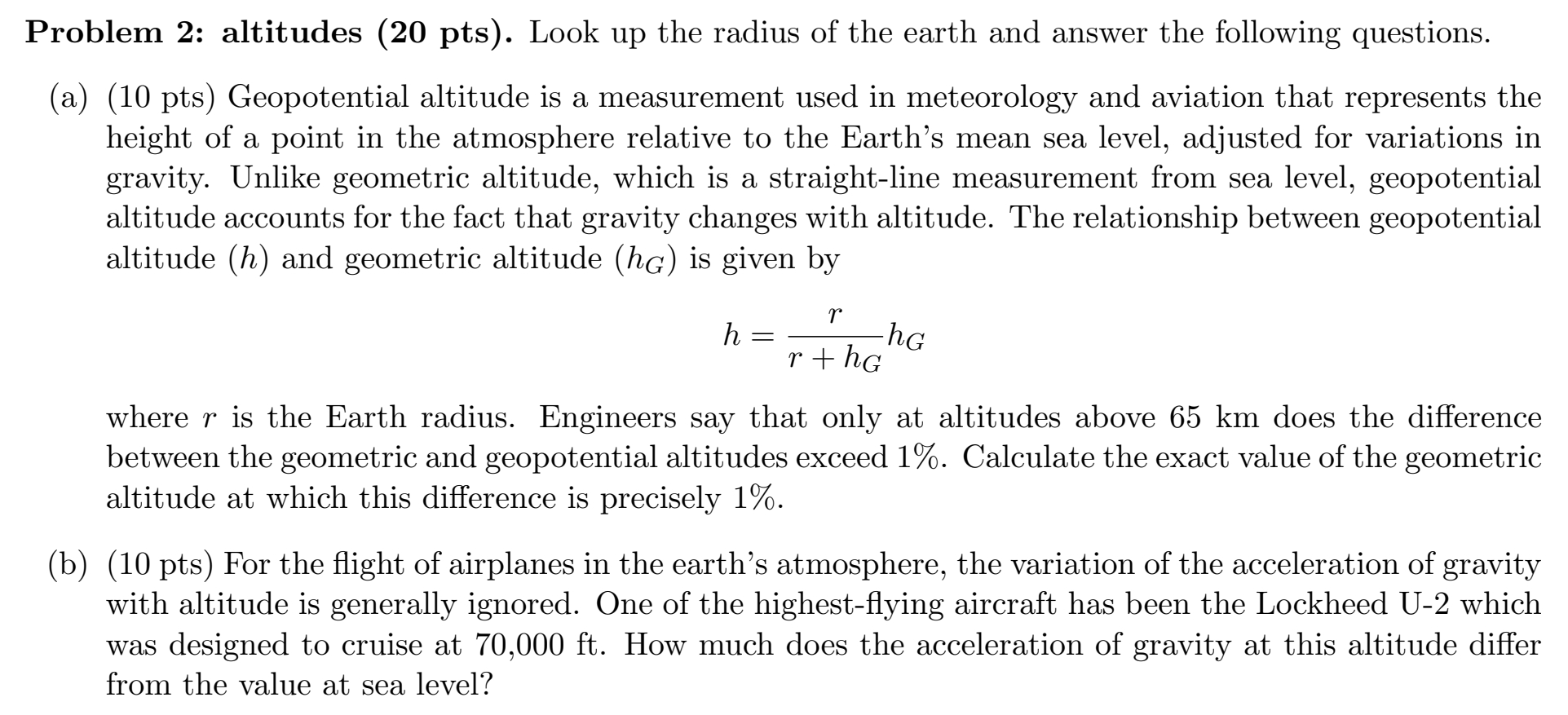
a pts Geopotential altitude is a measurement used in meteorology and aviation that represents the height of a point in the atmosphere relative to the Earth's mean sea level, adjusted for variations in gravity. Unlike geometric altitude, which is a straightline measurement from sea level, geopotential altitude accounts for the fact that gravity changes with altitude. The relationship between geopotential altitude h and geometric altitude lefthGright is given by
hfracrrhG hG
where r is the Earth radius. Engineers say that only at altitudes above km does the difference between the geometric and geopotential altitudes exceed Calculate the exact value of the geometric altitude at which this difference is precisely
b pts For the flight of airplanes in the earth's atmosphere, the variation of the acceleration of gravity with altitude is generally ignored. One of the highestflying aircraft has been the Lockheed U which was designed to cruise at mathrmft How much does the acceleration of gravity at this altitude differ from the value at sea level?
Step by Step Solution
There are 3 Steps involved in it
1 Expert Approved Answer
Step: 1 Unlock

Question Has Been Solved by an Expert!
Get step-by-step solutions from verified subject matter experts
Step: 2 Unlock
Step: 3 Unlock
 Study Help