







Question: Problem 2 [Centrifuging samples] A lab technician is centrifuging a blood sample at a rotation rate of 3 x 1i}:| rpm {revolutions per minute}. 111e
![Problem 2 [Centrifuging samples] A lab technician is centrifuging a blood](https://dsd5zvtm8ll6.cloudfront.net/si.experts.images/questions/2024/09/66f83c10ea335_33666f83c10ccecc.jpg)

![in a carnival ride] Passengers in a carnival ride move at constant](https://dsd5zvtm8ll6.cloudfront.net/si.experts.images/questions/2024/09/66f83c13180fe_33866f83c12df330.jpg)
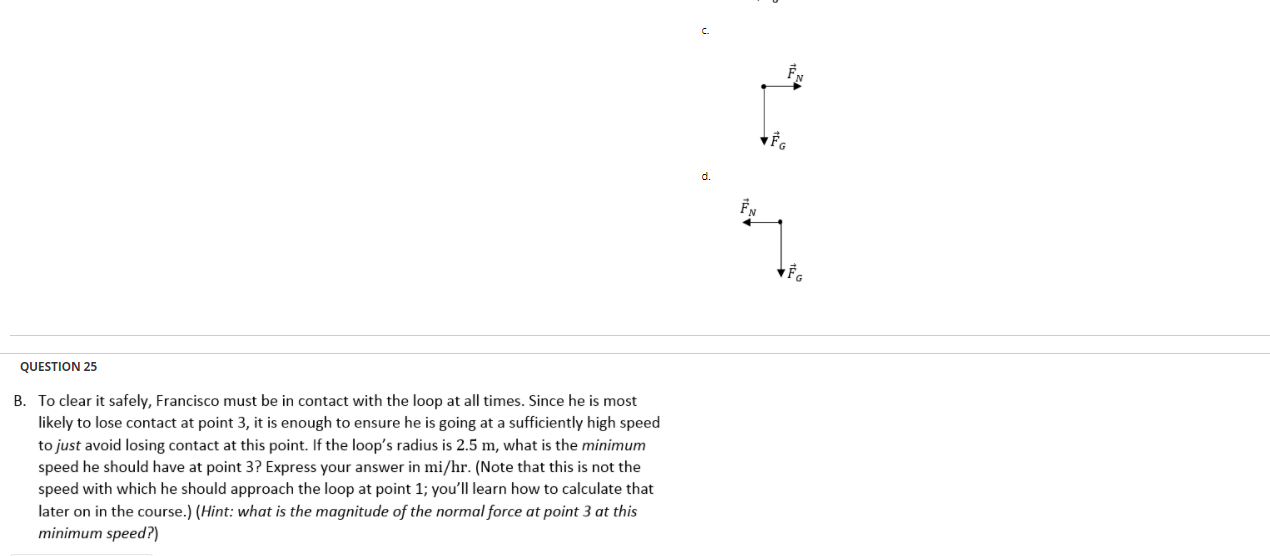
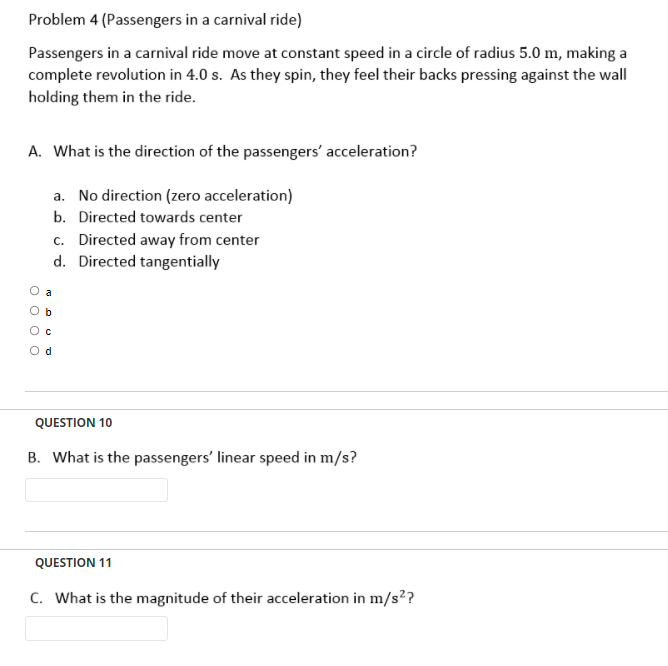
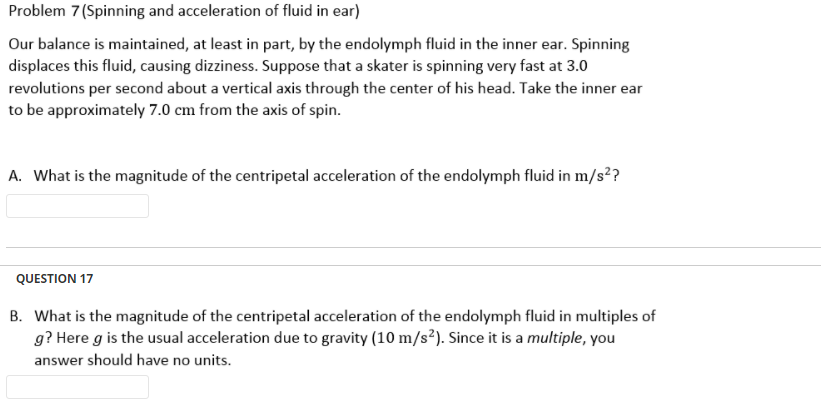
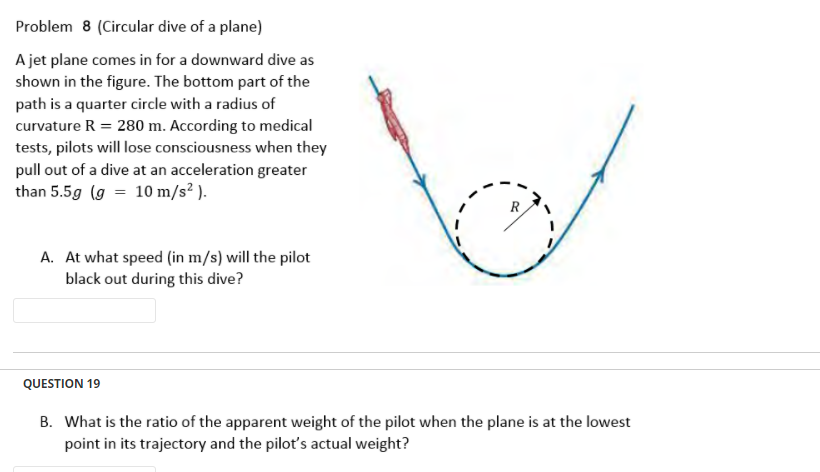
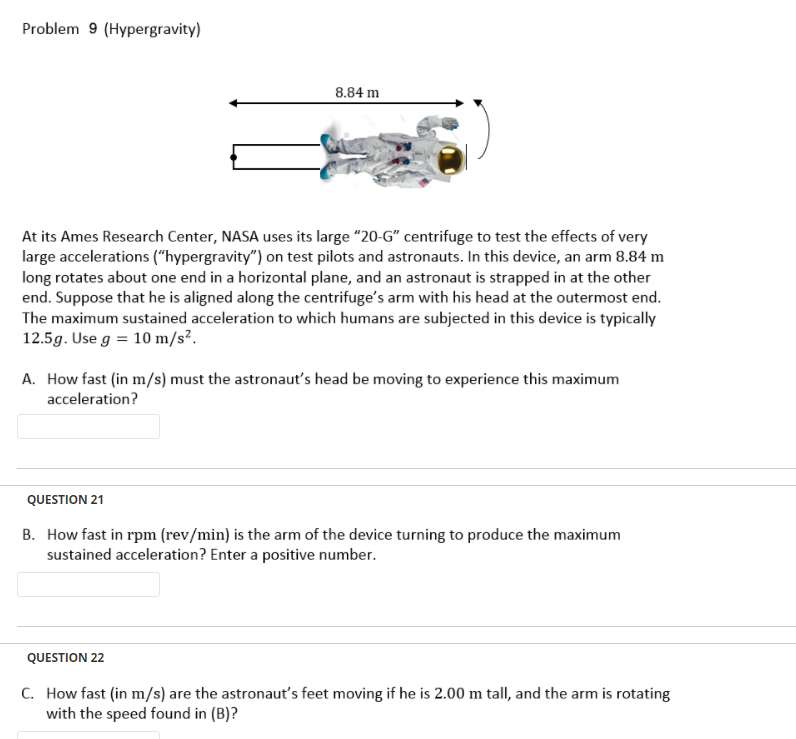
Problem 2 [Centrifuging samples] A lab technician is centrifuging a blood sample at a rotation rate of 3 x 1i}:| rpm {revolutions per minute}. 111e radius ofthe circular path followed by the sample is 0.15 m. A. Determine the linear speed of a blood cell in the sample. Give your answer in mls. QUESTION 5 B. What is the magnitude if the centripetal acceleration on the blood cell? Problem 4 {Passengers in a carnival ride] Passengers in a carnival ride move at constant speed in a circle of radius 5.0 In, making a complete revolution in 4.0 s. As they spin, they feel their backs pressing against the wall holding them in the ride. A. What is the direction of the passengers' acceleration? a No direction {zero acceleration) b. Directed towards oenter c Directed away from center cl Directed tangentially QUESTION 10 B. What is the passengers' linear speed in mls? QUESTION 11 C. What is the magnitude of their acceleration in 111/52? Problem 7 (Spinning and acceleration of fluid in ear) Our balance is maintained, at least in part, by the endolymph fluid in the inner ear. Spinning displaces this fluid, causing dizziness. Suppose that a skater is spinning very fast at 3.0 revolutions per second about a vertical axis through the center of his head. Take the inner ear to be approximately 7.0 cm from the axis of spin. A. What is the magnitude of the centripetal acceleration of the endolymph fluid in m/s?? QUESTION 17 B. What is the magnitude of the centripetal acceleration of the endolymph fluid in multiples of g? Here g is the usual acceleration due to gravity (10 m/s ). Since it is a multiple, you answer should have no units.Problem 8 {Circular dive of a plane] Ajet plane comes in for a downward dive as shown in the figure. The bottom part of the path is a quarter circle with a radius of curvature R = 280 In. According to medical tests, pilots will lose consciousness when they pull out of a dive at an acceleration greater than 5.53 (g = 10 mfs2 i. A. At what speed [in Ink} will the pilot black out during this dive? QUESTION 19 B. What is the ratio of the apparent weight of the pilot when the plane is at the lowest point in its trajectory and the pilot's actual weight? Problem 9 (Hypergravity) 8.84 m At its Ames Research Center, NASA uses its large "20-G" centrifuge to test the effects of very large accelerations ("hypergravity") on test pilots and astronauts. In this device, an arm 8.84 m long rotates about one end in a horizontal plane, and an astronaut is strapped in at the other end. Suppose that he is aligned along the centrifuge's arm with his head at the outermost end. The maximum sustained acceleration to which humans are subjected in this device is typically 12.5g. Use g = 10 m/s. A. How fast (in m/s) must the astronaut's head be moving to experience this maximum acceleration? QUESTION 21 B. How fast in rpm (rev/min) is the arm of the device turning to produce the maximum sustained acceleration? Enter a positive number. QUESTION 22 C. How fast (in m/s) are the astronaut's feet moving if he is 2.00 m tall, and the arm is rotating with the speed found in (B)?QUESTION 23 D. What is the difference between the centripetal acceleration of his head and feet? Express your answer in \"1'52 and enter a positiVE number. Fearless Stuntman Francisco wants to clear a \"vertical loop\" on his bicycle. The figure shows the scenario where he clears the loop safer ; that is, without losing contact with it at am]:I time. Treat the Francisco + bike system as a point mass in direct contact with the loop's surface and assume he stops pedaling before entering the loop. Ignore friction and other dissipative forces and useg = 10 m/sz. A. The following are free-body diagrams of the forces acting on Francisco at points 1-4 along the loop. Match each diagram to the correct point. (C(( bulMx C. d TJ4 QUESTION 25 B. To clear it safely, Francisco must be in contact with the loop at all times. Since he is most likely to lose contact at point 3, it is enough to ensure he is going at a sufficiently high speed to just avoid losing contact at this point. If the loop's radius is 2.5 m, what is the minimum speed he should have at point 3? Express your answer in mi/hr. (Note that this is not the speed with which he should approach the loop at point 1; you'll learn how to calculate that later on in the course.) (Hint: what is the magnitude of the normal force at point 3 at this minimum speed?)
Step by Step Solution
There are 3 Steps involved in it

Get step-by-step solutions from verified subject matter experts
 Study Help