







Question: Problem 2 : Conditional probabilities, total probability theorem, efficient markets? The dudes at NFQ Ltd . ( No Finance Quacks ) know that investors care
Problem : Conditional probabilities, total probability theorem, efficient markets?
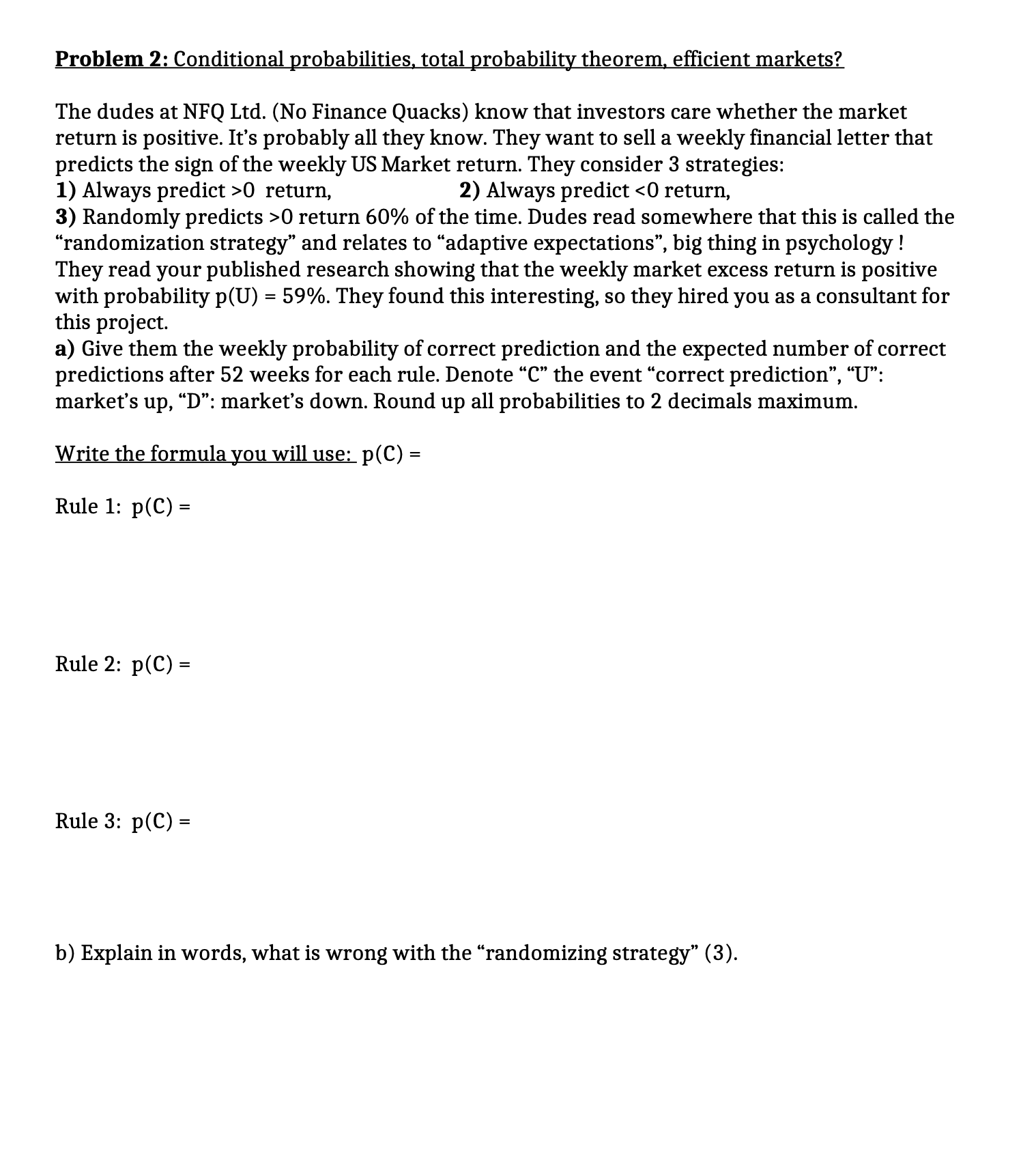
The dudes at NFQ LtdNo Finance Quacks know that investors care whether the market
return is positive. It's probably all they know. They want to sell a weekly financial letter that
predicts the sign of the weekly US Market return. They consider strategies:
Always predict return,
Always predict return,
Randomly predicts return of the time. Dudes read somewhere that this is called the
"randomization strategy" and relates to "adaptive expectations", big thing in psychology
They read your published research showing that the weekly market excess return is positive
with probability They found this interesting, so they hired you as a consultant for
this project.
a Give them the weekly probability of correct prediction and the expected number of correct
predictions after weeks for each rule. Denote C the event "correct prediction", U:
market's upD: market's down. Round up all probabilities to decimals maximum.
Write the formula you will use:
Rule :
Rule :
Rule :
b Explain in words, what is wrong with the "randomizing strategy" c NFQ is getting serious; they want to do conditional prediction. The rules in question a
were unconditional rules. They ask you to investigate conditional rules, maybe markets are not
efficient! Even though you already know the answer, you will be able to charge them for some
data analysis. You hop on the Data web site and download the US stock market excess
return over the risk free rate from the weekly factor file, the one named RmRf You use the
data from Jan to July included.
You first give them the three classic versionts of the the usual twoway table:
simple counts
joint probabilities
conditional probabilities.
T: Counts Table
Probability Table in
T: Joint
T: Conditional Probability Table
Make sure you can compute these probabilities cold. Write the formulas and results below
d Use your results to compute the unconditional probability of success of the conditional
rule predicting a positive negative return follows a positive negative return
e Given your data, can a conditional rule improve on unconditional rules?
f Given these results, how efficient do you think the US market is
g Wait wait! explain to the dudes why you used excess return on Rf not just the total return.
Step by Step Solution
There are 3 Steps involved in it
1 Expert Approved Answer
Step: 1 Unlock

Question Has Been Solved by an Expert!
Get step-by-step solutions from verified subject matter experts
Step: 2 Unlock
Step: 3 Unlock
 Study Help