







Question: Consider a monopolist selling sweets to two types of consumers (assume sweets are infinitely divisible, so that the monopolist can sell any nonnegative quantity).
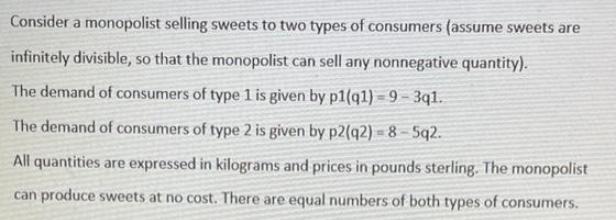

Consider a monopolist selling sweets to two types of consumers (assume sweets are infinitely divisible, so that the monopolist can sell any nonnegative quantity). The demand of consumers of type 1 is given by p1(q1)-9-3q1. The demand of consumers of type 2 is given by p2(q2)=8-5q2. All quantities are expressed in kilograms and prices in pounds sterling. The monopolist can produce sweets at no cost. There are equal numbers of both types of consumers. For this part, suppose the monopolist still cannot distinguish the consumers, and is still allowed to offer fixed packages. Instead of there being equal numbers of both types, there are now 75 consumers of type 1 and 100 consumers of type 2. What are the optimal quantities now? You do not need to compute the fees or the profits.
Step by Step Solution
3.43 Rating (153 Votes )
There are 3 Steps involved in it
step 1 Explanation opti... View full answer

Get step-by-step solutions from verified subject matter experts
 Study Help