







Question: Problem 2. Consider a state space where the start state is the integer 1 and each state k has two successors: the numbers 2k and
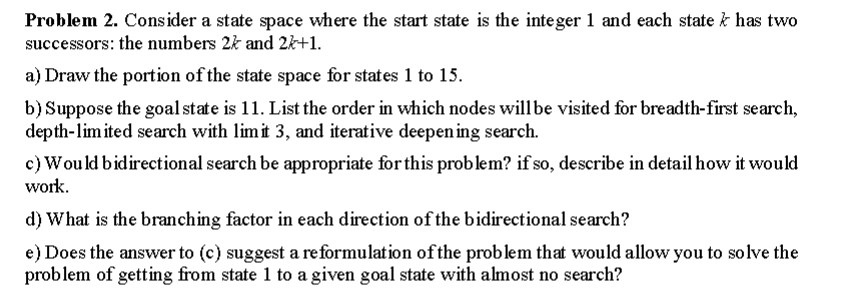
Problem 2. Consider a state space where the start state is the integer 1 and each state k has two successors: the numbers 2k and 2k+1. a) Draw the portion of the state space for states 1 to 15. b) Suppose the goal state is 11. List the order in which nodes willbe visited for breadth-first search, depth-limited search with limit 3, and iterative deepen ing search. c) Would bidirectional search be appropriate for this problem? if so, describe in detail how it would work. d) What is the branching factor in each direction of the bidirectional search? e) Does the answer to (c) suggest a reformulation of the problem that would allow you to solve the problem of getting from state 1 to a given goal state with almost no search? Problem 2. Consider a state space where the start state is the integer 1 and each state k has two successors: the numbers 2k and 2k+1. a) Draw the portion of the state space for states 1 to 15. b) Suppose the goal state is 11. List the order in which nodes willbe visited for breadth-first search, depth-limited search with limit 3, and iterative deepen ing search. c) Would bidirectional search be appropriate for this problem? if so, describe in detail how it would work. d) What is the branching factor in each direction of the bidirectional search? e) Does the answer to (c) suggest a reformulation of the problem that would allow you to solve the problem of getting from state 1 to a given goal state with almost no search
Step by Step Solution
There are 3 Steps involved in it

Get step-by-step solutions from verified subject matter experts
 Study Help