


Question: Problem 2 Consider an economy in which there are two dates t = 0 and t = 1, and two possible states, i = 1
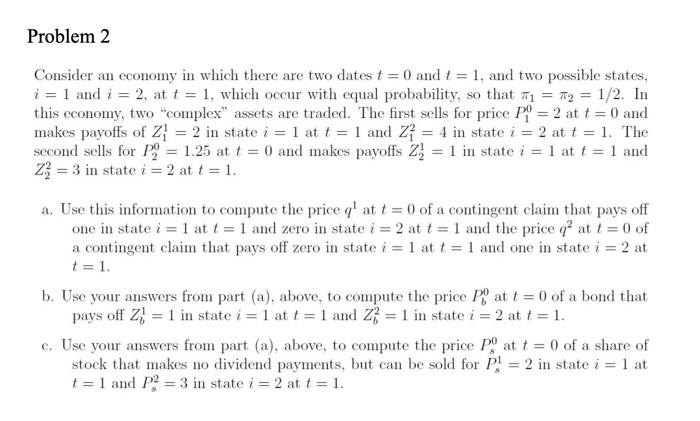
Problem 2 Consider an economy in which there are two dates t = 0 and t = 1, and two possible states, i = 1 and i = 2, at t = 1, which occur with equal probability, so that = 7 = 1/2. In this economy, two "complex" assets are traded. The first sells for price P = 2 at t = 0 and makes payoffs of Z = 2 in state i = 1 at t = 1 and Z2 = 4 in state i = 2 at t = 1. The second sells for P = 1.25 at t = 0 and makes payoffs Z = 1 in state i = 1 at t = 1 and Z2 = 3 in state i = 2 at t = 1. - a. Use this information to compute the price q at t = 0 of a contingent claim that pays off one in state i = 1 at t = 1 and zero in state i = 2 at t = 1 and the price q at t = 0 of a contingent claim that pays off zero in state i = 1 at t = 1 and one in state i = 2 at t = 1. b. Use your answers from part (a), above, to compute the price Pat t = 0 of a bond that pays off Z=1 in state i = 1 at t = 1 and Z2 = 1 in state i 2 at t = 1. c. Use your answers from part (a), above, to compute the price Po at t = 0 of a share of stock that makes no dividend payments, but can be sold for P = 2 in state i = 1 at t = 1 and P = 3 in state i = 2 at t = 1.
 Problem 2 Consider an economy in which there are two dates

Consider an economy in which there are two dates t=0 and t=1, and two possible states, i=1 and i=2, at t=1, which occur with equal probability, so that 1=2=1/2. In this economy, two "complex" assets are traded. The first sells for price P10=2 at t=0 and makes payoffs of Z11=2 in state i=1 at t=1 and Z12=4 in state i=2 at t=1. The second sells for P20=1.25 at t=0 and makes payoffs Z21=1 in state i=1 at t=1 and Z22=3 in state i=2 at t=1. a. Use this information to compute the price q1 at t=0 of a contingent claim that pays off one in state i=1 at t=1 and zero in state i=2 at t=1 and the price q2 at t=0 of a contingent claim that pays off zero in state i=1 at t=1 and one in state i=2 at t=1. b. Use your answers from part (a), above, to compute the price Pb0 at t=0 of a bond that pays off Zb1=1 in state i=1 at t=1 and Zb2=1 in state i=2 at t=1. c. Use your answers from part (a), above, to compute the price Ps0 at t=0 of a share of stock that makes no dividend payments, but can be sold for Ps1=2 in state i=1 at t=1 and Ps2=3 in state i=2 at t=1

Step by Step Solution

There are 3 Steps involved in it

1 Expert Approved Answer
Step: 1 Unlock blur-text-image
Question Has Been Solved by an Expert!

Get step-by-step solutions from verified subject matter experts

Step: 2 Unlock
Step: 3 Unlock

Students Have Also Explored These Related Finance Questions!