







Question: Problem 2 Consider the following simultaneous move game G: a az B 10,10 6,0 12,0 B2 0,6 1,5 -1,-1 B3 0,12 -1,-1 5,1 (a) What

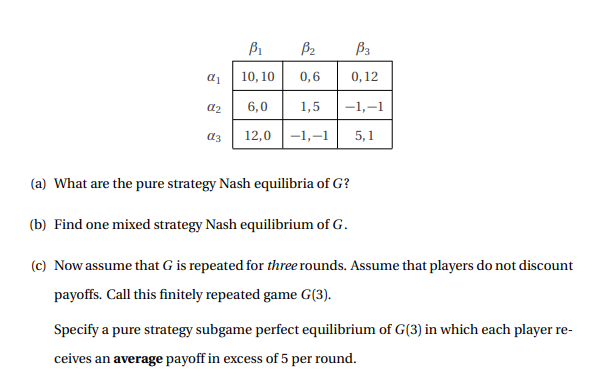
Problem 2 Consider the following simultaneous move game G: a az B 10,10 6,0 12,0 B2 0,6 1,5 -1,-1 B3 0,12 -1,-1 5,1 (a) What are the pure strategy Nash equilibria of G? (b) Find one mixed strategy Nash equilibrium of G. (c) Now assume that G is repeated for three rounds. Assume that players do not discount payoffs. Call this finitely repeated game G(3). Specify a pure strategy subgame perfect equilibrium of G(3) in which each player re- ceives an average payoff in excess of 5 per round. Problem 2 Consider the following simultaneous move game G: a az B 10,10 6,0 12,0 B2 0,6 1,5 -1,-1 B3 0,12 -1,-1 5,1 (a) What are the pure strategy Nash equilibria of G? (b) Find one mixed strategy Nash equilibrium of G. (c) Now assume that G is repeated for three rounds. Assume that players do not discount payoffs. Call this finitely repeated game G(3). Specify a pure strategy subgame perfect equilibrium of G(3) in which each player re- ceives an average payoff in excess of 5 per round
Step by Step Solution
There are 3 Steps involved in it

Get step-by-step solutions from verified subject matter experts
 Study Help