







Question: Problem 2 Consider the network shown in Figure 2. Suppose that the network uses a synchronous version of DV algorithm, where in each iteration, each
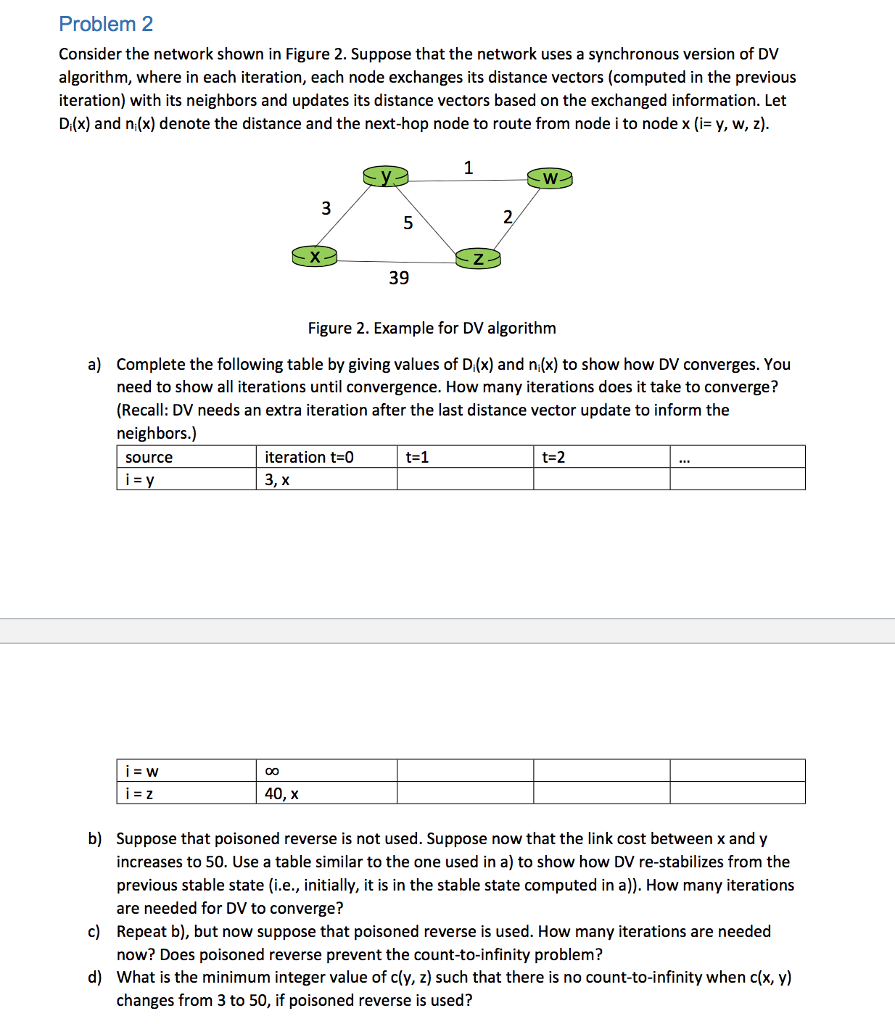
Problem 2 Consider the network shown in Figure 2. Suppose that the network uses a synchronous version of DV algorithm, where in each iteration, each node exchanges its distance vectors (computed in the previous iteration) with its neighbors and updates its distance vectors based on the exchanged information. Let D(x) and n(x) denote the distance and the next-hop node to route from node i to node x (i= y, w, z) 39 Figure 2. Example for DV algorithm a) Complete the following table by giving values of D(x) and n(x) to show how DV converges. You need to show all iterations until convergence. How many iterations does it take to converge? (Recall: DV needs an extra iteration after the last distance vector update to inform the neighbors.) source iteration t-0 t-1 t-2 40, x b) Suppose that poisoned reverse is not used. Suppose now that the link cost between x and y increases to 50. Use a table similar to the one used in a) to show how DV re-stabilizes from the previous stable state (i.e., initially, it is in the stable state computed in a). How many iterations are needed for DV to converge? c) Repeat b), but now suppose that poisoned reverse is used. How many iterations are needed now? Does poisoned reverse prevent the count-to-infinity problem? What is the minimum integer value of c(y, z) such that there is no count-to-infinity when c(x, y) changes from 3 to 50, if poisoned reverse is used d) Problem 2 Consider the network shown in Figure 2. Suppose that the network uses a synchronous version of DV algorithm, where in each iteration, each node exchanges its distance vectors (computed in the previous iteration) with its neighbors and updates its distance vectors based on the exchanged information. Let D(x) and n(x) denote the distance and the next-hop node to route from node i to node x (i= y, w, z) 39 Figure 2. Example for DV algorithm a) Complete the following table by giving values of D(x) and n(x) to show how DV converges. You need to show all iterations until convergence. How many iterations does it take to converge? (Recall: DV needs an extra iteration after the last distance vector update to inform the neighbors.) source iteration t-0 t-1 t-2 40, x b) Suppose that poisoned reverse is not used. Suppose now that the link cost between x and y increases to 50. Use a table similar to the one used in a) to show how DV re-stabilizes from the previous stable state (i.e., initially, it is in the stable state computed in a). How many iterations are needed for DV to converge? c) Repeat b), but now suppose that poisoned reverse is used. How many iterations are needed now? Does poisoned reverse prevent the count-to-infinity problem? What is the minimum integer value of c(y, z) such that there is no count-to-infinity when c(x, y) changes from 3 to 50, if poisoned reverse is used d)
Step by Step Solution
There are 3 Steps involved in it

Get step-by-step solutions from verified subject matter experts
 Study Help