







Question: Problem 2. Consider the ring 3. Part (a). If a is a prime number, use Euclid's Lemma to show that I (a) is a prime
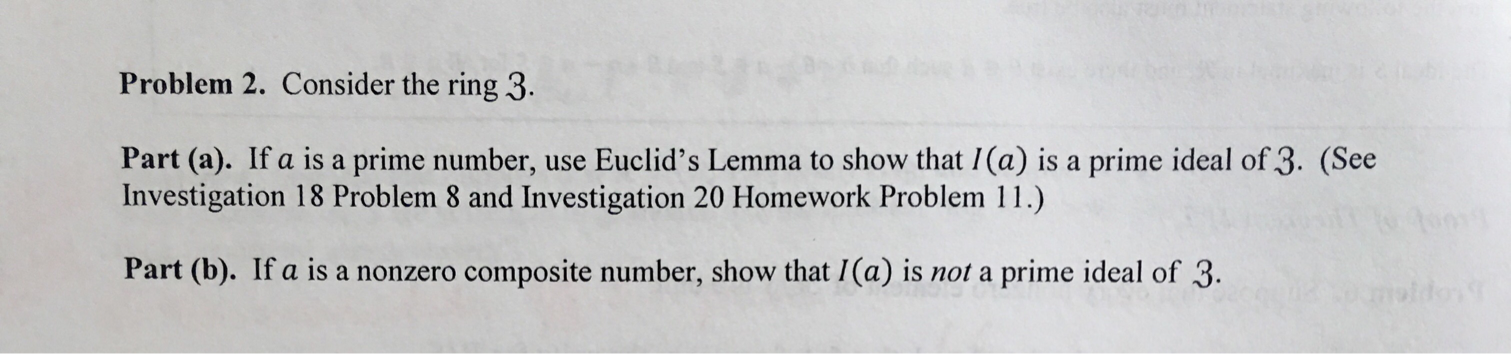
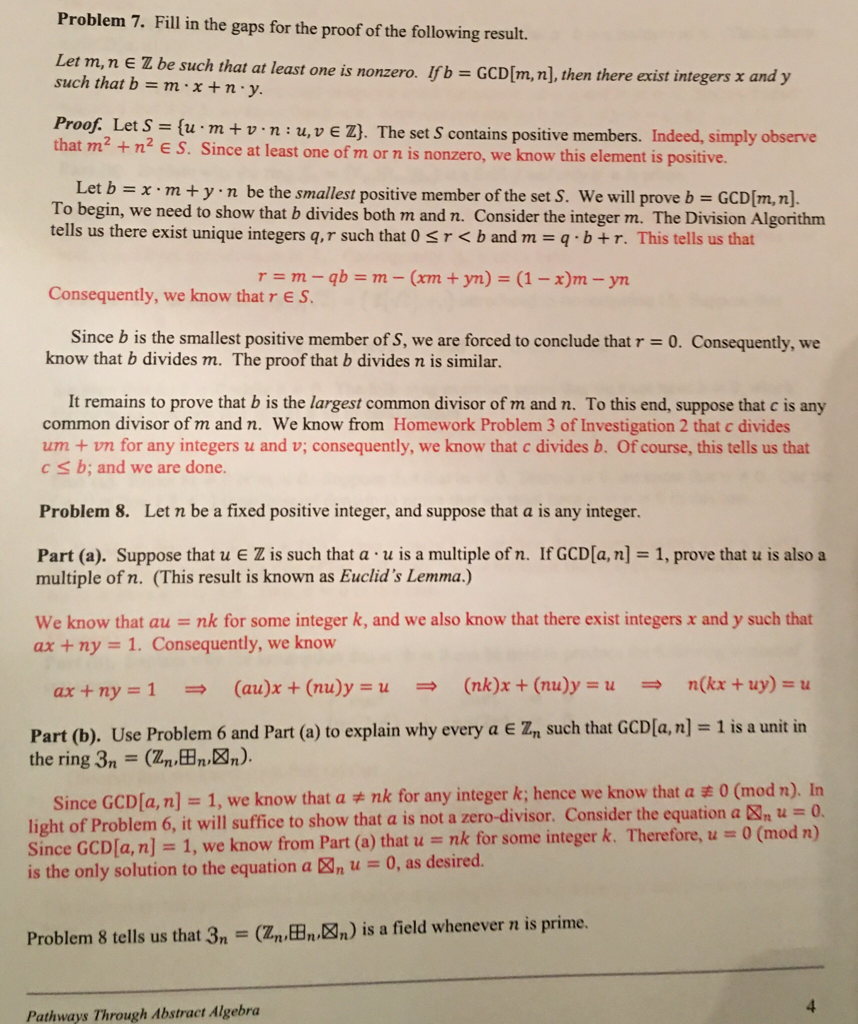
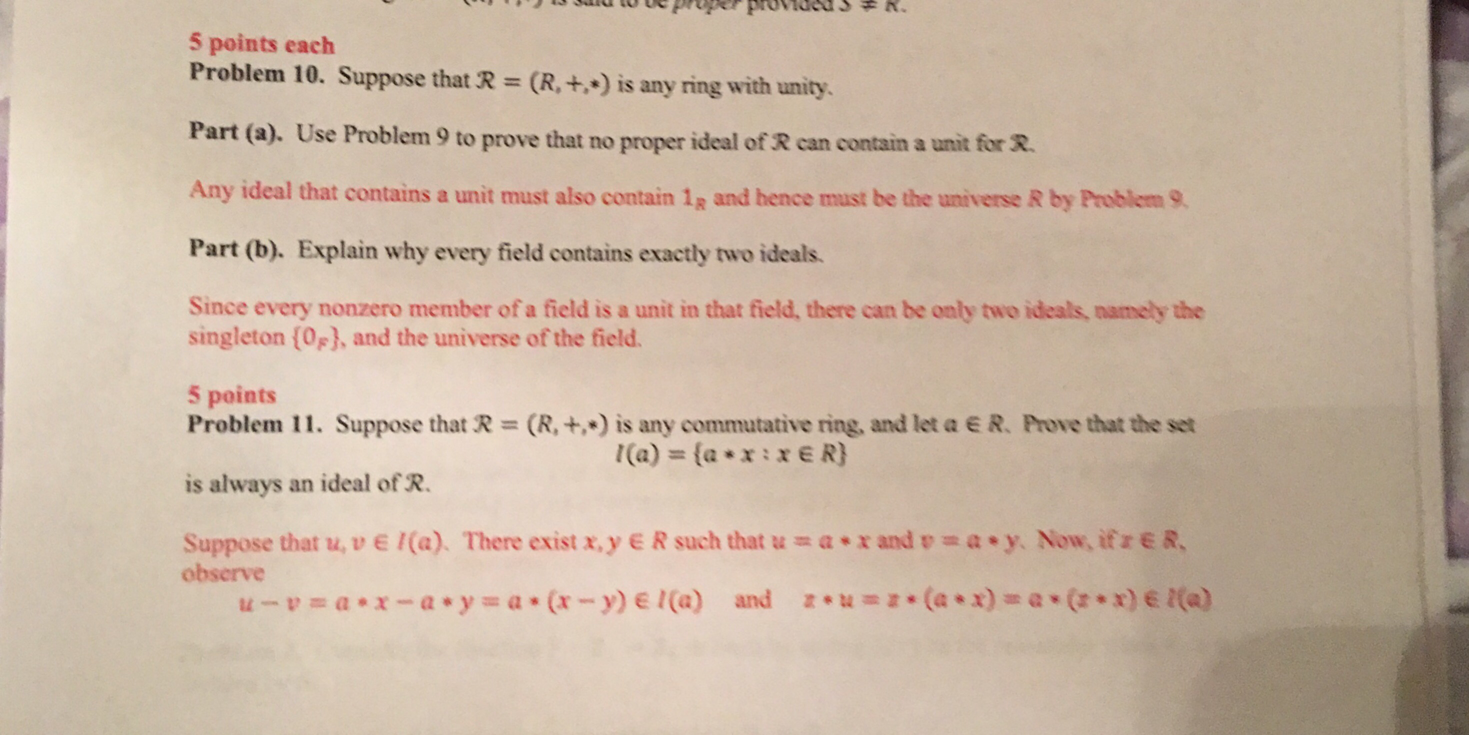
Problem 2. Consider the ring 3. Part (a). If a is a prime number, use Euclid's Lemma to show that I (a) is a prime ideal of 3. (See Investigation 18 Problem 8 and Investigation 20 Homework Problem 11.) to tong Part (b). If a is a nonzero composite number, show that I (a) is not a prime ideal of 3.Problem 7 . Fill in the gaps for the proof of the following result . Let m, nZ E Z be such that at least one is nonzero . Ifb = GCD[ m, 12], then there exist integers * and y such that b = m . * + 1 . Y . Proof. Lets = [U. m + 0 . 12 : U. DE Z). The set S contains positive members . Indeed , simply observe* that m _ + 72 _ ES. Since at least one of mor n is nonzero , we know this element is positive . Letb = * . m + y . To be the smallest positive member of the set S . We will prove b = GCD [ 1 , 12 ]. To begin , we need to show that b divides both m and 12 . Consider the integer in . The Division Algorithm tells us there exist unique integers q , Y such that D Tz Since b is the smallest positive member of'S , we are forced to conclude that * = 0 . Consequently , we know that b divides m. The proof that 6 divides ~z is similar . It remains to prove that b is the largest common divisor of m and n . To this end , suppose that c is any common divisor of' m and n . We know from Homework Problem 3 of Investigation 2 that c divides um + un for any integers U and V ; consequently , we know that c divides b. Of course , this tells us that C 5 b ; and we are done . Problem 8 . Let n be a fixed positive integer , and suppose that a is any integer . Part (2 ) . Suppose that U E I is such that a . " is a multiple of 1 . If GCD [ a, 12 ] = 1 , prove that " is also a multiple of n . ( This result is known as Euclid's Lemma . ) We know that au = nike for some integer K , and we also know that there exist integers * and*y such that ax + ny = 1. Consequently , we know art ny = 1 ( all ) x + ( nu ) y = U ~ ( nike )* + ( 1721 ) 2 = U - 1 ( Kx + uy ) = U) Part ( b ) . Use Problem 6 and Part ( a) to explain why every a E In such that GCD [ a. 12 ) = 1 is a unit in the ring 3 ~ = ( In, FAIn, Bon ) . Since GCD [ a , 12 ) = 1 , we know that a * nike for any integer k; hence we know that a * O ( mod 12 ) . In light of Problem 6 , it will suffice to show that a is not a zero - divisor . Consider the equation a By U = 0 . Since GCD [ a , 12 ) = 1 , we know from Part ( a ) that " = nik for some integer k. Therefore , " = 0 ( mod 12 ) is the only solution to the equation a Don U = O , as desired . Problem & tells us that 3 = ( In. {n. Qn ) is a field whenever it is prime "allways Through Abstract Algebrarovided 3 FR. 5 points each Problem 10. Suppose that R = (R. +.*) is any ring with unity. Part (a). Use Problem 9 to prove that no proper ideal of R can contain a unit for R. Any ideal that contains a unit must also contain 1; and hence must be the universe R by Problem 9 Part (b). Explain why every field contains exactly two ideals. Since every nonzero member of a field is a unit in that field, there can be only two ideals, namely the singleton {OF}, and the universe of the field 5 points Problem 11. Suppose that R = (R, +,*) is any commutative ring, and let a E R. Prove that the set I(a) = {a . x :xER) is always an ideal of R. Suppose that u, v E /(a). There exist x, y E R such that u = a . x and v = a . y. Now, if r ER. observe u-y=Q.X-Q.y=a.(x-y)el(a) and zou =z.(asx) =2.(2. *)(a)
Step by Step Solution
There are 3 Steps involved in it

Get step-by-step solutions from verified subject matter experts
 Study Help