







Question: Problem 2) Consider the same truss bridge as in Problem 2 of Assignment 3 . We want to analyze this truss bridge using iterative methods.
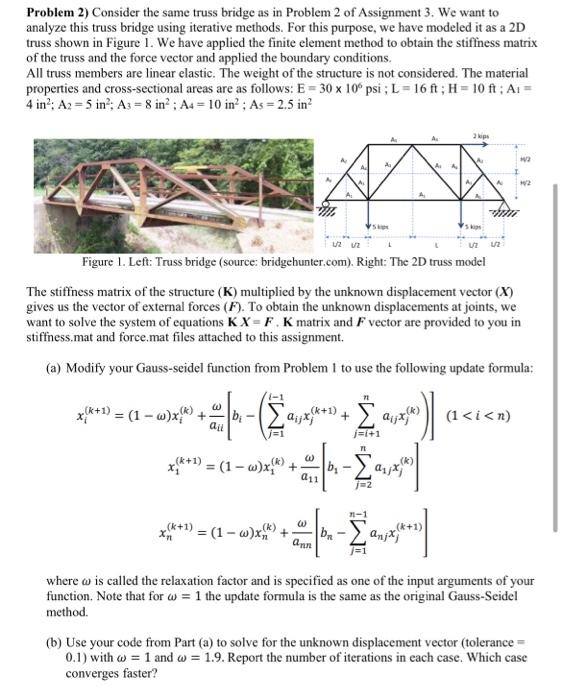

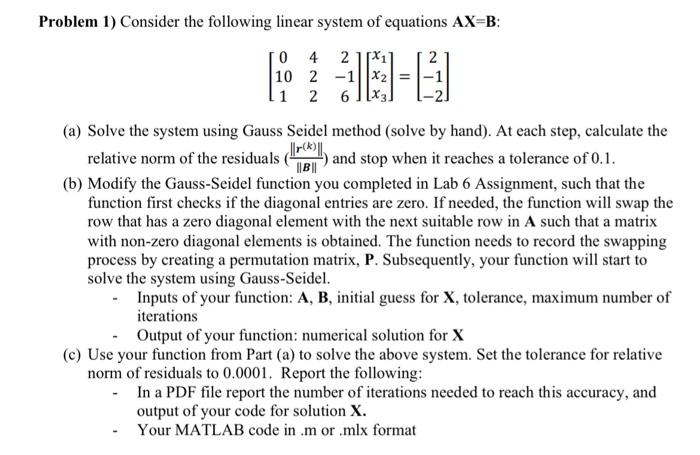
Problem 2) Consider the same truss bridge as in Problem 2 of Assignment 3 . We want to analyze this truss bridge using iterative methods. For this purpose, we have modeled it as a 2D truss shown in Figure 1. We have applied the finite element method to obtain the stiffness matrix of the truss and the force vector and applied the boundary conditions. All truss members are linear elastic. The weight of the structure is not considered. The material properties and cross-sectional areas are as follows: E=30106psi;L=16ft;H=10ft;A1= 4in2;A2=5in2;A3=8in2;A4=10in2;A5=2.5in2 Figure 1. Left: Truss bridge (source: bridgehunter,com). Right: The 2D truss model The stiffness matrix of the structure (K) multiplied by the unknown displacement vector (X) gives us the vector of external forces (F). To obtain the unknown displacements at joints, we want to solve the system of equations KX=F. K matrix and F vector are provided to you in stiffness.mat and force.mat files attached to this assignment. (a) Modify your Gauss-seidel function from Problem 1 to use the following update formula: xi(k+1)=(1)xi(k)+ail[bi(j=1i1aijxj(k+1)+j=i+1naijxj(k))](1
Step by Step Solution
There are 3 Steps involved in it

Get step-by-step solutions from verified subject matter experts
 Study Help