







Question: Problem 2: Convexity in 1- and 2-Dimensions 1. Consider the objective function f(v) = (1 v)2 for a scalar variable v. Using first and second
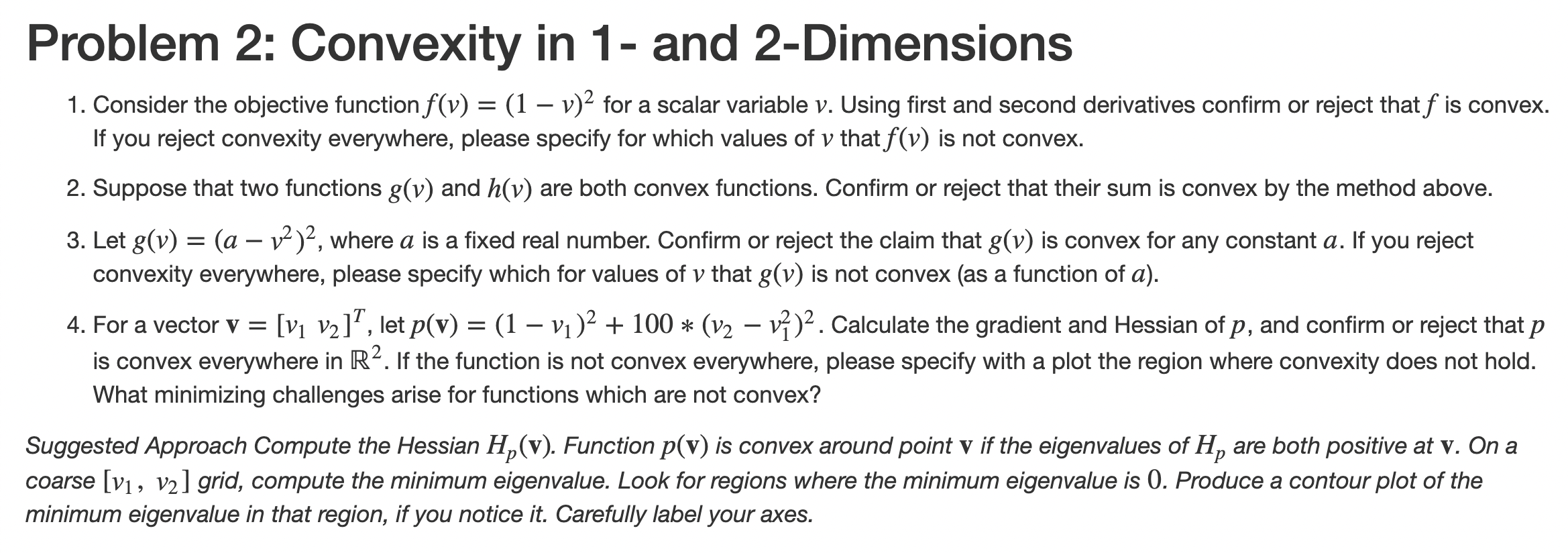
Problem 2: Convexity in 1- and 2-Dimensions 1. Consider the objective function f(v) = (1 v)2 for a scalar variable v. Using first and second derivatives confirm or reject that f is convex. If you reject convexity everywhere, please specify for which values of v that f(v) is not convex. 2. Suppose that two functions g(v) and h(v) are both convex functions. Confirm or reject that their sum is convex by the method above. 3. Let g(v) = (a v2)2, where a is a fixed real number. Confirm or reject the claim that g(v) is convex for any constant a. If you reject convexity everywhere, please specify which for values of v that g(v) is not convex (as a function of a). 4. For a vector v = [v1 v2]T, let p(v) = (1 v1)2 + 100 * (v2 v92. Calculate the gradient and Hessian of p, and confirm or reject that p is convex everywhere in R2. If the function is not convex everywhere, please specify with a plot the region where convexity does not hold. What minimizing challenges arise for functions which are not convex? Suggested Approach Compute the Hessian Hp (v). Function p(v) is convex around point v if the eigenvalues of Hp are both positive at v. On a coarse [v1, v2] grid, compute the minimum eigenvalue. Look for regions where the minimum eigenvalue is 0. Produce a contour plot of the minimum eigenvalue in that region, if you notice it. Carefully label your axes
Step by Step Solution
There are 3 Steps involved in it

Get step-by-step solutions from verified subject matter experts
 Study Help