







Question: Problem 2: Cost-Effective Pollution Control This quantitative problem reviews the basic analytics of cost-effective pollution control. You can use graphs or simple algebra to answer
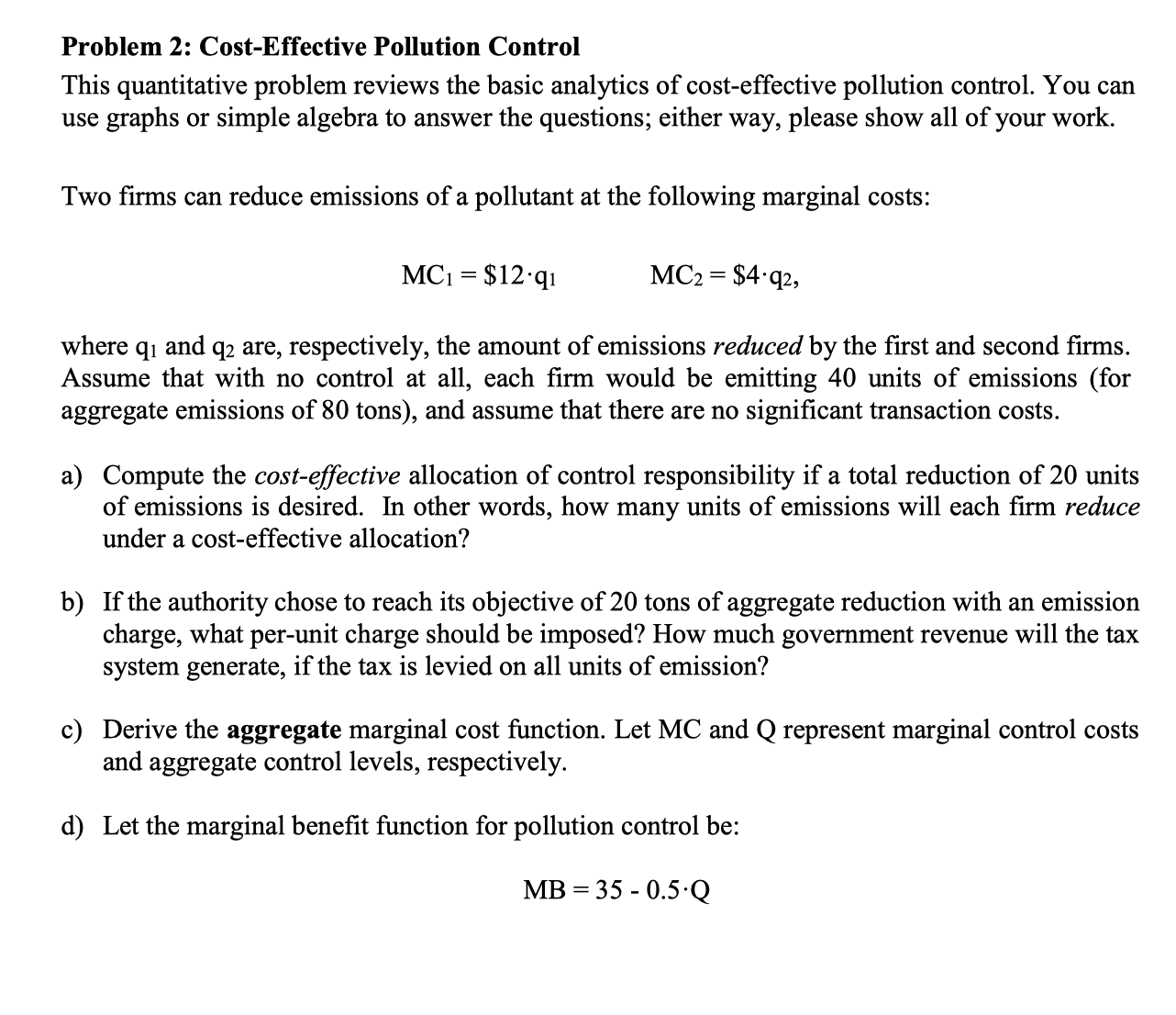
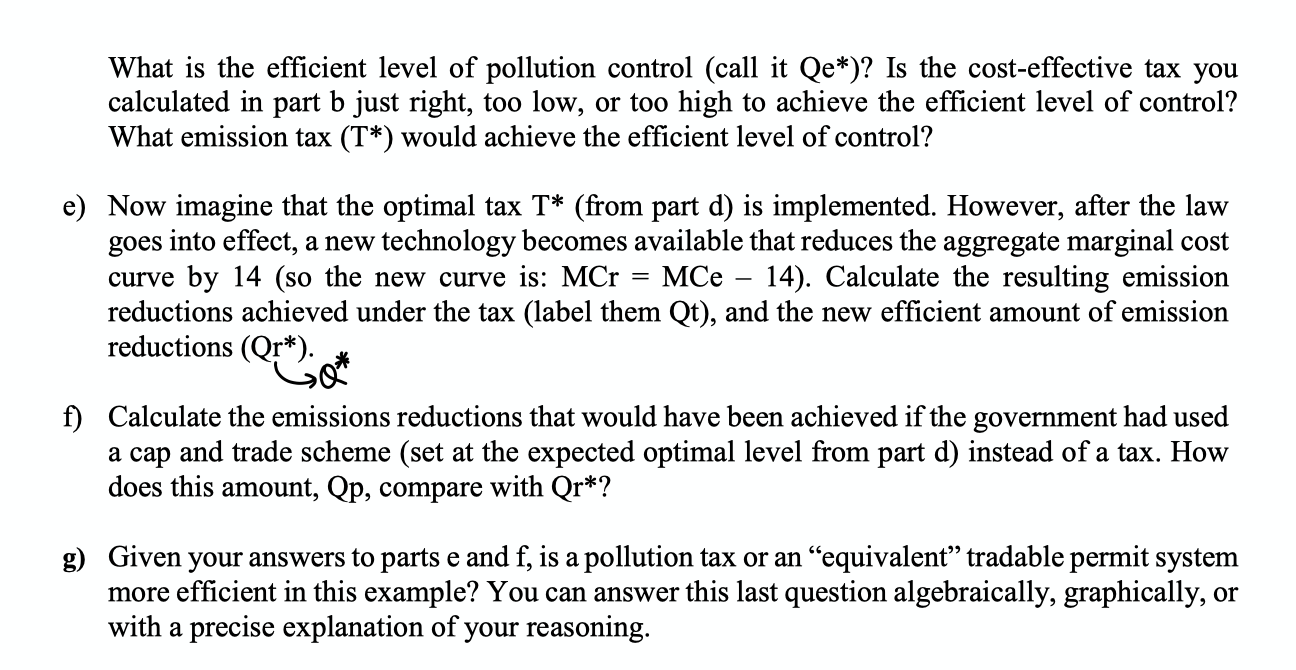
Problem 2: Cost-Effective Pollution Control This quantitative problem reviews the basic analytics of cost-effective pollution control. You can use graphs or simple algebra to answer the questions; either way, please show all of your work. Two firms can reduce emissions of a pollutant at the following marginal costs: MC1 = $12.q1 MC2 = $4.q2, where qi and q2 are, respectively, the amount of emissions reduced by the first and second firms. Assume that with no control at all, each firm would be emitting 40 units of emissions (for aggregate emissions of 80 tons), and assume that there are no significant transaction costs. a) Compute the cost-effective allocation of control responsibility if a total reduction of 20 units of emissions is desired. In other words, how many units of emissions will each firm reduce under a cost-effective allocation? b) If the authority chose to reach its objective of 20 tons of aggregate reduction with an emission charge, what per-unit charge should be imposed? How much government revenue will the tax system generate, if the tax is levied on all units of emission? c) Derive the aggregate marginal cost function. Let MC and Q represent marginal control costs and aggregate control levels, respectively. d) Let the marginal benefit function for pollution control be: MB = 35 - 0.5.QWhat is the efficient level of pollution control (call it Qe*)? Is the cost-effective tax you calculated in part b just right, too low, or too high to achieve the efficient level of control? What emission tax (T*) would achieve the efficient level of control? e) Now imagine that the optimal tax T* (from part d) is implemented. However, after the law goes into effect, a new technology becomes available that reduces the aggregate marginal cost curve by 14 (so the new curve is: MCr = MCe - 14). Calculate the resulting emission reductions achieved under the tax (label them Qt), and the new efficient amount of emission reductions (Qr*) f) Calculate the emissions reductions that would have been achieved if the government had used a cap and trade scheme (set at the expected optimal level from part d) instead of a tax. How does this amount, Qp, compare with Qr*? g) Given your answers to parts e and f, is a pollution tax or an "equivalent" tradable permit system more efficient in this example? You can answer this last question algebraically, graphically, or with a precise explanation of your reasoning
Step by Step Solution
There are 3 Steps involved in it

Get step-by-step solutions from verified subject matter experts
 Study Help