







Question: Problem 2. Cournot Competition with Simultaneous and Sequential Moves (30 points) Setup 1 The setup for parts (a) through (c) below are based on the
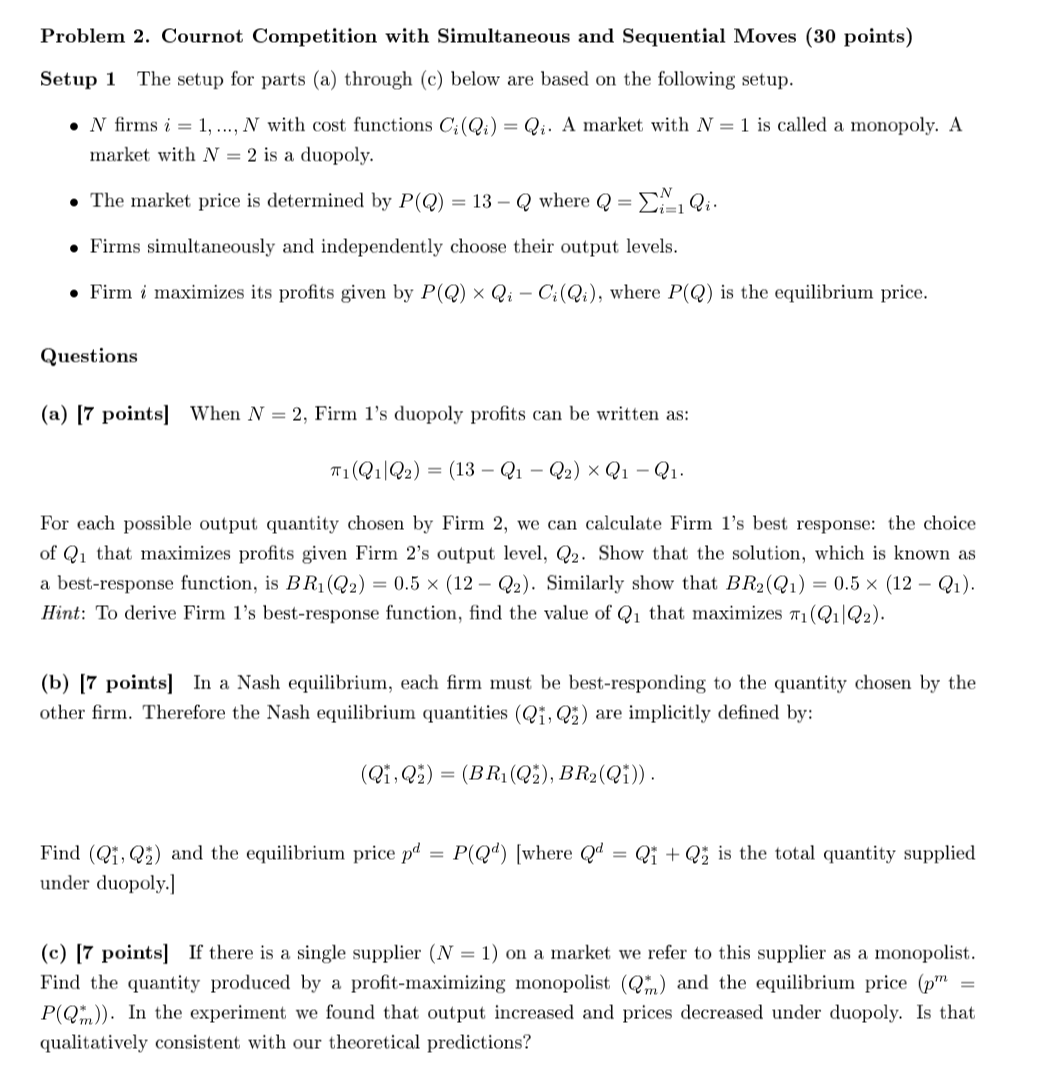
Problem 2. Cournot Competition with Simultaneous and Sequential Moves (30 points) Setup 1 The setup for parts (a) through (c) below are based on the following setup. 0 N rms 1' = 1, ..., N with cost functions 0,:(Q,) = Q,. A market with N = 1 is called a monopoly. A market with N = 2 is a duopoly. o The market price is determined by P(Q) = 13 _ Q where Q = 2:11 (9,. 0 Firms simultaneously and independently choose their output levels. 0 Firm 1: maximizes its prots given by P(Q) x Q, C,(Q,:), where HQ) is the equilibrium price. Questions (:1) [7 points] When N = 2, Firm 1's dnopoly prots can be written as: FilQilQel = {13 "Ql "'92) X Q1 \"'Q1- For each possible output quantity chosen by Firm 2, we can calculate Firm 1's best response: the choice of Q1 that maximizes prots given Firm 2's output level, Q2. Show that the solution, which is known as a best-response function, is BR1(Q2) = 0.5 X (12 Q2). Similarly show that BR2(Q1) = 0.5 X (12 Q1). Hint: To derive Firm 1's best-response function, nd the value of Q1 that maximizes 1(QllQ2). (b) [7 points] In a Nash equilibrium, each rm must be best-responding to the quantity chosen by the other rm. Therefore the Nash equilibrium quantities (Q3, Q5) are implicitly dened by: (Qng3) = (BitQE).BR2(Qi))- Find (@1295) and the equilibrium price pd = P(Qd) [where Qd = Q} + Q; is the total quantity supplied under duopoly.] (c) [7 points] If there is a single supplier (N = 1) on a market we refer to this supplier as a monopolist. Find the quantity produced by a prot-maximizing monopolist ( :n) and the equilibrium price [pm = P( :n)). In the experiment we found that output increased and prices decreased under duopoly. Is that qualitatively consistent with our theoretical predictions
Step by Step Solution
There are 3 Steps involved in it

Get step-by-step solutions from verified subject matter experts
 Study Help