



Question: Problem 2. Crushed rock is typically stored in conical piles formed by a truck with a conveyor belt that moves the rock high into the
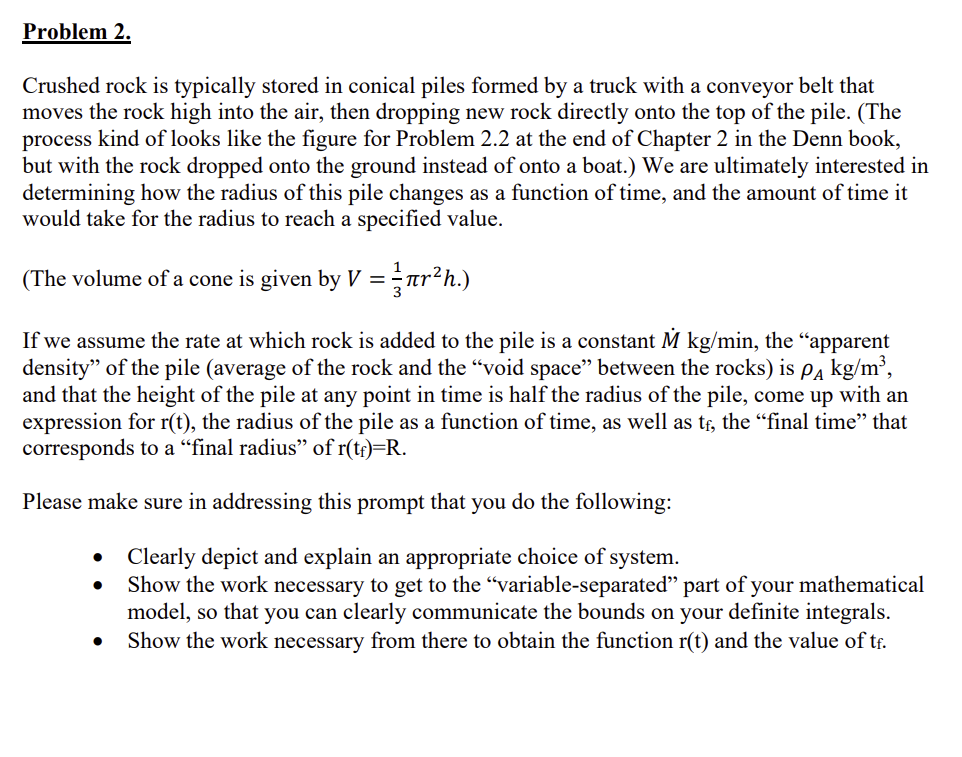
Problem 2. Crushed rock is typically stored in conical piles formed by a truck with a conveyor belt that moves the rock high into the air, then dropping new rock directly onto the top of the pile. (The process kind of looks like the figure for Problem 2.2 at the end of Chapter 2 in the Denn book, but with the rock dropped onto the ground instead of onto a boat.) We are ultimately interested in determining how the radius of this pile changes as a function of time, and the amount of time it would take for the radius to reach a specified value. (The volume of a cone is given by V = {nr?h.) If we assume the rate at which rock is added to the pile is a constant M kg/min, the apparent density of the pile (average of the rock and the void space between the rocks) is PA kg/m, and that the height of the pile at any point in time is half the radius of the pile, come up with an expression for r(t), the radius of the pile as a function of time, as well as tf, the final time that corresponds to a final radius of r(tt)=R. Please make sure in addressing this prompt that you do the following: . . Clearly depict and explain an appropriate choice of system. Show the work necessary to get to the variable-separated part of your mathematical model, so that you can clearly communicate the bounds on your definite integrals. Show the work necessary from there to obtain the function r(t) and the value of tf
Step by Step Solution
There are 3 Steps involved in it

Get step-by-step solutions from verified subject matter experts