



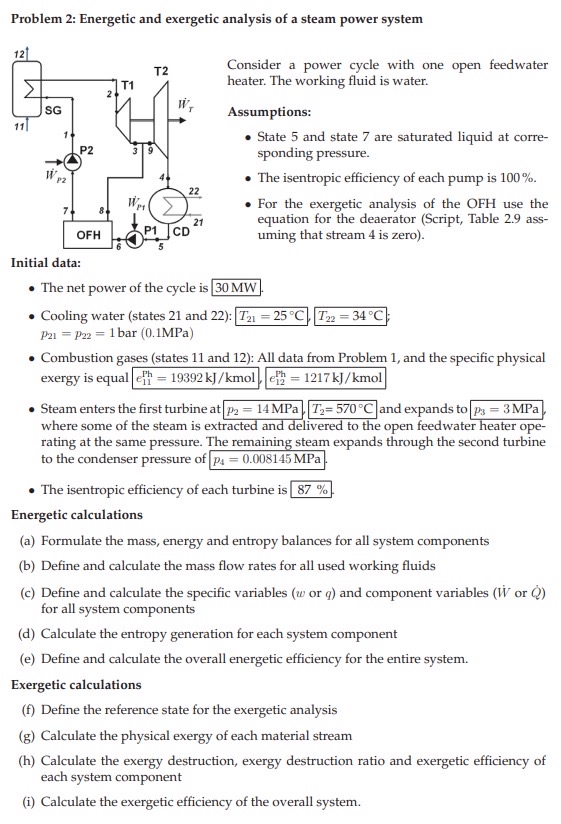
Question: Problem 2 : Energetic and exergetic analysis of a steam power system Consider a power cycle with one open feedwater heater. The working fluid is
Problem : Energetic and exergetic analysis of a steam power system
Consider a power cycle with one open feedwater heater. The working fluid is water.
Assumptions:
State and state are saturated liquid at corresponding pressure.
The isentropic efficiency of each pump is
For the exergetic analysis of the OFH use the equation for the deaerator Script Table assuming that stream is zero
Initial data:
The net power of the cycle is
Cooling water states and :
;
bar MPa
Combustion gases states and : All data from Problem and the specific physical exergy is equal mol,mol
Steam enters the first turbine at and expands to MPa, where some of the steam is extracted and delivered to the open feedwater heater operating at the same pressure. The remaining steam expands through the second turbine to the condenser pressure of
The isentropic efficiency of each turbine is
Energetic calculations
a Formulate the mass, energy and entropy balances for all system components
b Define and calculate the mass flow rates for all used working fluids
c Define and calculate the specific variables or and component variables or for all system components
d Calculate the entropy generation for each system component
e Define and calculate the overall energetic efficiency for the entire system.
Exergetic calculations
f Define the reference state for the exergetic analysis
g Calculate the physical exergy of each material stream
h Calculate the exergy destruction, exergy destruction ratio and exergetic efficiency of each system component
i Calculate the exergetic efficiency of the overall system.
Step by Step Solution
There are 3 Steps involved in it
1 Expert Approved Answer
Step: 1 Unlock

Question Has Been Solved by an Expert!
Get step-by-step solutions from verified subject matter experts
Step: 2 Unlock
Step: 3 Unlock