







Question: Problem 2. Explain what operations the following C++ function (myfunction) does. Under what scenarios, will the function experience the worst-case performance? What is the worst
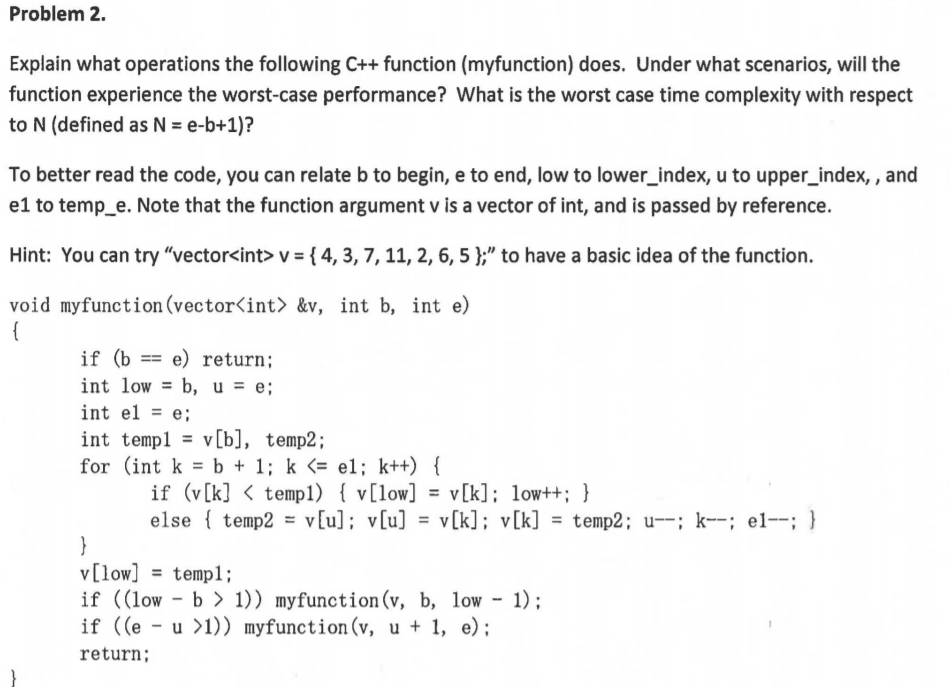
Problem 2. Explain what operations the following C++ function (myfunction) does. Under what scenarios, will the function experience the worst-case performance? What is the worst case time complexity with respect to N (defined as N = e-b+1)? To better read the code, you can relate b to begin, e to end, low to lower_index, u to upper_index, , and e1 to temp_e. Note that the function argument v is a vector of int, and is passed by reference. Hint: You can try "vector
Step by Step Solution
There are 3 Steps involved in it

Get step-by-step solutions from verified subject matter experts
 Study Help