







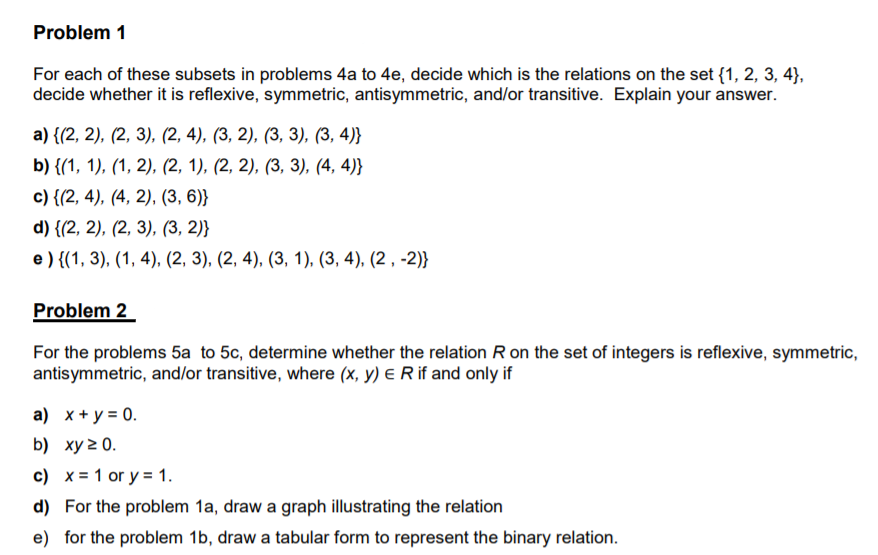
Question: Problem 2 For the problems 5a to 5c, determine whether the relation R on the set of integers is reflexive, symmetric, antisymmetric, and/or transitive, where
Problem 2
For the problems 5a to 5c, determine whether the relation R on the set of integers is reflexive, symmetric, antisymmetric, and/or transitive, where (x, y) ? R if and only if
a) x + y = 0.
b) xy ? 0.
c) x = 1 or y = 1.
d) For the problem 1a, draw a graph illustrating the relation
Step by Step Solution
There are 3 Steps involved in it
1 Expert Approved Answer
Step: 1 Unlock

Question Has Been Solved by an Expert!
Get step-by-step solutions from verified subject matter experts
Step: 2 Unlock
Step: 3 Unlock
 Study Help