



Question: Problem 2. Frequentist Coverage of The Bayesian Posterior Interval. (35 pts) Suppose that y1, .., yn is an IID sample from a Normal (#, 1).
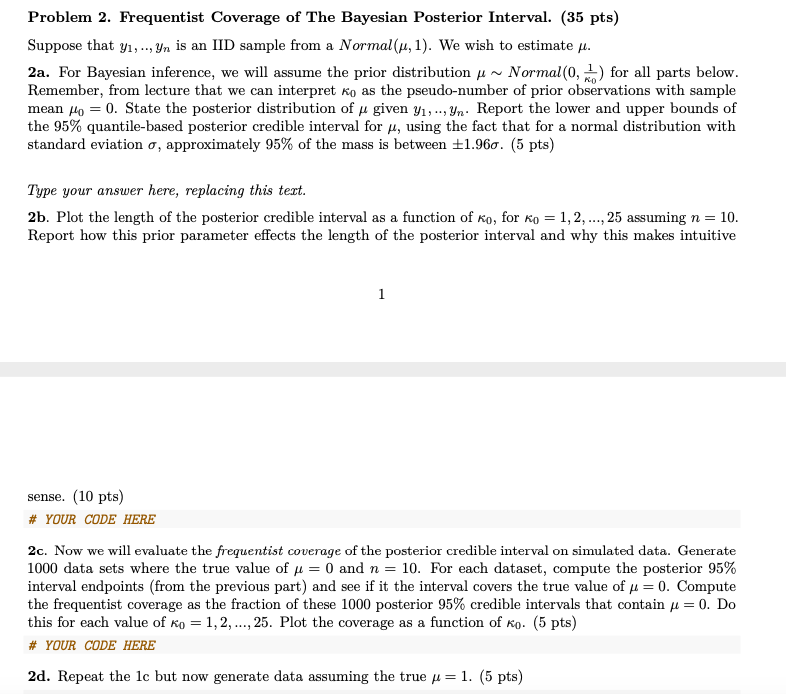
Problem 2. Frequentist Coverage of The Bayesian Posterior Interval. (35 pts) Suppose that y1, .., yn is an IID sample from a Normal (#, 1). We wish to estimate /. 2a. For Bayesian inference, we will assume the prior distribution # ~ Normal(0, ,) for all parts below. Remember, from lecture that we can interpret go as the pseudo-number of prior observations with sample mean #o = 0. State the posterior distribution of / given y1,.., y. Report the lower and upper bounds of the 95% quantile-based posterior credible interval for , using the fact that for a normal distribution with standard eviation o, approximately 95% of the mass is between 1.960. (5 pts) Type your answer here, replacing this text. 2b. Plot the length of the posterior credible interval as a function of Ko, for Ko = 1, 2, ..., 25 assuming n = 10. Report how this prior parameter effects the length of the posterior interval and why this makes intuitive sense. (10 pts) # YOUR CODE HERE 2c. Now we will evaluate the frequentist coverage of the posterior credible interval on simulated data. Generate 1000 data sets where the true value of # = 0 and n = 10. For each dataset, compute the posterior 95% interval endpoints (from the previous part) and see if it the interval covers the true value of / = 0. Compute the frequentist coverage as the fraction of these 1000 posterior 95% credible intervals that contain # = 0. Do this for each value of Ko = 1, 2, ..., 25. Plot the coverage as a function of Ko. (5 pts) # YOUR CODE HERE 2d. Repeat the Ic but now generate data assuming the true # = 1. (5 pts)
Step by Step Solution
There are 3 Steps involved in it

Get step-by-step solutions from verified subject matter experts