







Question: Problem 2 (from GLS) In our basic model with money, the money demand curve is implicitly defined by: Mt it 1 + it u' (Ci)A
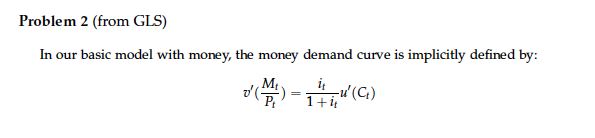
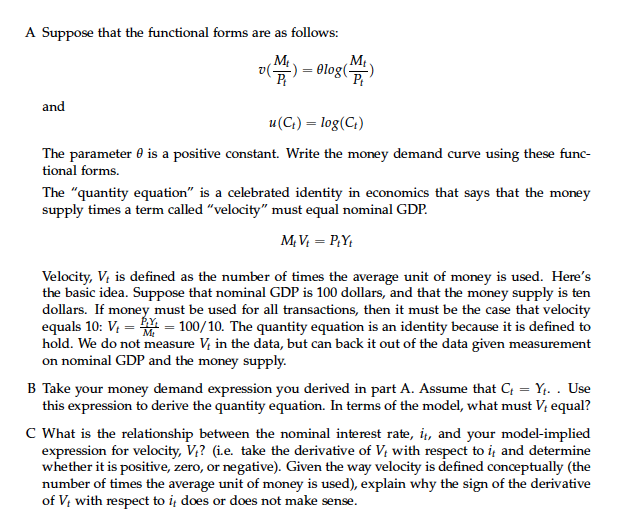
Problem 2 (from GLS) In our basic model with money, the money demand curve is implicitly defined by: Mt it 1 + it u' (Ci)A Suppose that the functional forms are as follows: and u(Ci) = log(Ct) The parameter 0 is a positive constant. Write the money demand curve using these func- tional forms. The "quantity equation" is a celebrated identity in economics that says that the money supply times a term called "velocity" must equal nominal GDP. MV = PYt Velocity, V, is defined as the number of times the average unit of money is used. Here's the basic idea. Suppose that nominal GDP is 100 dollars, and that the money supply is ten dollars. If money must be used for all transactions, then it must be the case that velocity equals 10: Vi = M BY = 100/10. The quantity equation is an identity because it is defined to hold. We do not measure V, in the data, but can back it out of the data given measurement on nominal GDP and the money supply. B Take your money demand expression you derived in part A. Assume that C = Y. . Use this expression to derive the quantity equation. In terms of the model, what must V, equal? C What is the relationship between the nominal interest rate, it, and your model-implied expression for velocity, V,? (ie. take the derivative of V, with respect to i, and determine whether it is positive, zero, or negative). Given the way velocity is defined conceptually (the number of times the average unit of money is used), explain why the sign of the derivative of Vi with respect to i, does or does not make sense
Step by Step Solution
There are 3 Steps involved in it

Get step-by-step solutions from verified subject matter experts
 Study Help