







Question: Problem 2 Gibbons problem 3.8 on page 171. Reinterpret the buyer and seller in the double auction analyzed in Section 3.2.C as a firm that
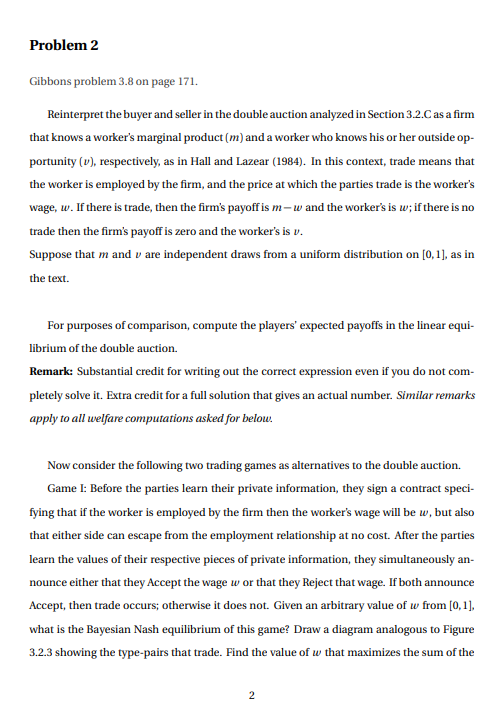
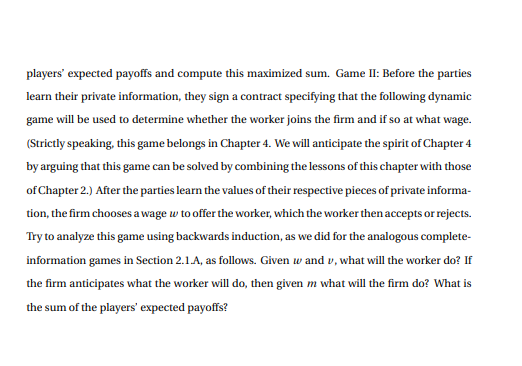
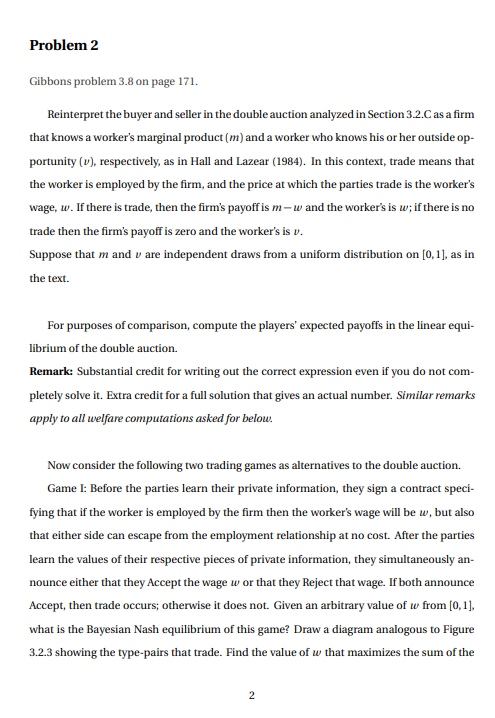
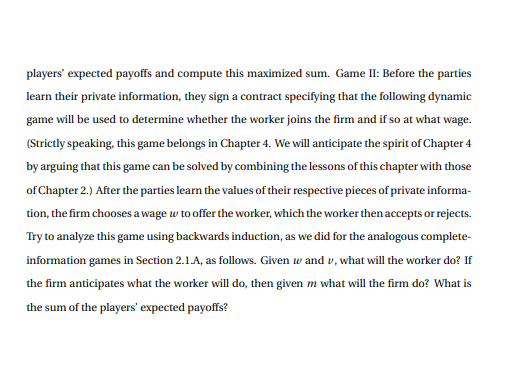
Problem 2 Gibbons problem 3.8 on page 171. Reinterpret the buyer and seller in the double auction analyzed in Section 3.2.C as a firm that knows a worker's marginal product (m) and a worker who knows his or her outside op- portunity (v), respectively, as in Hall and Lazear (1984). In this context, trade means that the worker is employed by the firm, and the price at which the parties trade is the worker's wage, w. If there is trade, then the firm's payoff is m-w and the worker's is w; if there is no trade then the firm's payoff is zero and the worker's is v. Suppose that m and v are independent draws from a uniform distribution on [0, 1], as in the text. For purposes of comparison, compute the players' expected payoffs in the linear equi- librium of the double auction. Remark: Substantial credit for writing out the correct expression even if you do not com- pletely solve it. Extra credit for a full solution that gives an actual number. Similar remarks apply to all welfare computations asked for below. Now consider the following two trading games as alternatives to the double auction. Game I: Before the parties learn their private information, they sign a contract speci- fying that if the worker is employed by the firm then the worker's wage will be w, but also that either side can escape from the employment relationship at no cost. After the parties learn the values of their respective pieces of private information, they simultaneously an- nounce either that they Accept the wage w or that they Reject that wage. If both announce Accept, then trade occurs; otherwise it does not. Given an arbitrary value of w from [0,1], what is the Bayesian Nash equilibrium of this game? Draw a diagram analogous to Figure 3.2.3 showing the type-pairs that trade. Find the value of w that maximizes the sum of the 2players' expected payoffs and compute this maximized sum. Game II: Before the parties learn their private information, they sign a contract specifying that the following dynamic game will be used to determine whether the worker joins the firm and if so at what wage. (5trictly speaking, this game belongs in Chapter 4. We will anticipate the spirit of Chapter 4 by arguing that this game can be solved by combining the lessons of this chapter with those of Chapter 2.) After the parties learn the values of their respective pieces of private informa- tion, the firm chooses awage w to offer the worker, which the worker then accepts or rejects. Try to analyze this game using backwards induction, as we did for the analogous complete- information games in Section 2.1.4, as follows. Given w and v, what will the worker do? If the firm anticipates what the worker will do, then given m what will the firm do? What is the sum of the players' expected payoffs
Step by Step Solution
There are 3 Steps involved in it

Get step-by-step solutions from verified subject matter experts
 Study Help