







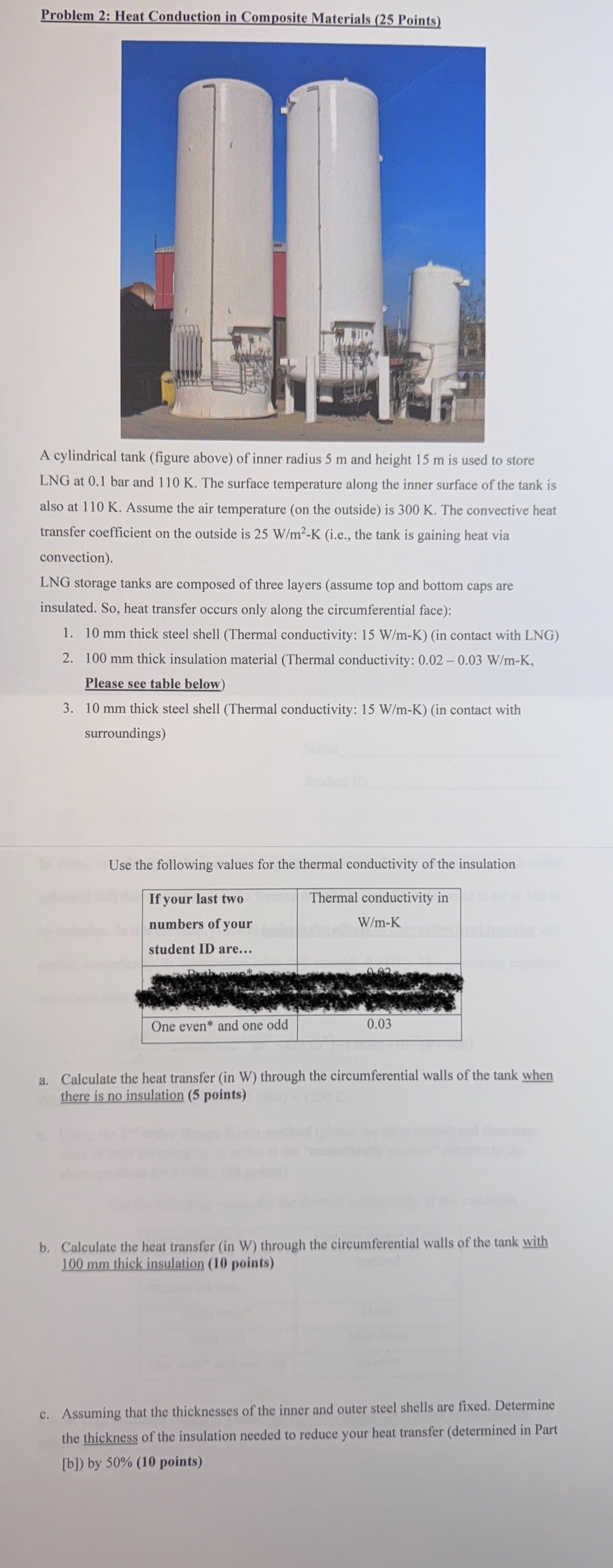
Question: Problem 2 : Heat Conduction in Composite Materials ( 2 5 Points ) A cylindrical tank ( figure above ) of inner radius 5 m
Problem : Heat Conduction in Composite Materials Points
A cylindrical tank figure above of inner radius m and height m is used to store LNG at bar and K The surface temperature along the inner surface of the tank is also at K Assume the air temperature on the outside is K The convective heat transfer coefficient on the outside is ie the tank is gaining heat via convection
LNG storage tanks are composed of three layers assume top and bottom caps are insulated. So heat transfer occurs only along the circumferential face:
mm thick steel shell Thermal conductivity: in contact with LNG
mm thick insulation material Thermal conductivity: Please see table below
mm thick steel shell Thermal conductivity: in contact with surroundings
Use the following values for the thermal conductivity of the insulation
tableIf your last twonumbers of yourstudent ID are...
a Calculate the heat transfer in W through the circumferential walls of the tank when there is no insulation points
b Calculate the heat transfer in W through the circumferential walls of the tank with mm thick insulation points
c Assuming that the thicknesses of the inner and outer steel shells are fixed. Determine the thickness of the insulation needed to reduce your heat transfer determined in Part b by points
Step by Step Solution
There are 3 Steps involved in it
1 Expert Approved Answer
Step: 1 Unlock

Question Has Been Solved by an Expert!
Get step-by-step solutions from verified subject matter experts
Step: 2 Unlock
Step: 3 Unlock
 Study Help