



Question: Problem 2. In a second-price auction where the designer intends to allocate a single indi- visible good to one of the players (as mentioned class,
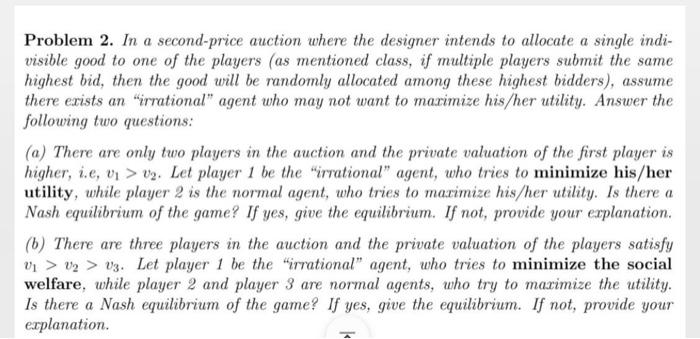
Problem 2. In a second-price auction where the designer intends to allocate a single indi- visible good to one of the players (as mentioned class, if multiple players submit the same highest bid, then the good will be randomly allocated among these highest bidders), assume there exists an "irrational" agent who may not want to maximize his/her utility. Answer the following two questions: (a) There are only two players in the auction and the private valuation of the first player is higher, i.e, u > 09. Let player 1 be the "irrational" agent, who tries to minimize his/her utility, while player 2 is the normal agent, who tries to maximize his/her utility. Is there a Nash equilibrium of the game? If yes, give the equilibrium. If not, provide your explanation. (b) There are three players in the auction and the private valuation of the players satisfy V > 02 > 03. Let player 1 be the "irrational" agent, who tries to minimize the social welfare, while player 2 and player 3 are normal agents, who try to maximize the utility. Is there a Nash equilibrium of the game? If yes, give the equilibrium. If not, provide your explanation. Problem 2. In a second-price auction where the designer intends to allocate a single indi- visible good to one of the players (as mentioned class, if multiple players submit the same highest bid, then the good will be randomly allocated among these highest bidders), assume there exists an "irrational" agent who may not want to maximize his/her utility. Answer the following two questions: (a) There are only two players in the auction and the private valuation of the first player is higher, i.e, u > 09. Let player 1 be the "irrational" agent, who tries to minimize his/her utility, while player 2 is the normal agent, who tries to maximize his/her utility. Is there a Nash equilibrium of the game? If yes, give the equilibrium. If not, provide your explanation. (b) There are three players in the auction and the private valuation of the players satisfy V > 02 > 03. Let player 1 be the "irrational" agent, who tries to minimize the social welfare, while player 2 and player 3 are normal agents, who try to maximize the utility. Is there a Nash equilibrium of the game? If yes, give the equilibrium. If not, provide your explanation
Step by Step Solution
There are 3 Steps involved in it

Get step-by-step solutions from verified subject matter experts