







Question: Problem 2 In this problem we will show how changes in taxation can change consumption of an agent if she is borrowing-constrained. The agent's income
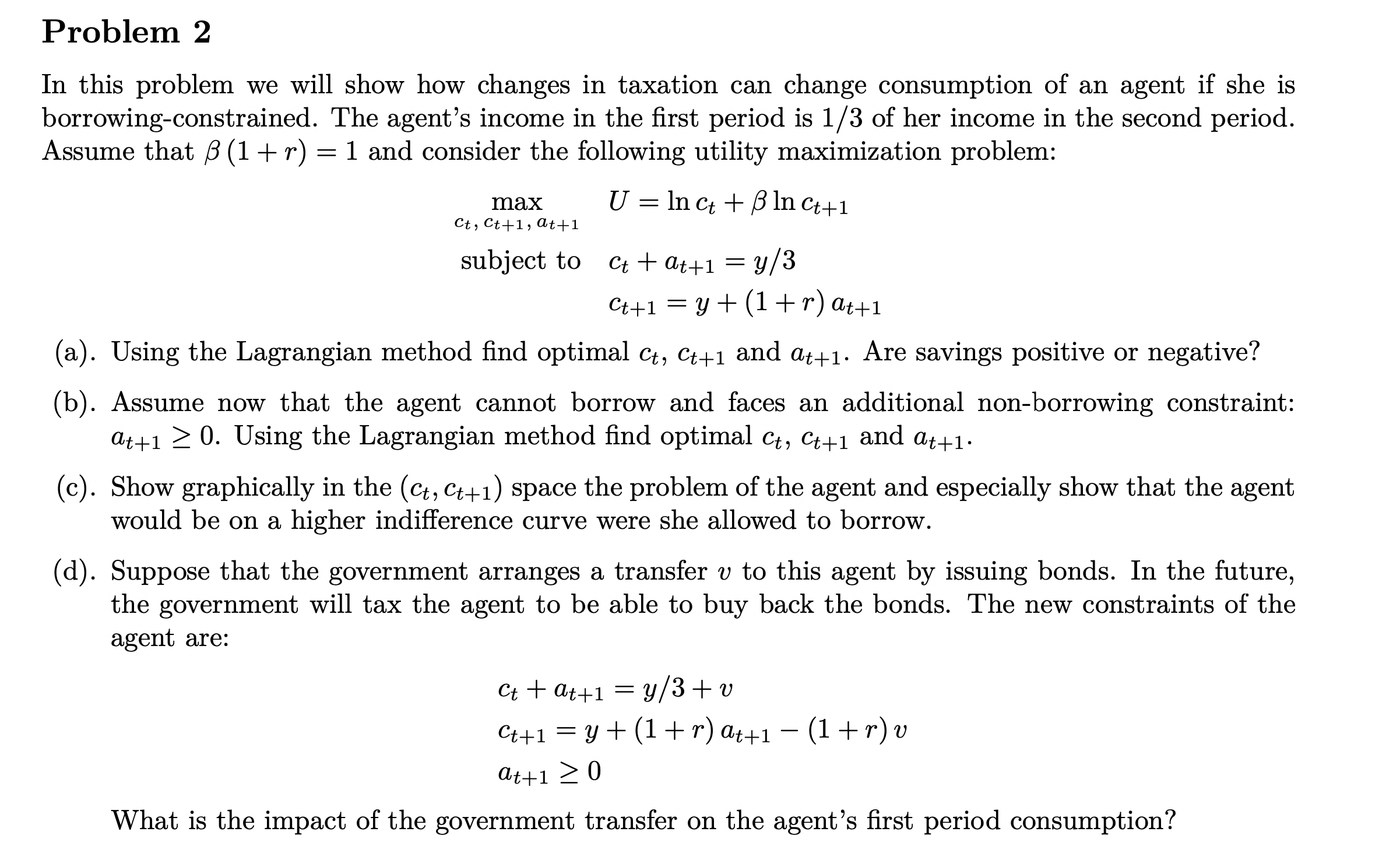
Problem 2 In this problem we will show how changes in taxation can change consumption of an agent if she is borrowing-constrained. The agent's income in the rst period is 1/3 of her income in the second period. Assume that (1 + r) = 1 and consider the following utility maximization problem: max U=lnct+lnct+1 Ct, Ct+1,1t+1 subject to ct + at+1 = y/3 Ct+1 = y + (1 + 7') at+1 (a). Using the Lagrangian method nd optimal ct, ct+1 and at\". Are savings positive or negative? (b). Assume now that the agent cannot borrow and faces an additional nonborrowing constraint: at+1 2 0. Using the Lagrangian method nd optimal ct, ct+1 and (n+1. (c). Show graphically in the (ct, Ct+1) space the problem of the agent and especially show that the agent would be on a higher indifference curve were she allowed to borrow. (d). Suppose that the government arranges a transfer 1) to this agent by issuing bonds. In the future, the government will tax the agent to be able to buy back the bonds. The new constraints of the agent are: ct+at+1 =y/3+v Ct+1=y+(1+7')at+1(1+7')\" at+120 What is the impact of the government transfer on the agent's rst period consumption
Step by Step Solution
There are 3 Steps involved in it

Get step-by-step solutions from verified subject matter experts
 Study Help