





Question: Problem 2. In this problem, whenever you need to solve a system of linear equations, be sure to use augmented matrices and Gaussian elimination! Show
Problem 2. In this problem, whenever you need to
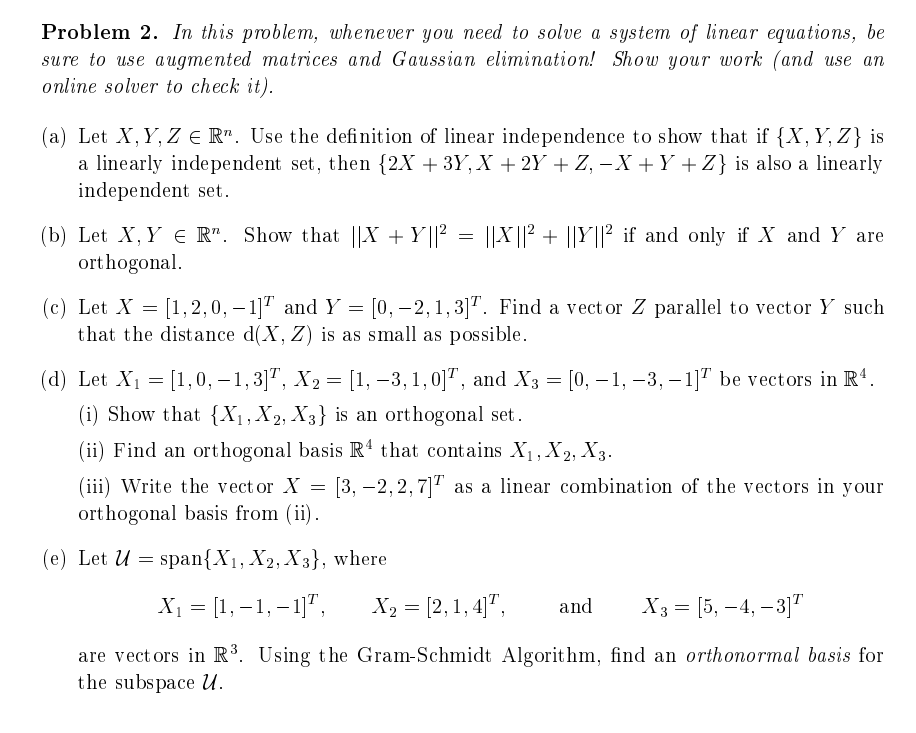
Problem 2. In this problem, whenever you need to solve a system of linear equations, be sure to use augmented matrices and Gaussian elimination! Show your work (and use an online solver to check it). (a) Let X, Y, Z E R". Use the definition of linear independence to show that if {X, Y, Z } is a linearly independent set, then {2X + 3Y, X + 2Y + Z, -X +Y + Z} is also a linearly independent set. (b) Let X, Y E R". Show that | |X + Y||? = | |X||2 + | |Y||2 if and only if X and Y are orthogonal. (c) Let X = [1, 2,0, -1]] and Y = [0, -2, 1,3]]. Find a vector Z parallel to vector Y such that the distance d( X, Z) is as small as possible. (d) Let X1 = [1, 0, -1, 3]], X2 = [1, -3, 1,0]7, and X3 = [0, -1, -3, -1] be vectors in R4. (i) Show that {X1, X2, X3} is an orthogonal set. (ii) Find an orthogonal basis R' that contains X1, X2, X3. (iii) Write the vector X = [3, -2,2, 7]" as a linear combination of the vectors in your orthogonal basis from (ii) . (e) Let U = span {X1, X2, X3), where X1 = [1, -1, -1]7, X2 = [2, 1, 4]], and X3 = [5, -4, -3] are vectors in R3. Using the Gram-Schmidt Algorithm, find an orthonormal basis for the subspace U

Step by Step Solution

There are 3 Steps involved in it

1 Expert Approved Answer
Step: 1 Unlock blur-text-image

Question Has Been Solved by an Expert!

Get step-by-step solutions from verified subject matter experts

Step: 2 Unlock
Step: 3 Unlock

Students Have Also Explored These Related Mathematics Questions!