







Question: Problem 2: In your astronomy class you have been tasked to create a data set to record the major characteristics of the 8 planets in
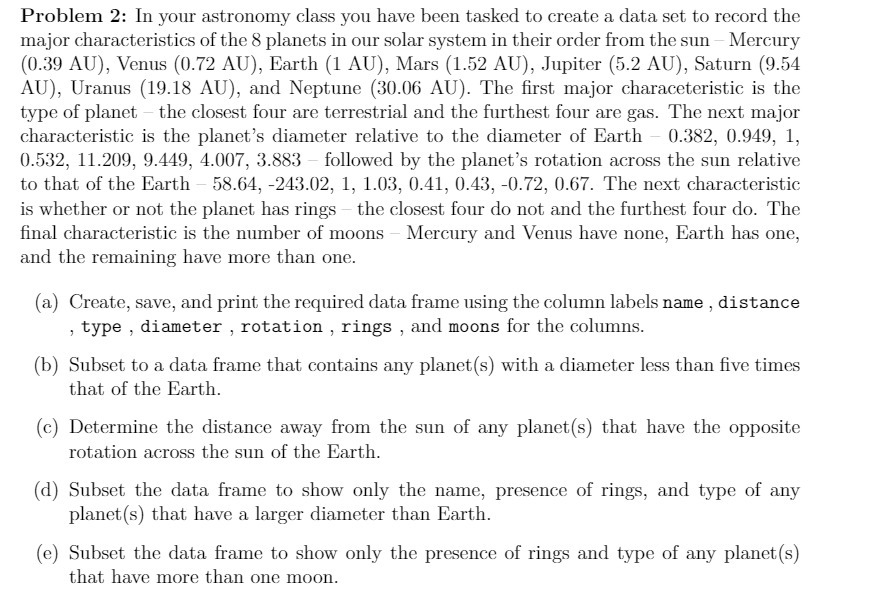
Problem 2: In your astronomy class you have been tasked to create a data set to record the major characteristics of the 8 planets in our solar system in their order from the sun Mercury [9.39 AU), Venus {0.72 All], Earth (1 AU}, Mars (1.52 AU}, Jupiter (5.2 AU), Saturn (9.54 AU), Uranus [19.18 AU), and Neptune (30.116 AU}. The rst major characeteristic is the type of planet the closest four are terrestrial and the furthest four are gas. The next major characteristic is the planet's diameter relative to the diameter of Earth [1.382, 0.949, 1, 11.532, 11.299, 9.449, 4.1197, 3.883 followed by the planetis rotation across the sun relative to that of the Earth 58.64, 243.02, 1, 1.03, {1.41, 9.43, 41.72, 0.1337. The next characteristic is whether or not the planet has rings the closest four do not and the furthest four do. The nal characteristic is the number of moons Mercury and Venus have none, Earth has one, and the remaining have more than one. (a) Create, save, and print the required data frame using the column labels name , distance , type , diameter , rotation , rings , and moons for the colunms. (b) Subset to a data frame that contains any planet(s) with a diameter less than ve times that of the Earth. (c) Determine the distance away from the sun of any pianet(s) that have the opposite rotation across the sun of the Earth. (d) Subset the data frame to show only the name, presence of rings, and type of any planet {s} that have a larger diameter than Earth. (e) Subset the data frame to show only the presence of rings and type of any planet(s) that have more than one moon
Step by Step Solution
There are 3 Steps involved in it

Get step-by-step solutions from verified subject matter experts
 Study Help